
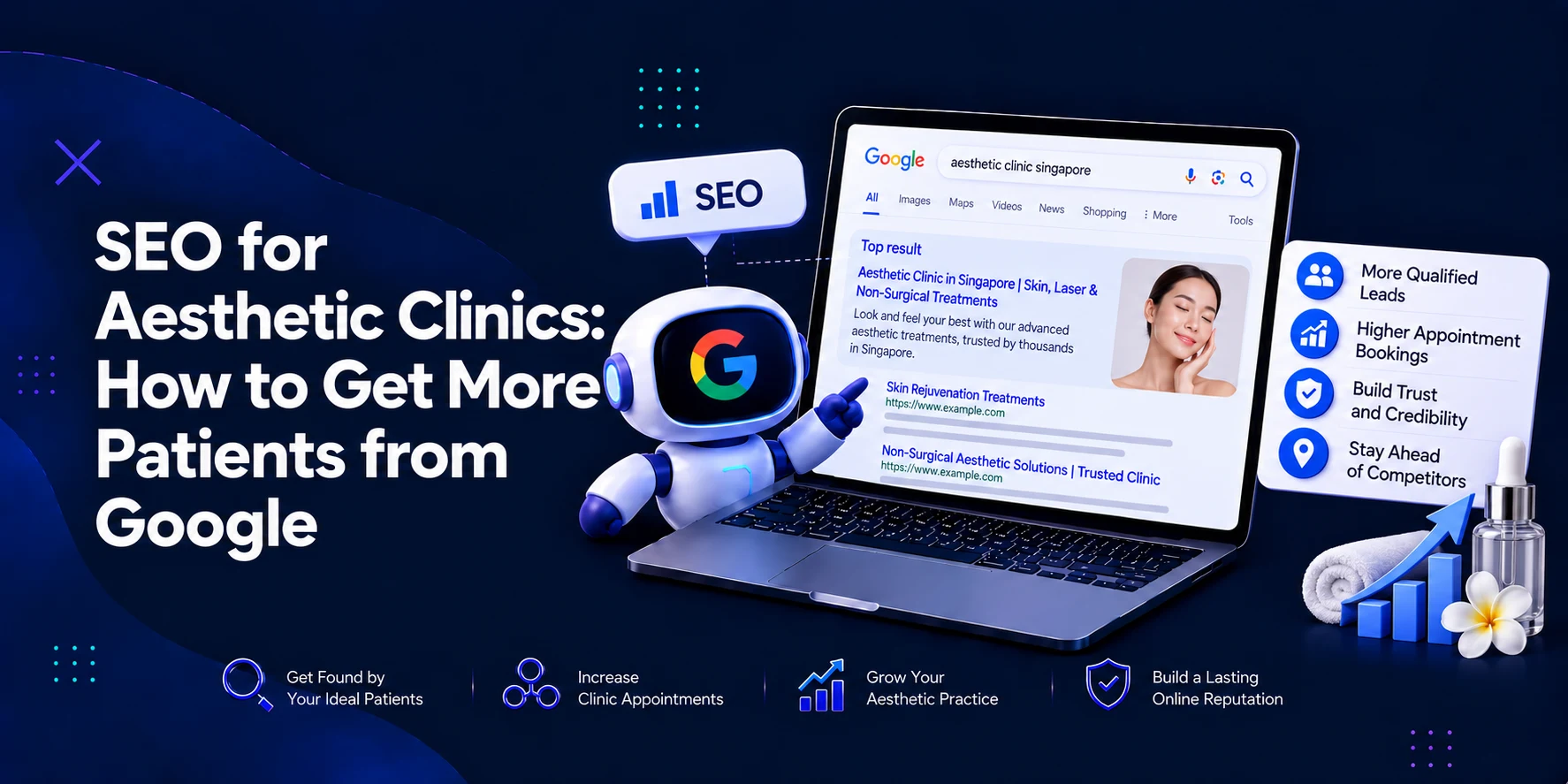
People searching for aesthetic treatments often start with Google. They may look for Botox, fillers, skin treatments, laser services, body contouring, or an aesthetic clinic near their home. If your clinic does not appear when they search, you could lose potential patients to competitors.
This is where SEO for aesthetic clinics becomes important.
SEO helps your website appear in front of people who are already searching for treatments you provide, which can bring more relevant visitors to your website, build trust in your clinic, and turn searches into enquiries.
The challenge is that aesthetic search results can be competitive, so clinics need more than a polished website.
They need useful treatment pages, strong local visibility, clear content, and a website that makes it easy for people to take the next step. This guide explains how aesthetic clinics can use SEO to attract more patients from Google.
Get a free digital marketing consultation from BThrust's Singapore team and find out what's holding your growth back.
SEO matters because it helps your clinic reach potential patients at the point when they are searching for a treatment, practitioner, or local provider.
A person searching for “lip fillers near me” has a different level of intent from someone scrolling through social media. They have already shown an interest in the treatment and may be comparing clinics, which makes search traffic valuable.
Good aesthetic clinic SEO can help you appear for treatment searches, local searches, problem-based searches, and questions that patients ask before booking.
It can also reduce your dependence on paid advertising. Advertising stops producing traffic when you stop paying. SEO pages can continue attracting searches after they have been published, provided they stay useful and relevant.
SEO connects your services with patient demand.
For example, someone may search for:
Each search gives your clinic a chance to appear.
A wider SEO for clinics strategy can follow the same principle. The aim is not to attract every visitor. It is to reach people whose needs match your services.
An aesthetic clinic should choose keywords based on its treatments, patient needs, location, and the reason behind each search.
Keyword research should begin with what your patients want rather than what your clinic wants to promote.
Think about the words people use when they have a concern. Someone worried about acne scars may not know the name of the treatment they need, while another person may know the exact procedure and search for a provider.
Both users could become patients, but they need different content.
These keywords describe a service or procedure.
Examples include “dermal fillers”, “laser skin treatment”, “acne scar treatment” and “skin rejuvenation”.
Your main treatment pages should target terms that match the service on the page. Avoid placing several unrelated treatments on one page. A focused page gives search engines and visitors a clearer idea of what you offer.
Some people search by concern instead of treatment. They may search for help with pigmentation, wrinkles, unwanted hair, acne scars, dull skin, or facial volume loss.
Creating content around these concerns can introduce your clinic before the person has chosen a treatment.
Location matters because most patients want a clinic they can visit without a difficult journey.
A clinic in Singapore, for example, may include location terms where they fit the page and patient intent. A broader SEO Singapore strategy should connect services with the areas where the clinic serves patients.
Do not force location names into every paragraph. Use them where they help visitors understand your service area.
Service pages should explain the treatment, who it may suit, what patients can expect, and how they can contact the clinic.
A thin service page can struggle to rank and may leave visitors with unanswered questions.
A useful page gives potential patients enough information to understand the treatment before they make an enquiry.
Start with a simple explanation of the treatment.
Tell readers what it is designed to address and how the procedure works, so try to avoid complex medical terms when a simpler phrase will do.
A strong page may cover:
This approach supports SEO for healthcare while giving patients information they can use when considering their options.
The page needs visitors to understand their next steps immediately after they finish reading it.
The website needs to show visitors exactly how they can contact the clinic while also providing appointment booking options and consultation scheduling services.
Should present suitable calls to action, which should appear at appropriate points across the page instead of showing them after every written section.
Local SEO helps your clinic appear when people search for aesthetic services in a specific area or close to their current location.
For aesthetic clinics, location can have a major influence on the final choice. Many patients compare nearby providers before they book.
Your local presence should give them clear and consistent information about your clinic.
Your clinic name, address, phone number, opening hours, and website details should stay consistent across major online listings.
Conflicting information can confuse both users and search engines.
Your website should also make your location easy to find. Add clear contact details and useful information about the area you serve.
For clinics competing in a busy market, SEO in Singapore should focus on both treatment relevance and location relevance rather than repeating place names across every page.
Reviews create trust between customers and businesses, but their impact increases when all digital content from the business appears authentic.
The first element of evaluative assessment requires teachers to observe students during their learning activities.
The teaching plan includes three main activities that direct students to create their own representations of classroom learning content.
Useful content helps your clinic answer patient questions, target more searches, and demonstrate knowledge of the treatments you provide.
Your website should not consist only of sales pages.
Potential patients have questions before they book. They want to understand treatment choices, safety, recovery, suitability, cost factors, and expected outcomes.
A blog or advice section gives you space to address these topics.
Your team already has a source of content ideas: patient consultations.
Write down the questions people ask most often.
You could create content about topics such as:
Each article should answer one clear search need.
A good SEO for doctor content strategy follows a similar model. Focus on the questions real patients ask and provide clear, responsible information.
Blog content should connect readers with relevant service pages.
For example, an article about acne scars could link to your acne scar treatment page. A guide about skin ageing could point readers towards suitable treatment options.
Internal links help users explore your site and help search engines understand how pages relate to each other.
A structured SEO plan for clinics should use internal links to connect educational content, service pages, practitioner information, and location pages.
Clinics can build trust by publishing accurate information, showing who provides treatment, and making their experience and standards clear.
Aesthetic treatments involve a person’s health, appearance, money, and wellbeing. Patients want confidence before choosing a provider.
Your website should give them reasons to trust the clinic.
Create detailed profiles for the professionals who provide treatments.
Include relevant qualifications, experience, areas of practice, professional memberships, and other useful credentials.
Avoid vague claims such as “the best expert” unless you can support them with clear evidence.
For SEO in healthcare, trust is part of creating a useful website. Visitors should be able to understand who is providing the information and who may provide their treatment.
Avoid promising guaranteed outcomes, but aesthetic treatments can produce different results for different people, so your content should reflect this.
Explain benefits without hiding limitations, risks, or recovery considerations. Clear information can make your content more useful while setting better expectations before a consultation.
Technical SEO helps search engines access your pages and gives visitors a smoother experience when they use your website.
Even strong content can struggle if the website has technical problems.
Patients may also leave if pages take too long to load, buttons do not work, or the site is difficult to use on a phone.
Many local treatment searches happen on mobile devices.
Your website should be easy to read and use on a small screen. Text should be clear, buttons should be easy to tap, and forms should not require endless scrolling.
Large images and videos can make aesthetic websites slow.
Compress visual files where possible and avoid adding media that does not improve the page. Before-and-after photos may help patients understand treatments, but they should not make the site difficult to use.
Keep your navigation simple because visitors need to find their way from the homepage to treatment pages and practitioner profiles, educational content, contact details, and booking services without any confusion.
The system enables search engines to find essential clinic pages, which leads to better SEO results for aesthetic clinics.
Yes. Search behaviour continues to change, so clinics need content that gives clear answers and demonstrates genuine expertise.
People now search in more conversational ways, so instead of typing a short treatment name, they may ask detailed questions about symptoms, options, costs, risks, or recovery.
This creates a need for content built around real questions.
An AI SEO in Singapore approach can focus on making information easy for modern search systems to understand and surface.
Use descriptive headings, short paragraphs, clear definitions, useful examples, and direct answers to common questions.
Avoid filling pages with repeated keywords. Search content still needs to work for the person reading it.
The same principle applies to SEO for doctor websites. Clear explanations and credible information are more useful than content written only to target search terms.
Aesthetic clinics should avoid copied content, keyword stuffing, weak service pages, unsupported claims, and websites built only around search rankings.
SEO can become counterproductive when every page is written for an algorithm instead of a patient.
Each treatment page should have a clear purpose.
Do not copy content from manufacturers, competitors, or other pages on your own website. Original content gives you room to explain your clinic’s approach and answer the questions your patients ask.
Using SEO for aesthetic clinics does not mean placing the same phrase in every section.
Keywords should fit the subject and sentence. If a phrase feels forced, rewrite the sentence.
Traffic alone does not grow a clinic. Your website needs to turn suitable visitors into enquiries. Make contact details easy to find, explain the consultation process, and give visitors a clear next step.
Overall, SEO for aesthetic clinics in Singapore helps them find their target patients because people search for medical treatments and evaluate different service providers during their clinic search process. Organisations need to go beyond standard keyword selection when they want their content to stay visible in sustainable ways.
Aesthetic clinics need to develop their SEO through treatment page content, local SEO strategies, patient-centered material and doctor expertise, website speed, and established paths for patient conversion. The strategy needs to provide users with correct information that enables them to make educated choices about their medical treatment. Organisations need to perform website reviews as users change their search methods and as technological systems evolve.
Keep treatment information accurate, answer genuine patient questions, maintain consistent local details, and avoid tactics such as keyword stuffing or unsupported claims. The main goal requires more than just increasing the number of visitors to the website.