
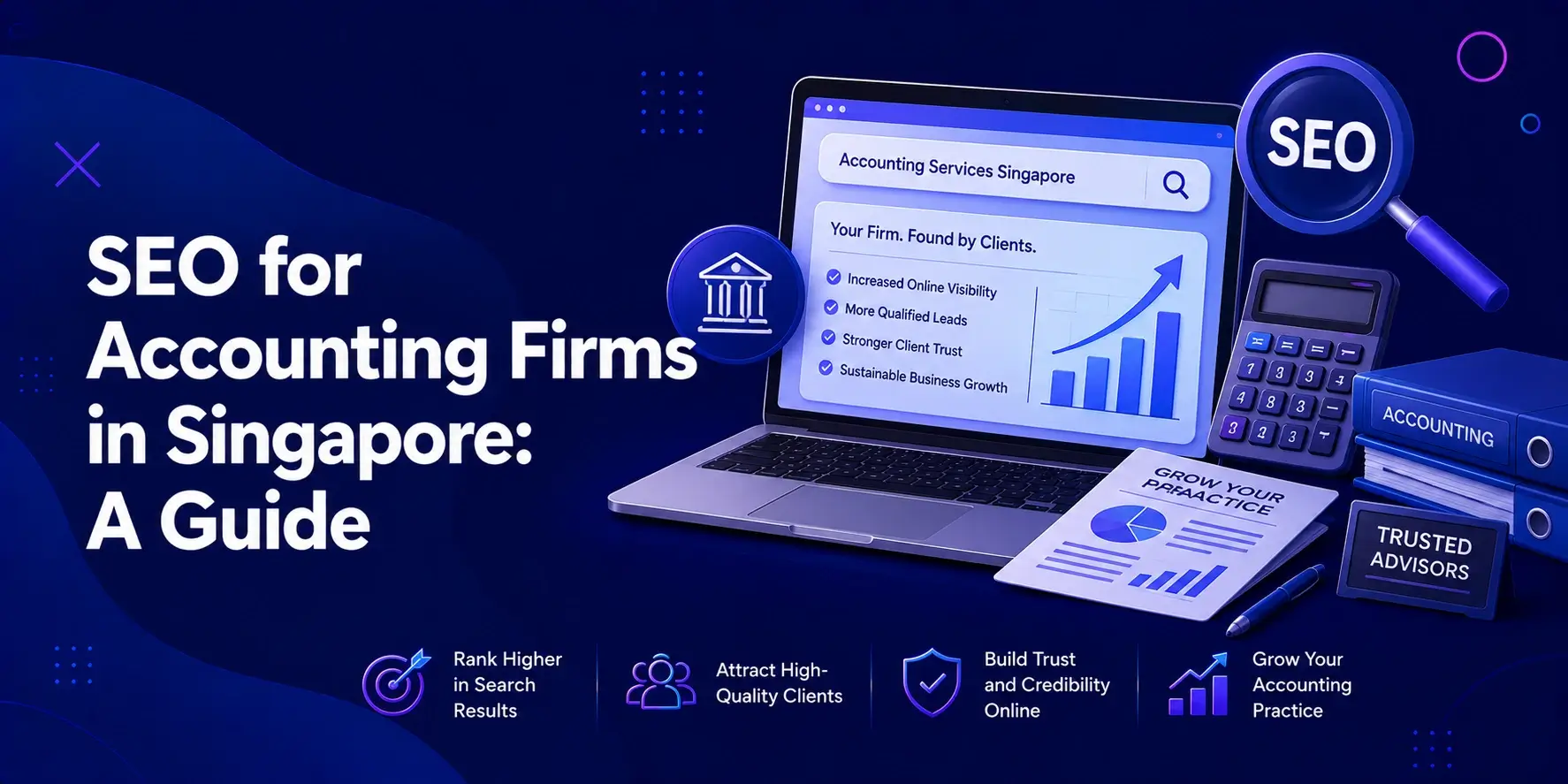
SEO for accounting firms is about optimising your practice’s website, Google Business Profile and content so business owners searching for an accountant, tax agent or auditor in Singapore find your firm first — on Google, on Maps and increasingly within AI-generated answers. For a Singapore practice, that means mixing local SEO (address, reviews, service-area pages) with trust signals like ACRA registration and ISCA membership, so you show up when someone searches “corporate tax filing Singapore” or “XBRL accountant near me” instead of relying on word of mouth alone.
Most accounting firms here still get most of their new clients through referrals. It’s a real strength, but it’s also a ceiling. Referrals only extend as far as your current network. Meanwhile, thousands of business owners are googling ‘accountant for SME Singapore’, ‘GST registration help’, or ‘bookkeeping services near me’ every month. And SEO for CPA firms that serve cross-border or expat clients. SEO for accounting firms is how you intercept these in-market searchers before a competitor’s website does.
In Singapore, Internet penetration is now about 98.4% of the population, so almost every potential client is online and searching before they even pick up the phone. Here, nearly 99% of all businesses are SMEs, employing nearly 70% of the workforce – a huge, ever-renewing pool of entrepreneurs who need an accountant and are Googling for one now. This guide will show you exactly how to capture that demand.
Get a free digital marketing consultation from BThrust's Singapore team and find out what's holding your growth back.
As search has become the first stop for business owners shopping for professional services, most accounting firms aren’t showing up there.
Search has mostly taken over from the Yellow Pages and a lot of cold outreach. If a firm’s website doesn’t come up when someone searches a relevant term, that firm doesn’t make the shortlist.
The supply side is also crowded with over 39,000 members in ISCA and hundreds of public accounting entities registered with ACRA. “Even if the work is great, if you’re not on the list, you’re not even in the conversation.
SEO bridges that gap. It brings your firm face-to-face with business owners right when they’re looking for help with tax filing, XBRL filing, incorporation support, or a second opinion on their books.
There is also a compounding effect that referrals lack. One referral means one introduction. A well-ranked service page will continue to get enquiries month after month, year after year, as long as it is visible. No one has to personally vouch for you each time.
Unlike paid ads, organic visibility doesn’t disappear the second you stop paying. It takes longer to build, but it’s a long-term asset that continues to work in the background while your team works on client work.
Use the language clients use to search, not your firm’s internal jargon.
Clients don’t typically search for “statutory compliance services”. They look for things like:
Group them by purpose: compliance deadlines (tax season, AGM filing), one-off needs (incorporation, audit), and ongoing needs (monthly bookkeeping, payroll). Every cluster should have its own service page, not a single, generic “services” page trying to rank for everything at once.
It’s worth separating out ‘near me’ and location-based searches from broader searches. Someone searching “accountant Tanjong Pagar” wants to find a firm they can visit, someone searching “best accounting software integration Singapore” is further away from booking, closer to researching. Both deserve content, but should not be treated the same way or sent to the same landing page.
It’s often the single highest-leverage SEO asset a small accounting firm has, and it’s free.
When people search for “accountant near me” or “tax agent [neighbourhood] Singapore”, Google’s local map pack typically ranks higher than the usual organic listings. That’s what gets you into that pack: a fully active Google Business Profile.
To make it work.
Most firms don’t realise how important reviews are. Generally, a practice that has 40 reviews and a 4.8 rating will beat a practice with five reviews and no responses, even if the latter has a technically better constructed website.
Dedicated, specific service pages almost always beat a single broad “our services” page.
A page for each core service – corporate tax, GST, XBRL, payroll, incorporation, audit – with:
Don’t stuff the same keywords across each page. Pages that clearly answer one specific question do better with Google (and now AI search tools) than pages trying to be everything to everyone.
Technical basics still count: fast load times, a mobile-friendly design, and HTTPS. Slow site loses local searchers fast, especially on mobile devices.
It also helps to include a clear “About” page that names the partners, their qualifications, and how long the firm has been operating in Singapore. Anonymous-sounding “we” copy without named people tends to work worse and provides search engines less to go on when assessing credibility.
They don’t directly move rankings, but they heavily impact whether a searcher clicks, stays, and converts — and Google indirectly tracks that behaviour.
Accounting is a purchase of trust. Prospects are handing over their financial records and tax obligations to a stranger, so credibility signals really matter.
Each key page:
These same signals also power AI Overviews and chatbot-style answers, which favour pages that clearly state credentials and affiliations over vague claims.
They tell Google that your firm is a real, established business in Singapore, which matters more for local service searches than most firms expect.
A citation is just your business name, address, and phone number listed in the same format on another website. Backlinks are links that come to your website from other websites.
Accounting firms have found the most useful sources to be:
Don’t buy links in bulk or join link farms – for a regulated profession such as accounting, this can do more reputational harm than SEO good. A few good, consistent listings will beat out dozens of low-quality ones.
Answer the exact compliance questions your prospects are already looking for, before they even pick up the phone.
Singapore’s accounting calendar is a series of questions that repeat: AGM deadlines, ECI filing, GST thresholds, Form C-S submission, and CPF contribution changes. Each is a content opportunity.
Useful formats include
Publish regularly, not in fits and starts. A handful of strong, deadline-relevant articles published over the course of the year usually do better than a one-off content sprint.
Yes — AI Overviews and chatbot answers increasingly pull from pages that state facts clearly, cite credentials, and answer one question directly, so the same discipline that supports AEO also helps you get cited inside AI-generated answers.
This is a real break from classic SEO, where #1 ranking was the only goal. Today, your content can be cited in an AI answer without the click, which still builds awareness and trust with the searcher.
This means short, direct opening answers under each heading, clearly stated credentials, and structured, scannable sections – exactly what the rest of this guide advises.
If you prefer to have this handled end-to-end rather than bit by bit, BThrust’s SEO services in Singapore cover the local and on-page fundamentals. The AI SEO services in Singapore page is more about getting cited inside AI Overviews and chatbot answers.
Most practices benefit from outside help with technical SEO, content strategy and AI-search optimisation, while small firms with one marketing staff member can usually handle Google Business Profile and basic on-page fixes in-house.
A fair crack of the whip:
There is no single right answer here – it depends on whether you have the time and the specific skill set on your team, not just the budget.
Here is a starting punch list – most items take less than an hour each:
Ensure your name, address, and phone number are consistent across your website, GBP, and any directories
Work through these over a couple of weeks, and most small practices start to see measurable movement in local search visibility within two to three months.
Referrals are going to stay a mainstay for accounting firms winning clients in Singapore, and that’s OK. But they are a limited channel, capped by those who already know you.
SEO gives you a second channel – the business owners who don’t know you yet, but are actively searching for exactly what you sell, right now, on Google.
Start with the quick wins above, develop our service-specific content, and keep your trust signals front and center. The companies that consistently appear in search are the ones capturing the inbound enquiries that used to go solely to whoever had the loudest referral network.
If you’d prefer to have a team handle the strategy, technical work, and content calendar for you, BThrust works exclusively with professional service firms in Singapore on just this sort of search visibility.