
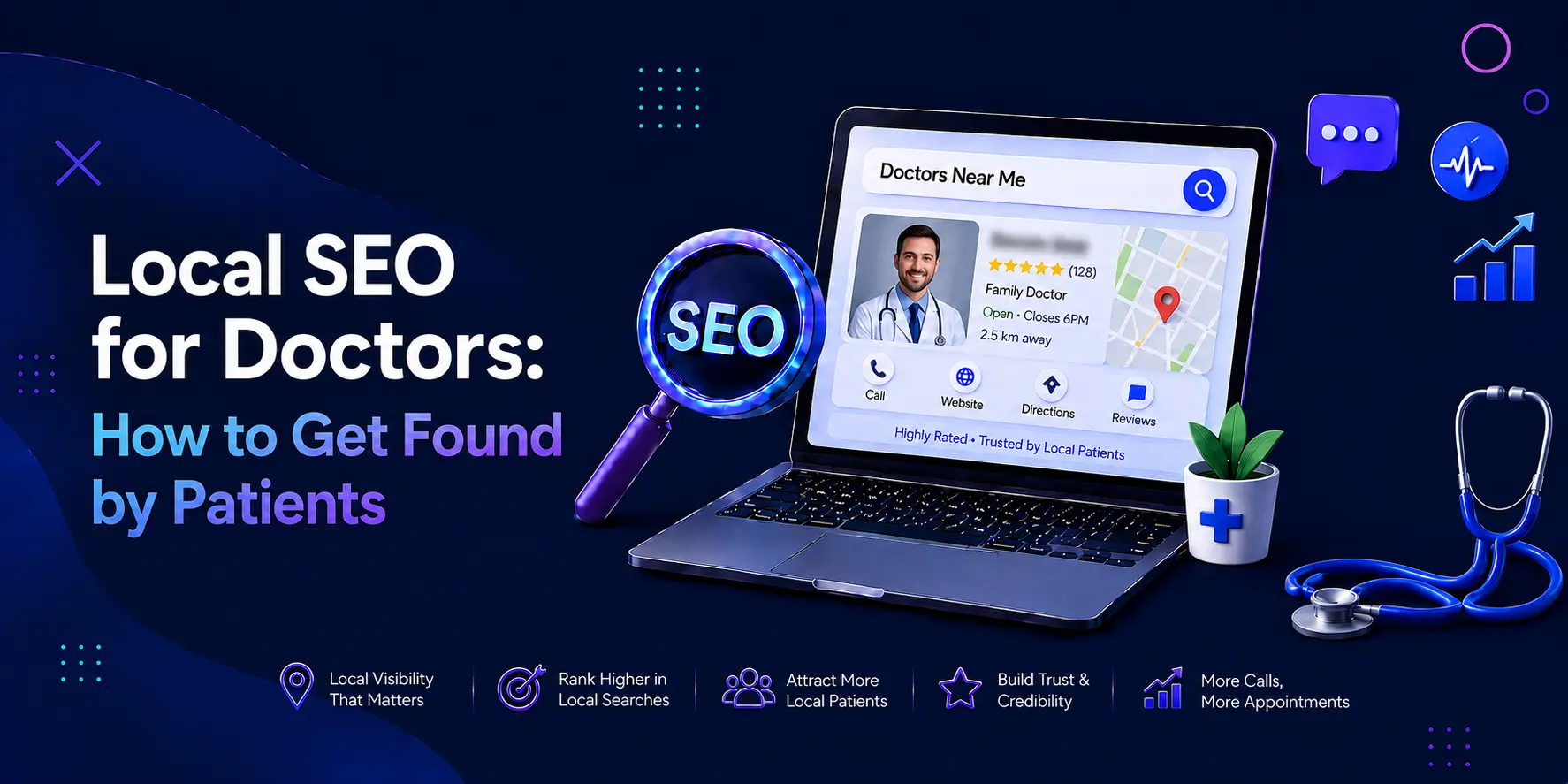
Finding a doctor often starts with a local search. A patient may search for a dentist nearby, a skin specialist in their city, or a private doctor who treats a certain condition. They then compare a few options before making contact.
This makes Local SEO for Doctors an important part of patient acquisition. It helps your practice appear when people in your area search for the services you provide.
Strong local visibility is not just about getting higher rankings. Patients also need clear information about your services, location, experience, and ways to book an appointment.
This guide explains how local search works for medical practices and what you can do to improve your visibility.
Get a free digital marketing consultation from BThrust's Singapore team and find out what's holding your growth back.
Local SEO for Doctors is the process of improving the online presence of a medical practice so people can find it during location-based searches.
A general SEO campaign may target people across a large region. Local SEO focuses on patients within the area that your practice serves.
For example, someone may search for:
Search engines try to show medical practices that match the patient’s needs and location.
This is where doctor SEO connects your website, practice details, services, and local presence. It helps search engines understand who you are, what you offer, and where you operate.
The same principles form an important part of SEO for Healthcare, but doctors need a stronger focus on local intent because most appointments take place at a physical location.
Local SEO matters because patients tend to look for medical care within a practical distance from their home, workplace, or current location.
A person who needs a dermatologist is unlikely to travel across the country when suitable specialists are available nearby.
Local search can connect your practice with these patients at the point when they are considering an appointment.
Good physician SEO can help you:
This is also why SEO for Medical Clinics should focus on more than website traffic. The real goal is to attract people who can become patients.
Search engines look at factors such as relevance, distance, trust, and the overall prominence of a medical practice.
Relevance is about how closely your practice matches the search. If someone searches for a paediatrician, a practice with clear paediatric services has a stronger connection to that query.
Distance relates to the location of the patient and practice.
Trust and prominence can come from reviews, accurate business information, useful website content, local mentions, and links from respected websites.
Your website also gives search engines context about your practice.
Clear pages about doctors, treatments, locations, and conditions make this easier.
A good SEO agency for Doctor campaigns should work on these areas as one connected strategy rather than chasing rankings for a few keywords.
Doctors should choose keywords based on the services patients need, the language they use, and the locations they search from.
Start with your core services.
A cardiologist, for example, might create a list around heart consultations, cardiac screening, chest pain assessment, and other relevant services.
Then add local intent.
This could create terms such as:
“cardiologist in Leeds”
“heart specialist near me”
“cardiac screening Leeds”
You should also consider different types of patient intent.
Service keywords describe what you provide.
Location keywords connect that service to a town, city or neighbourhood.
Condition keywords reflect the problems patients want help with.
Doctor-name keywords help patients who already know a practitioner.
Comparison keywords may include terms around the best, top-rated, or experienced doctors.
Good doctor SEO maps these searches to the right pages instead of forcing dozens of unrelated phrases onto one page.
This approach is useful across SEO for Healthcare because it creates content around real patient needs.
Doctors should provide complete, accurate, and consistent information about their practice across local search listings.
Your core details should include:
These details need to match the information shown on your website and other trusted directories.
Add clear descriptions of your medical services. Use genuine images of the practice where suitable. Keep holiday hours and temporary changes up to date.
Patients should not have to search through several pages to work out when you are open or how to contact you.
For anyone researching how to rank a doctor’s website on Google Maps, accurate practice information is one of the first areas to address. Strong rankings also depend on relevance, reviews, website quality, and local authority.
A doctor’s website should give each important service, practitioner, and location a clear place within a simple structure.
Avoid putting every service on the homepage.
Create dedicated pages for major treatments and services. A dermatology practice, for example, might have separate pages for acne treatment, eczema care, mole checks, and other core services.
In many practices, yes.
A doctor page can include:
These pages help patients understand who may treat them.
They also support physician SEO by giving search engines clear information about each practitioner.
If you operate from several genuine locations, create a useful page for each one.
Include the address, contact details, opening times, available services, doctors at that location, and directions.
Avoid creating dozens of near-identical pages with only the city name changed.
This is an important principle in SEO for Medical Clinics, especially for groups with several branches.
Patient reviews can strengthen trust, provide useful local signals, and help people compare medical practices.
Patients often read reviews before choosing a doctor. They look at comments about communication, waiting times, staff, and the overall experience. A steady flow of genuine reviews can make your practice appear more trustworthy.
Ask patients for feedback through a simple process that follows healthcare and privacy rules. Never pressure them to leave positive reviews.
Take care when responding to public comments. Avoid mentioning personal medical details, even if the patient discusses their treatment.
Reviews support Local SEO for Doctors, but they work best with accurate practice information and a useful website.
Doctors can build trust by making their experience, qualifications, and medical information clear to patients.
Create detailed practitioner profiles that include qualifications, experience, specialities, and relevant credentials. This information helps patients understand who will provide their care.
Medical articles should name the author or reviewer where appropriate. Review important health content to keep it accurate and current.
You can also explain how your medical content is written and checked. This supports SEO for healthcare while helping patients trust your information.
A good SEO agency for doctors should treat medical credibility as a key part of the SEO strategy.
Doctors can build local authority through trusted citations, relevant links and connections within their community.
Your practice may appear on healthcare directories, professional organisations, medical associations and local websites. Make sure your name, address and contact details remain consistent across these listings.
Focus on quality rather than collecting hundreds of links. Mentions from respected medical and local websites can help build authority.
Community health events, educational programmes and local partnerships may also create useful opportunities for mentions.
Professional local seo services should focus on relevant and trusted links rather than mass link building.
Mobile experience matters because many patients use their phones to find doctors, check services, and contact practices.
Patients should be able to find your phone number, address, and opening hours without searching through several pages.
Pages should load well, text should be easy to read, and menus should remain simple. Appointment forms should also be short and clear.
Patients should be able to:
These SEO tips for private practice doctors can help turn local website visits into patient enquiries.
Doctors should measure local SEO through search visibility, patient enquiries, and appointment-related actions.
Keyword rankings can show whether your practice is gaining local visibility, but rankings should not be the only measure of success.
Track important service and location keywords to see which areas are improving.
Useful metrics include:
Compare these results over time. A page with less traffic may generate more patient enquiries than a page with higher traffic.
When choosing a Healthcare SEO Agency, ask how it connects SEO performance with enquiries and business goals.
A useful local SEO checklist for doctors should cover practice information, website structure, content, reviews, local authority, and patient conversion.
Start with these actions:
Use this local SEO checklist for doctors as an ongoing process rather than a one-off project.
The same foundation can support broader SEO for Clinics, though larger clinics may need more work around multiple doctors, departments and locations.
Overall, Local SEO operates at its peak when medical practices deliver essential information to their patients during their most crucial moments. Local patients can find your practice more easily when you create service pages that provide correct contact details, doctor profiles, and authentic patient reviews.
Doctors need to develop powerful Local SEO strategies which support their complete patient process instead of concentrating on search engine results. Your website needs to answer common questions while it shows visitors what you do and provides them with an easy path to get in touch with you. Use the local SEO checklist for doctors to find gaps in your current presence. Maintain identical practice information throughout your website while you work to enhance important web pages and track the specific website activities which produce new patient appointments.
SEO management for doctors requires two approaches that either involve self-management or agency collaboration to create ongoing improvements that serve patient needs. The objective remains straightforward because you want to direct appropriate visitors toward your practice during their time of need for your services.