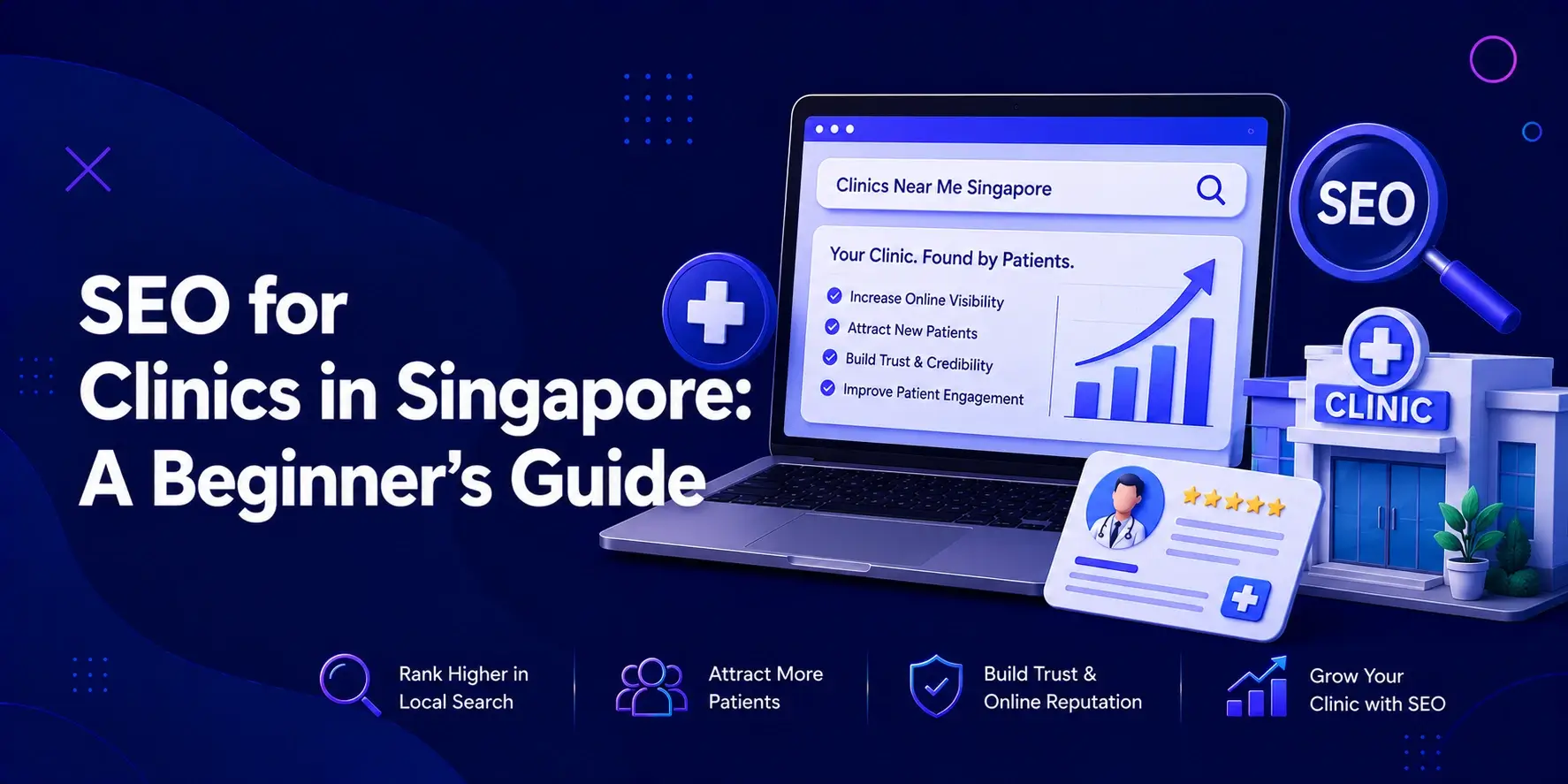
SEO for clinics means optimising your website, Google Business Profile, and online content so that people looking for clinics nearby on Google, Maps, or AI search tools can find your clinic, trust it, and book an appointment without you paying for every click. In practice, it’s what determines if your clinic shows up when someone searches for “GP near me”, “dentist Tampines,” or “skin clinic Singapore”.
You don’t need to be a marketing graduate to get found by patients searching nearby – here’s SEO made simple for clinics, in plain steps that any clinic owner, doctor, or admin staff can follow. No coding, no design background, no marketing speak required.
This guide also covers the basics of medical clinic SEO specifically, because Google holds healthcare websites to a higher trust standard than a regular retail or F&B business, and that changes how you approach it.
Want Results Like These for Your Business?
Get a free digital marketing consultation from BThrust's Singapore team and find out what's holding your growth back.
Why SEO is Needed by Clinics in Singapore
SEO is important because almost every patient in Singapore searches online before choosing a clinic. If your clinic is not visible, a competitor down the road wins the booking.
Here are a few numbers for perspective:
- DataReportal’s Digital 2025 Singapore report says that Singapore’s internet penetration is around 95.8%, with around 5.61 million internet users in the country.
- Singapore’s smartphone penetration is about 97%, one of the highest in the world, according to Statista.
- About 87.1% of Singapore’s internet users use search engines on a regular basis to find information, services, and businesses.
Simply put: your patients are almost certainly online, almost certainly on a phone, and almost certainly looking before they book. That’s how you get your clinic in front of that moment.
How is Medical Clinic SEO Different from Traditional Business SEO?
Medical clinic SEO is unique in that Google has higher trust signals for health-related sites, and Singapore has specific healthcare advertising rules.
It has three things different:
- Increased trust requirements. Health content is considered ‘Your Money or Your Life’ (YMYL) content by Google. Pages need credible, accurate information and clear authorship – ideally from a named practitioner with the right qualifications.
- Regulatory Guardrails. Certain claims (e.g., guarantees of outcomes, before and after photos for certain procedures, testimonials that are not verified) are restricted under Singapore’s Healthcare Services Act and Singapore Medical Council guidelines. Your SEO content needs to be compliant, not optimised.
- The name of the game is hyperlocal intent. Almost no one searches for a clinic without a location, even if it’s implicit. “Near me” and neighbourhood-based searches are much more important than they would be for, say, an e-commerce store.
How To Start Improving SEO For Your Clinic?
The best way to start is to go through these six steps, roughly in order:
- Get your Google Business Profile and optimise it fully.
- Build or clean up a simple mobile-friendly website
- Use the right keywords for the service and location on your pages.
- Collect and respond to patient reviews on a regular basis.
- Create content that is authentic, useful, and what people are really searching for.
- Review your progress monthly and adjust.
Each of these is explained in more detail below, beginning with the one that provides results most quickly.
How to Set Up and Optimise Your Google Business Profile?
Your Google Business Profile (GBP) is often the one thing you can fix that will have the biggest impact because it is what appears on Google Maps and in local search results – often before your website even gets clicked.
Here’s how to do it correctly:
- Claim your listing. Go to Google Business Profile and find your clinic. Claim it if it already exists (not uncommon, as patients or directories may have added it). If not, make a new one.
- Check who owns it. Google will verify this by phone, email, or postcard to the address of your clinic. Finish this – unverified listings get less exposure.
- Select the appropriate category. Instead of using the generic label “Doctor”, use specific categories such as “Medical Clinic”, “Dental Clinic”, or “Skin Care Clinic”.
- Match your NAP exactly. Your Name, Address, and Phone number (NAP) on GBP should be an exact match with your website and any directory listings, including unit numbers and abbreviations.
- Add real opening hours, including public holiday adjustments — outdated hours are a major reason patients go elsewhere.
- Post real pictures of your clinic’s exterior, the waiting room, and the treatment rooms. Clinics with photos get way more profile views and direction requests than those that don’t.
- List your services individually (e.g., “Health Screening,” “Vaccination,” “Minor Surgery”) so Google can match you to specific searches.
- Turn on messaging and Q&A and check them often – an unanswered question on your profile is a lost booking.
(This is a good place to add a screenshot of the Google Business Profile “Info” tab, showing where hours, categories, and services are edited.)
How to Get and Manage Patient Reviews?
You get more reviews just by asking happy patients at the right time, and you manage them by responding to each one professionally and quickly.
A simple system that works in most clinics:
- Ask immediately after a good visit – verbally, or with an SMS/WhatsApp follow-up with a direct link to leave a Google review. Timing is more important than wording.
- Make it easy to link to. Instead of asking patients to look for you manually, share the built-in “ask for reviews” link generator in your Google Business Profile.
- Reply to all reviews, even the positive ones. A short, authentic response (“Thank you Mrs Lim, glad Dr Tan was able to help with your follow-up”) sends out a signal of an active, caring clinic to both patients and Google.
- Answer negative reviews calmly. While we appreciate your concern, we are unable to discuss medical matters here. Please speak to the patient herself or take this up with the clinic management.
- Don’t purchase or fabricate reviews. Fake testimonials about clinical outcomes not only violate Google’s policies and can lead to the suspension of their profiles but also constitute breaches of Singapore’s healthcare advertising guidelines.
(Here you can paste a screenshot of a sample review reply or the GBP review management screen, so staff can see a visual example of the workflow.)
What Website Elements Help Clinics Rank Higher?
When a clinic website loads quickly on mobile, has a clear statement of who’s behind the care, and is structured around what patients actually search for, it ranks better.
Focus on:
- Mobile responsive and fast. Most patients will find your site through a phone search – a slow or messy page will lose them in seconds.
- NAP in your website footer should be consistent and exactly match your Google Business Profile.
- Different pages for each service/location (e.g., Skin Clinic Orchard vs a generic Services page).
- Doctor bio pages with qualifications and SMC registration numbers – these add the trust signals Google looks for in health content.
- A clear booking call-to-action (a visible “Book Now,” WhatsApp, or click-to-call button on all pages)
- A secure connection (https), which is now a baseline expectation, not a bonus.
- Basic structured data (also known as schema markup) tags your site as a “MedicalClinic” or “LocalBusiness.” You don’t have to write this yourself–a developer or your SEO partner can add this in an afternoon.
How Do Keywords Work for Clinic SEO?
Keywords are simply the specific words and phrases patients are typing into Google and it’s your job to naturally use the right ones throughout your pages, titles, and Google Business Profile.
Keywords for clinics generally fall into a few patterns:
- Service + location: “physiotherapy Tampines”, “dental clinic Bukit Timah”
- Condition + Clinic: “eczema clinic singapore,” “back pain specialist”
- Location-based searches: “GP near me,” “dentist open now”
- Brand searches: people searching directly for your clinic’s name, often after a referral
Don’t stuff keywords into sentences like a sausage. Begin to write for the patient — a well-phrased, helpful sentence with the right phrase will beat a clumsy sentence with lots of times repeated.
Is Local SEO More Critical Than General SEO for Clinics?
Yes — for clinics, local SEO should typically take precedence over general SEO, as almost all relevant searches contain a location aspect, even if it’s implied.
Local SEO is more than your Google Business Profile and consists of:
- Citations: Consistent listings in directories such as local business listing sites, health directories, and industry associations, all containing the same NAP details.
- Location pages: If you have multiple branches, each branch should have its own page with its own address, hours, and photos—not one page shared by all.
- Local backlinks – mentions or links from local news sites, community groups, or partner businesses (e.g., a nearby gym referring patients to your physiotherapy clinic) are more relevant locally than generic ones.
How Long Until You See Results From SEO?
Most clinics will notice significant movement in 3 to 6 months, with stronger, more stable rankings building up in 6 to 12 months.
A rough timeline:
- Weeks 1-4: Google Business Profile improvements tend to show up the fastest – more profile views, more direction requests.
- Months 2-4: Website fixes and new content begin to have an impact on rankings for some search terms.
- Months 4–12: Reviews, citations, and content compound and rankings become more stable against competitors.
Paid ads stop when you stop paying, while SEO results tend to build and compound over time — which is also why starting early is more important than starting perfectly.
If you want to concentrate on your patients and leave the technical setup, content, and ongoing optimisation to a team of specialists, check out SEO services in Singapore for local businesses like clinics to see what this looks like in practice.
What Mistakes Should Clinics Stay Away From?
The most common SEO mistakes for clinics are usually preventable with a little bit of consistency:
- Mismatch in NAP on website, Google Business Profile & directories.
- Keyword stuffing doesn’t read well to patients, and it can hurt your rankings.
- Buying or incentivising fake reviews risks both platform penalties and regulatory issues.
- Not considering the mobile experience when most searches are on a phone.
- Making claims that violate advertising rules – guaranteed results, before/after images, or unverified testimonials about treatment results.
- Once you set up Google Business Profile, never touch it again — stale hours, old photos, and unanswered questions quietly drive patients elsewhere.
What Free Tools Can Beginners Use To Check Their Clinic’s SEO?
You don’t need to spend money on software to get started. A few free Google tools can handle most of what a clinic needs at the beginning.
- Google Business Profile Manager lets you know how many people saw your profile, requested directions, or phoned you straight from it.
- Google Search Console: free and directly connected to your website, showing which search terms already bring patients to your site and which pages have technical errors.
- Google PageSpeed Insights: It tests the mobile page load speed of your website and gives an easy score and recommendations for improvement.
- Google Trends: useful to understand if patients are searching more for “dentist near me” or “dental clinic Singapore,” for example, so you can match the language patients use.
None of these requires technical training to read at a basic level – start with Google Business Profile Manager and Search Console, as both directly reflect patient behaviour rather than abstract scores.
Getting Started This Week
SEO for clinics doesn’t have to be a huge project to get started. Pick one thing from this guide – claiming your Google Business Profile, or asking your last three happy patients for a review – and do it this week before moving on to the next step.
Small, consistent actions compound faster than one big overhaul that never happens. If you’d prefer to leave the process to a team that does this for healthcare providers across Singapore every day, BThrust works with clinics to turn local search visibility into real patient bookings, so your team can focus on care, not algorithms.