
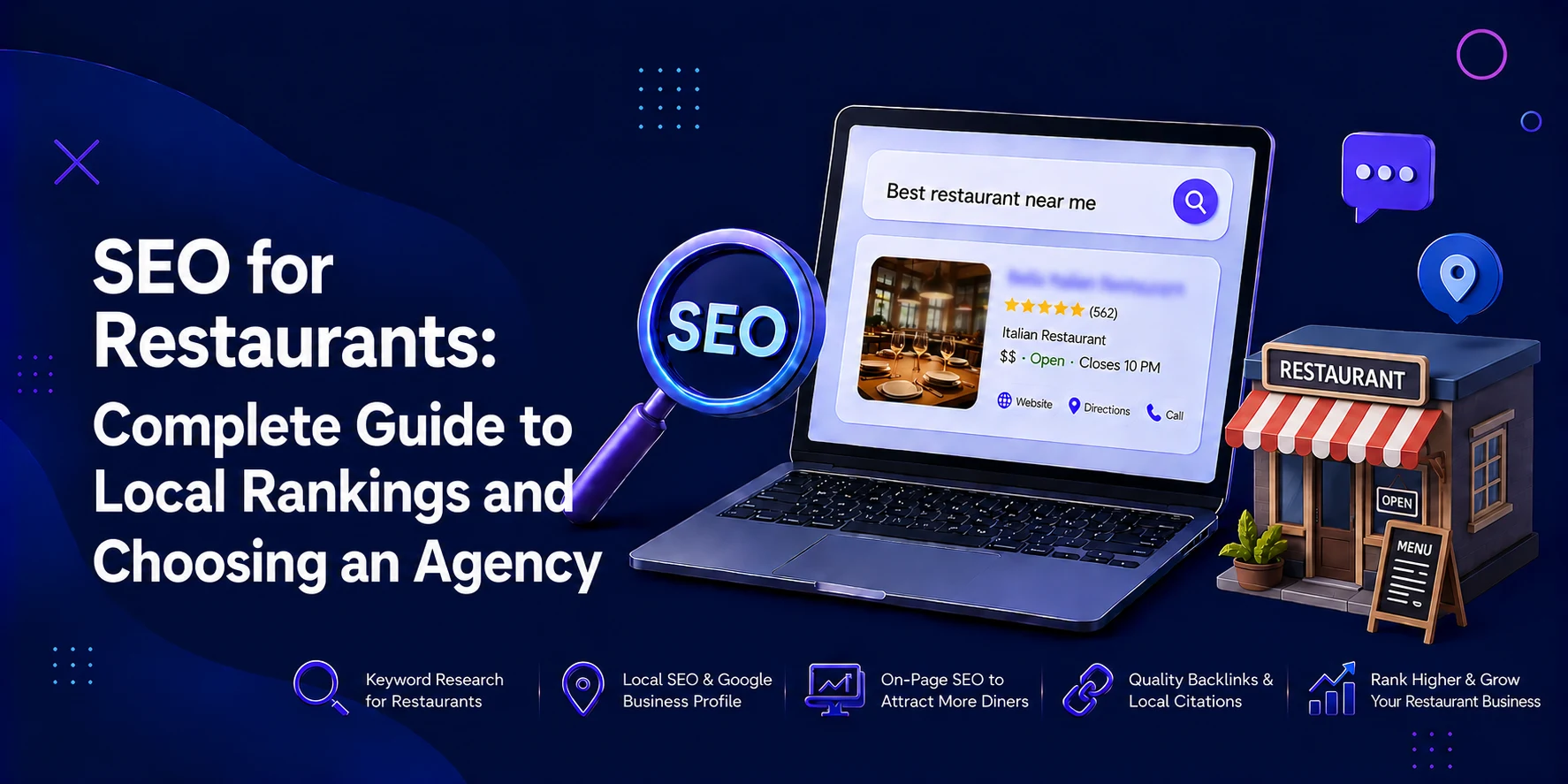
Running a restaurant means competing for attention before a customer even reaches your door. People search for places to eat based on location, cuisine, price, reviews, opening hours, menus, and dining needs. If your restaurant does not appear when these searches happen, potential customers may choose a competitor.
SEO for restaurants helps your business appear in search results when people are ready to eat, order food, or make a booking. It covers your website, local listings, reviews, location signals, content, and technical performance.
A good strategy does more than increase website traffic, which can help generate bookings, phone calls, direction requests, and orders. This guide explains how restaurant SEO works, ways to improve local rankings, and how to choose the right SEO partner.
Get a free digital marketing consultation from BThrust's Singapore team and find out what's holding your growth back.
SEO for restaurants is the process of improving a restaurant’s online presence so people can find it through search engines and local search results.
Restaurant searches often have strong buying intent. Someone searching for “Italian restaurant near me” is not researching Italian food. They are looking for somewhere to eat.
This makes restaurant SEO different from many other forms of search marketing. A complete strategy may include:
Professional restaurant SEO services bring these areas together rather than treating them as separate tasks.
Restaurant searches can take many forms. A customer might search by cuisine, dish, neighbourhood, dietary need, or occasion.
Examples include “vegan restaurant near me”, “best sushi in Singapore”, “birthday dinner restaurant” and “late-night food near Orchard”.
Understanding these needs helps you create pages that match what diners want.
Local SEO helps restaurants appear in searches made by people looking for food within a specific area.
Most restaurants depend on customers who live, work, or travel nearby. This makes local SEO for restaurants a core part of organic search strategy.
A person may search for a restaurant while walking through a neighbourhood or planning dinner for the weekend. Search engines use location, relevance, and business information to decide which restaurants to show.
Strong local restaurant SEO can help your restaurant appear for searches linked to your cuisine, dishes, and location.
Your restaurant name, address, and phone number should remain consistent across your website and trusted business listings.
Your opening hours should also stay current. Incorrect details create a poor customer experience and can weaken trust.
Your Google Business Profile should include useful information such as your correct category, address, contact details, website, opening hours, menu, and photos.
Avoid focusing on broad terms such as “restaurant” alone. Use phrases connected to your location and offering such as:
A provider offering local SEO services should research how customers search within your target area instead of using the same keyword plan for every restaurant.
To improve map visibility, keep your business information accurate, earn genuine reviews, build local relevance, and create a strong website.
Understanding how to rank a restaurant on Google Maps starts with recognising that no single change guarantees a top position. Search visibility depends on several signals.
Fill out each relevant field in your local business listing. Choose the most accurate primary category and add suitable secondary categories where needed.
Include your correct address, phone number, website, menu link, and business hours.
Add clear photos of your food, dining area, exterior, and entrance. These help customers understand what to expect.
Respond to positive and negative feedback in a professional way. Your responses show potential customers that the restaurant values its guests.
If you want to learn how to rank a restaurant on Google Maps, focus on building a complete local presence rather than chasing one ranking factor.
A restaurant SEO checklist should cover local listings, website pages, menus, reviews, technical health, location signals, and performance tracking.
A useful local SEO checklist for restaurants gives your team a repeatable process for checking the factors that influence search visibility.
Check that your business name, address, phone number and opening hours are correct across major listings.
Keep your Business Profile complete and update it when your menu, opening times or contact information change.
Each important page should have a clear title, heading and purpose.
Your homepage should explain what your restaurant offers and where it is located. Menu and location pages should contain useful text that search engines can read.
Create a simple process for asking customers for reviews. Monitor feedback and respond when needed.
Check mobile usability, page speed, broken links, redirects, and indexability.
Your local SEO checklist for restaurants should also include regular ranking, traffic, booking, and conversion checks.
The website needs speedy performance together with mobile compatibility and simple navigation to achieve better SEO results for restaurant businesses. People who want to find your restaurant’s food and location will find your website useful when they can access it through fast loading times, a mobile-friendly design, and simple navigation.
Restaurants must establish customer experience as their fundamental starting point to develop their website search engine optimization for their dining establishment. The restaurant requires a single page which should display complete menu information together with operating schedules and location details,
booking services and customer service phone numbers.
This can help the site appear for searches based on specific dishes, cuisines and dietary needs.
Create clear pages for:
Use descriptive page titles and natural headings.
A specialist providing SEO services for restaurant businesses should also check whether these pages match customer search intent.
Many restaurant searches happen on phones.
Menus should work on small screens, and pages should load without long waits.
These basics are central to improving restaurant website SEO because poor usability can cost you bookings even when the website ranks.
Restaurants need SEO services that combine local search, website optimisation, content, technical improvements and performance measurement.
The right restaurant SEO services depend on the size of the business, its market and its competition.
A single-location café may need a different strategy from a restaurant group with branches across several neighbourhoods.
Local optimisation should improve location signals, listings, reviews and location-based pages.
Restaurants in competitive markets may also compare providers offering SEO services in Singapore with specialists focused on hospitality or food businesses.
A restaurant website needs clear page structure, useful content, strong internal links and sound technical foundations.
Technical work may cover crawling, indexing, page speed, mobile performance, duplicate pages and broken links.
Search behaviour continues to change as people use new ways to discover businesses and compare options. Some companies may include an AI SEO service within a wider organic search strategy.
The focus should remain on accurate business information, clear website content, trusted mentions, and useful pages rather than chasing short-term trends.
Consider hiring an agency when your restaurant lacks search visibility, your team has limited SEO skills, or competitors keep outranking you for valuable local searches.
A specialist SEO agency for restaurants can manage research, technical work, local optimisation, content, and reporting while your team focuses on restaurant operations.
Hiring outside support may make sense when:
An experienced restaurant SEO company should connect its work to business outcomes instead of sending reports filled with rankings alone.
Choose an agency based on relevant experience, a clear strategy, transparent reporting, and evidence of measurable results.
Finding the best SEO agency for restaurants is not about choosing the company that makes the biggest promises. Look at how well the agency understands local search and restaurant customer behaviour.
Ask whether the agency has worked with restaurants, hospitality brands, or location-based businesses.
A capable SEO agency for restaurants should understand menus, local listings, reviews, multi-location pages and high-intent searches.
Do not rely on claims.
Ask to see BThrust SEO results or review relevant case studies before making a decision. Look for improvements in qualified traffic, local visibility, bookings, calls, and other meaningful actions.
When comparing a restaurant SEO company, ask what was changed, how long the campaign took, and how success was measured.
Ask for a clear scope of work.
Some providers focus on technical SEO. Others provide content, link building, and local SEO services as part of one campaign.
If you operate in Singapore, comparing specialists that provide SEO services in Singapore can help you understand local competition and search behaviour.
The best SEO agency for restaurants should be able to explain its approach in plain language.
You can evaluate restaurant SEO performance through three main elements, which include search result visibility, natural website visitors, and customer interactions through phone calls, booking activities, order placements, and navigation requests.
Search engine rankings serve as essential indicators, but they need to be evaluated together with other performance indicators.
The set of useful metrics contains:
Your provider should explain how SEO services and restaurant campaigns contribute to these outcomes.
Before signing a long contract, ask to see their SEO results through relevant examples or case studies. Past performance cannot guarantee future rankings, but it can show whether the team has experience solving similar problems.
Investing in SEO for a restaurant is a successful investment when it helps your business show up for local customers during their decision-making about where to eat.
The restaurant business needs to link its website with its local presence, customer reviews, menu information, and content to fulfill the actual requirements of its target customers.
So
Professional assistance helps restaurants that lack time or expertise to handle these tasks by making the process more accessible. The perfect partnership requires a detailed strategy from the provider, who must describe each suggestion and show how their SEO work supports business targets.
The main objective of SEO management at your business or through professional help remains to direct more customers toward your restaurant during their search for dining options.