
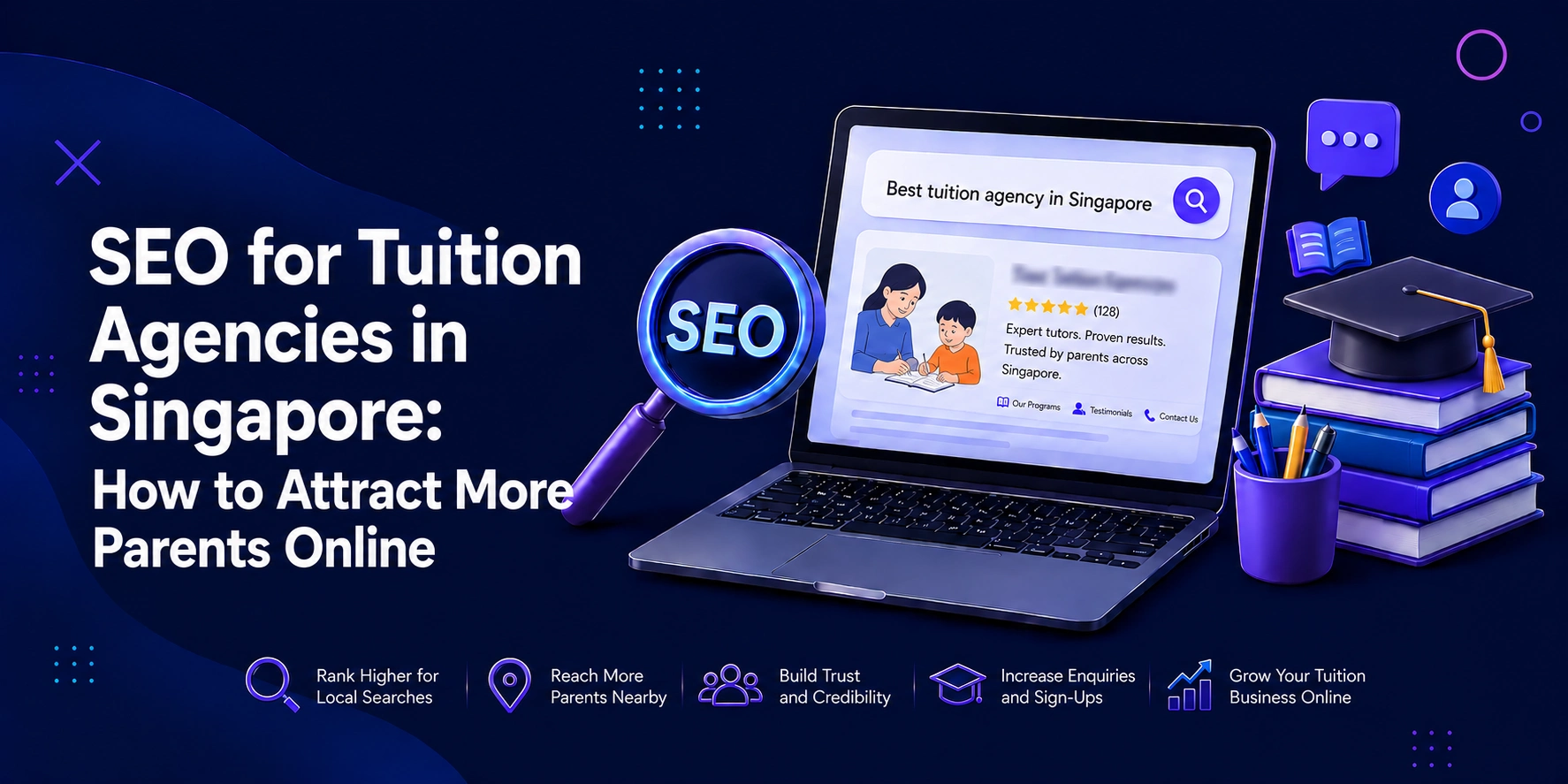
Singapore’s tuition industry is highly competitive. Parents looking for academic support can choose from tuition centres, enrichment schools, online tuition providers, freelance tutors, and home tuition agencies. For a tuition agency, simply having a website is therefore not enough. The website needs to appear when parents are actively searching for help.
This is where search engine optimisation (SEO) becomes valuable. Implementing tailored SEO for Tuition services allows agencies to attract high-intent traffic. Unlike advertising, where traffic generally stops when the advertising budget is switched off, a well-optimised website can continue attracting prospective parents through organic search.
When executing SEO Singapore strategies, tuition agencies must reach people at the exact moment they are searching for terms such as “Maths tutor Singapore”, “home tuition for Primary 6” or “IB Chemistry tutor”.
The objective should not simply be to generate more website visitors. A successful SEO strategy for tuition attracts the right visitors — parents and students who have a genuine need for academic support.
Here is how tuition agencies in Singapore can build an SEO strategy that turns Google searches into genuine enquiries.
Get a free digital marketing consultation from BThrust's Singapore team and find out what's holding your growth back.
Good SEO starts with understanding search intent.
A tuition provider might describe its service internally as “personalised academic support”, but parents may search for something much more specific. Effective SEO for Tuition focuses on these precise terms, including:
Google itself recommends thinking about the terminology different users might employ when searching, rather than attempting to force every possible keyword variation into a page. By building targeted SEO for Tuition campaigns around clear user needs, agencies can turn organic search visibility into consistent parent enquiries.
This means tuition agencies should think beyond one broad keyword such as “tuition Singapore.”
Someone searching for “tuition” could be looking for almost anything. A parent searching for “Secondary 4 A Maths home tutor Singapore” has a much clearer requirement.
These longer and more specific searches may individually receive fewer searches, but they often represent stronger commercial intent.
A useful keyword strategy should therefore cover several layers:
Broad service keywords
Examples include “home tuition Singapore”, “private tuition Singapore” and “tuition agency Singapore”.
Subject-specific keywords
These could include “English tuition”, “Maths tuition”, “Chemistry tutor” and “Chinese tuition”.
Academic-level keywords
Examples include “Primary School tuition”, “Secondary School tutor”, “JC tuition” and “IB tuition”.
Problem-based searches
Parents also search according to the challenge their child is facing:
“how to improve PSLE Maths”
“child struggling with Chinese”
“how to improve English composition”
“how to prepare for O-Level Chemistry”
These searches provide an important opportunity for informational content.
One common SEO mistake is trying to rank a single homepage for every tuition-related keyword.
Imagine a tuition agency that offers tutors for English, Maths, Science, Chinese, Secondary School, JC and IB.
If all those services are described on one page, Google has relatively little information with which to understand each individual service.
A better website architecture creates useful pages around significant services.
For example:
Primary School
Secondary School
Post-secondary
The goal isn’t to generate hundreds of near-identical pages by replacing “Maths” with “Science”.
Each page should genuinely answer the questions someone looking for that particular type of tutor is likely to have.
Google’s current guidance emphasises useful, original and people-first content rather than content mass-produced primarily to capture search traffic.
Large tuition websites may already compete aggressively for broad terms.
Smaller agencies can find opportunities further down the search funnel.
Instead of concentrating entirely on:
Maths tuition Singapore
consider topics such as:
Primary 5 Maths home tutor Singapore
A Maths tutor for Secondary 3
IB Maths private tutor Singapore
home tuition for PSLE Maths
The search volume for each phrase may be smaller, but the searcher’s requirement is far clearer.
This concept can extend into content marketing.
An agency trying to attract parents looking for English tuition might publish:
A relevant tuition service can then be introduced naturally when appropriate.
Service pages capture people who already know they want tuition.
Content marketing allows an agency to reach parents earlier in their decision-making process.
Think about the questions parents ask before contacting a tutor:
Does my child actually need tuition?
How much does home tuition cost?
Should I choose a student tutor or an MOE teacher?
Is group tuition or one-to-one tuition better?
How many hours of tuition should my child have?
Each question can become an article.
A particularly valuable approach is to publish information based on the agency’s actual experience.
For example, tuition rates are a major concern for parents. Rather than publishing a generic article saying prices “vary depending on experience”, an agency could provide actual market ranges.
This tuition-rate guide, for example, breaks rates down by educational level and tutor category, including part-time tutors, full-time tutors and current or former teachers.
Information derived from actual enquiries, tutor applications and parent questions is difficult for generic websites to replicate.
That distinction is becoming increasingly important. Google’s guidance for both conventional and AI-powered search emphasises original, useful information rather than commodity content that simply restates what already exists online.
Trust is especially important when parents are choosing someone to teach their children.
A tuition website should therefore answer questions such as:
Who operates the agency?
How long has it been operating?
How are tutors selected?
What qualifications do tutors have?
How does matching work?
What happens if the tutor isn’t suitable?
Are there genuine parent testimonials?
Is pricing explained?
Can parents easily contact the agency?
Real experience can also become an SEO advantage.
For example, Yes Tuition has a tutor database across categories including current and former teachers, full-time tutors, graduates, and part-time tutors.
A tuition agency with years of operating history has information that a generic education publisher does not.
Use it.
An article about choosing tutors could explain what parents commonly request. A tuition-rates article could use actual tutor asking rates. An examination article could incorporate questions frequently raised by students.
Google specifically encourages publishers to make authorship clear and demonstrate first-hand experience and expertise where appropriate.
A common content strategy is to publish whatever keyword happens to appear attractive that month.
One week the blog discusses PSLE Maths. The next article is about university rankings. Then there is an article about AI. Then parenting. Then perhaps careers.
This creates a scattered website.
A better approach is to build content clusters.
Suppose an agency wants greater visibility for English tuition.
Its core page could be:
English Tuition Singapore
Supporting articles might include:
These articles can internally link to one another and, where relevant, to the main English tuition page.
The result is a coherent collection of resources around English education.
The same strategy can be applied to Maths, Science, Chinese, PSLE, O Levels, JC and IB.
Tuition is inherently local.
Even when an agency provides islandwide home tuition, parents may search geographically:
“Maths tuition Tampines”
“private tutor Woodlands”
“tuition centre Bishan”
“home tutor Jurong”
Google Business Profile can therefore be important for tuition businesses with an eligible physical presence.
The website itself can also contain useful geographical information. But avoid automatically generating hundreds of thin pages such as:
“Maths Tuition Tampines”
“Maths Tuition Bedok”
“Maths Tuition Pasir Ris”
where almost every sentence is identical except for the location.
A location page should exist because it offers genuine value to someone searching in that area, not simply because a keyword tool shows search volume.
Internal linking is one of the simplest SEO improvements a tuition agency can make.
Suppose an article is titled:
5 Ways to Help Your Child Improve in Secondary School Maths
If the article discusses situations where students need individual guidance, it can naturally link to the agency’s Secondary Maths tuition page.
Similarly:
How to Prepare for PSLE English
could link to:
PSLE English Tuition
This helps visitors discover relevant services while also helping search engines understand relationships between pages.
The anchor text should be descriptive rather than repeatedly forcing the same keyword.
For example:
“students who need additional help with PSLE English preparation…”
is more natural than inserting “best cheap PSLE English tuition Singapore” into an unrelated sentence.
Google’s Search Essentials specifically recommends using words people would use to find content in prominent places, including titles, headings, and descriptive link text.
Links from other websites can help search engines discover and understand a tuition website, but quality and relevance matter.
A tuition agency should look for opportunities from:
Guest contributions can work particularly well when there is genuine subject overlap.
For example, an article on a digital marketing website might discuss:
How Parents Search for Tuition Online: An SEO Guide for Education Businesses
A parenting publication could instead cover:
How to Know When Your Child Needs Additional Academic Support
The tuition agency can be referenced where it genuinely contributes something useful.
The objective shouldn’t be to insert keyword-rich backlinks into as many websites as possible. Google explicitly distinguishes people-first SEO from content or linking practices designed primarily to manipulate rankings.
Parents frequently search from their phones.
A website that loads slowly, has tiny text, intrusive pop-ups, or difficult navigation can lose potential enquiries even if it ranks well.
Google recommends ensuring websites are secure, fast, accessible and functional across devices, while its page-experience guidance highlights mobile usability and avoiding intrusive experiences.
Tuition websites should therefore pay particular attention to:
The path from Google search to enquiry should be short.
If a parent lands on a Chemistry tuition page, they shouldn’t need to navigate through five menus before finding out how to request a Chemistry tutor.
Ranking first for a keyword is valuable only if the resulting traffic contributes to the business.
Every important service page should therefore have a clear next step.
That might be:
Request a Tutor
View Tuition Rates
Speak to a Tuition Coordinator
Browse Tutor Profiles
The page should also answer the questions that could prevent someone from enquiring.
How quickly can a tutor be found?
Are there agency fees?
Can parents choose tutor qualifications?
Can they request a male or female tutor?
Can lessons be held at home?
What happens if the tutor isn’t suitable?
Removing uncertainty improves conversion rates.
This is where SEO and conversion optimisation overlap. Getting 10,000 visitors who have little interest in engaging a tutor is less valuable than attracting 1,000 parents who are actively looking for one.
SEO shouldn’t end when an article reaches Google’s first page.
Tuition agencies should track what happens afterwards.
Google Search Console can reveal:
Analytics can then help determine what visitors do after arriving.
For a tuition agency, the most meaningful outcomes might include:
This information should influence future content.
If a detailed article about Secondary Maths attracts parents who subsequently request tutors, creating more resources around Secondary Maths may make sense.
If another article generates thousands of visits but virtually no meaningful engagement, its business value may be much lower despite impressive traffic numbers.
Search behaviour is changing as users increasingly encounter AI-generated answers and conversational search experiences.
However, this does not mean tuition agencies need an entirely separate optimisation strategy for every AI platform.
Google’s current guidance states that the foundational SEO practices used for conventional Search also apply to its AI features, and there are no additional technical requirements for appearing as a supporting link beyond being indexed and eligible for Search.
The underlying lesson is straightforward: create information worth citing.
For a tuition agency, that might mean:
The more distinctive and useful the information, the more reasons both traditional search engines and emerging AI search systems have to surface it.
SEO for tuition agencies in Singapore isn’t about stuffing “tuition Singapore” into every paragraph or producing hundreds of AI-generated articles.
It is about understanding what parents need at different stages of their search.
A parent may begin with:
“Why is my child struggling with Maths?”
Later, that search might become:
“Does my child need Maths tuition?”
Then:
“Primary 6 Maths tutor Singapore”
And eventually:
“home tuition rates Singapore.”
A strong tuition website has useful content for each stage.
Build comprehensive service pages for the subjects and educational levels you actually serve. Publish articles answering genuine parent questions. Organise related content into subject clusters. Demonstrate first-hand experience. Strengthen internal linking. Earn relevant external references. Make the site fast and easy to use, and measure whether organic traffic ultimately produces enquiries.
Most importantly, write for parents first.
Google’s guidance is explicit that its systems aim to prioritise helpful, reliable content created primarily for people rather than pages produced to manipulate search rankings.
For tuition agencies, that principle makes commercial sense as well. A parent doesn’t need another generic article telling them that education is important. They need specific information that helps them decide what to do next.
The tuition agencies that provide those answers consistently have the strongest foundation for turning organic search visibility into parent enquiries.