
Running an online store is not just about adding products and waiting for customers to find them. With thousands of e-commerce websites competing for the same customers, search engine visibility has become an important part of online growth. This is where SEO comes in.
However, SEO for an e-commerce store is not exactly the same as SEO for a service website, blog, or corporate website. Shopify stores, in particular, come with their own structure, features, and limitations that require a more specific approach.
Understanding Shopify SEO vs generic SEO can help store owners identify what needs to be optimised and why traditional SEO strategies may not always be enough for an online store.
Get a free digital marketing consultation from BThrust's Singapore team and find out what's holding your growth back.
Generic SEO refers to the broader process of optimising a website so that search engines can understand its content and rank its pages for relevant search queries.
It is commonly used for websites such as:
A conventional SEO strategy directs its efforts toward keyword analysis, website optimisation, technical SEO maintenance, content development, link acquisition, website performance optimisation, and user interface design.
A digital marketing agency which targets “SEO services in Singapore” as a keyword will work on its service page optimisation, create additional blog content, establish suitable backlinks, enhance its website performance, and develop its internal website navigation system.
The main goal of most businesses involves boosting their natural website visitors while they work to obtain new customers who will become leads or sign up for their services or perform other conversion actions. The basic rules of SEO apply to e-commerce websites, but their distinct website architecture and business goals create additional challenges for optimisation work.
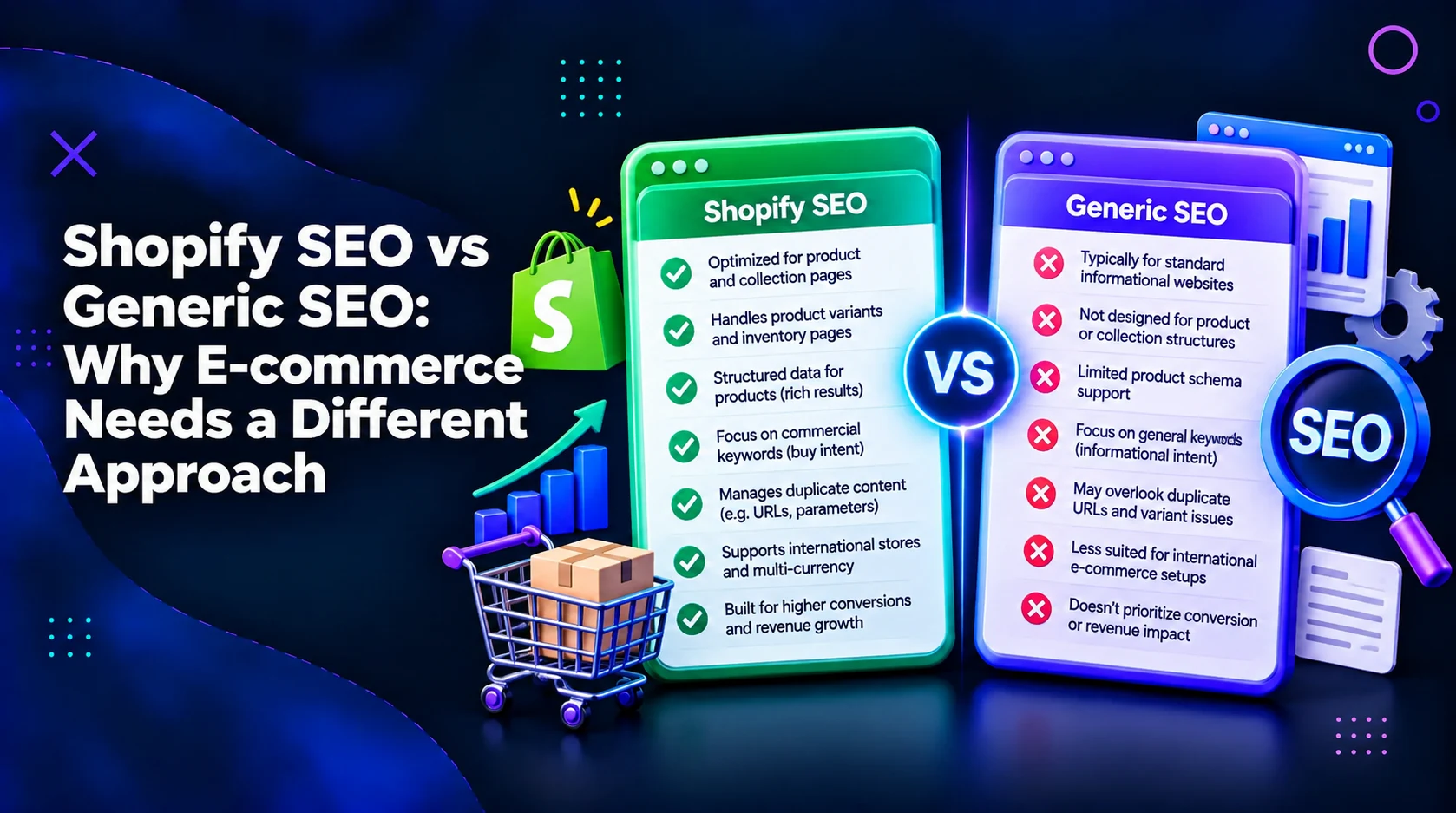
Shopify SEO involves the process of optimising online stores which run on Shopify to achieve better search engine results and attract visitors who find their websites through natural search engine results.
Shopify includes various SEO-friendly elements which users can access immediately. These elements consist of title tags, meta descriptions, URLs, canonical tags, sitemaps, and structured data capabilities that users can customise.
However, simply creating a Shopify store does not guarantee strong search rankings.
The Shopify website platform faces various operational obstacles which include duplicate content issues and problems with product pages and collection pages, website indexing and URL management, page load speed, product variation management, and internal website navigation.
Shopify requires specialized SEO approaches because it operates as an independent platform.
The basic principles of SEO continue to exist, but marketers need to modify their execution methods because Shopify uses its own platform-based structure.
The biggest difference between Shopify SEO and generic SEO is the type and scale of the website being optimised.
A standard business website may contain dozens or hundreds of important pages. An e-commerce website can have thousands of URLs because of products, collections, filters, variants, blogs, and other pages.
Here are some important e-commerce SEO differences.
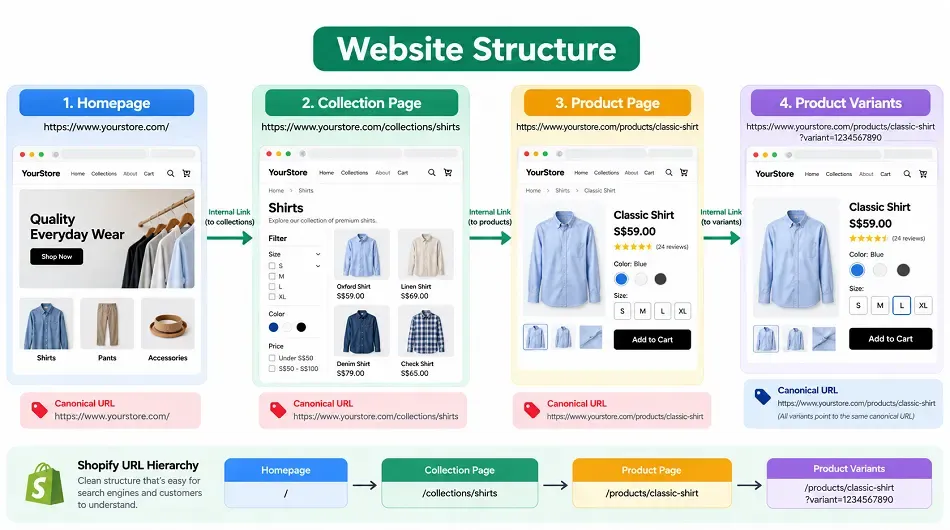
A typical business website may have a relatively simple structure:
Homepage → Services → Individual Service Pages → Blog
An e-commerce store often looks more like:
Homepage → Collections → Subcollections → Products → Variants
This creates many more pages that search engines need to crawl and understand.
For Shopify stores, creating a logical hierarchy between collections and products is therefore extremely important.
For example, a clothing store might have:
Men → Shoes → Running Shoes → Product Page
This structure helps users and search engines understand how different pages are related.
Product pages are at the heart of e-commerce SEO.
A service website may focus on optimising a few important landing pages, while an online store may have hundreds or thousands of product pages.
Each important product page should ideally have:
Copying the same product description across multiple products can make it harder for search engines to understand what makes each page unique.
Therefore, product-level optimisation is one of the most important parts of Shopify SEO.
One common mistake Shopify store owners make is focusing only on individual products.
Collection pages can also target valuable commercial keywords.
For example, instead of optimising only a product page for:
“black running shoes”
a store could also optimise a collection page around:
“black running shoes for men”
The collection page can provide useful introductory content, relevant products, internal links, and optimised metadata.
This creates additional opportunities to rank for category-level searches.
Technical SEO is important for every website, but e-commerce stores usually have more URLs and more complex navigation.
Some common Shopify-specific SEO issues include:
Shopify performs automatic management of various technical SEO components, yet store owners must track their website’s crawling and indexing status. The objective is not to make every URL indexable. Search engines should focus on pages which provide valuable content to users instead of every page.
Keyword research for a normal website often focuses on informational or service-based searches.
For example:
“how does SEO work?”
or
“SEO agency in Singapore”
E-commerce websites need to target different types of search intent.
These can include:
Informational:
“how to choose running shoes”
Commercial investigation:
“best running shoes for beginners”
Transactional:
“buy running shoes online”
Product-specific:
“Nike running shoes size 10”
Understanding search intent is essential because users searching for products are often much closer to making a purchase.
This is why keyword research for Shopify stores should consider product, category, brand, and transactional searches—not just informational keywords.
Internal linking helps search engines discover pages and understand relationships between different pages.
In an e-commerce store, internal linking opportunities are everywhere.
For example:
Blog → Collection → Product
A blog about choosing running shoes can link to a running-shoes collection, which can then link to individual products.
Similarly, related products can be linked to one another.
A well-planned internal linking structure can help distribute authority throughout the website while making navigation easier for customers.
E-commerce websites usually contain many images because customers need to see products before purchasing them.
However, large images can negatively affect page loading performance.
Shopify store owners should therefore pay attention to:
A visually attractive store is useful, but it should not come at the cost of a poor user experience.
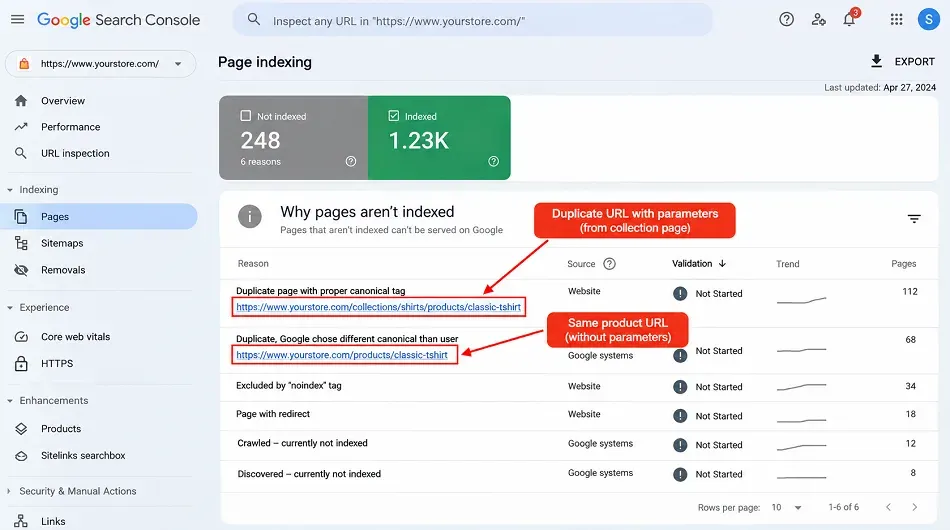
Although Shopify makes it relatively easy to launch an online store, several Shopify SEO problems in Singapore and other competitive markets can affect organic visibility.
Similar product descriptions, variant URLs, and collection structures can create duplicate or near-duplicate content.
Some stores contain product pages with only a product name, image, and price.
These pages may provide limited information to search engines and customers.
Adding useful product information, specifications, FAQs, reviews, and unique descriptions can make the page more valuable.
Some Shopify stores create collections but do not optimise their titles, descriptions, headings, or internal links.
This can result in missed opportunities for category-level keywords.
Shopify apps can add valuable functionality, but installing too many apps can introduce additional scripts and potentially affect website performance.
Store owners should regularly review installed apps and remove unnecessary ones.
A large portion of online shopping happens through mobile devices.
Therefore, Shopify stores should be tested on different screen sizes to ensure that navigation, product pages, checkout-related elements, and content work smoothly.
Not every Shopify store operates globally.
Businesses targeting a specific market should combine e-commerce SEO with local SEO strategies.
For example, a Singapore-based Shopify store may target keywords related to products plus location.
This is where SEO in Singapore can become relevant for an e-commerce business.
A local Shopify SEO strategy may include:
For businesses competing in Singapore’s e-commerce market, understanding local customer behavior and search patterns can be just as important as technical optimisation.
Search systems continue their evolution because users now prefer to use AI-based search systems for their search needs.
The development of AI SEO in Singapore technology sector has led to rising interest from Singaporean businesses and multiple international markets.
Shopify businesses need to produce useful content which contains clear information that follows proper structure, and maintains trustworthiness.
Product pages need to answer actual customer questions instead of presenting generic search terms which lack real value.
For example, instead of writing:
“Buy premium running shoes. Our running shoes are premium running shoes available online.”
A better product page could explain:
Useful information can serve both traditional search engines and emerging AI-driven search experiences.
A practical Shopify SEO strategy can be divided into several steps.
Identify keywords based on products, categories, brands, locations, and search intent.
Start with the homepage, major collection pages, and high-value product pages.
Check indexing, redirects, canonicalisation, broken links, page speed, mobile usability, and crawlability.
Publish blogs, buying guides, FAQs, comparisons, and other content that answers customer questions.
Connect relevant blogs, collections, categories, and products to create a logical website structure.
Earn links through useful content, digital PR, partnerships, industry websites, and other legitimate strategies.
Track organic traffic, rankings, clicks, impressions, conversions, indexed pages, and other relevant metrics.
For businesses that do not have an in-house SEO team, professional ecommerce SEO services can help manage these activities.
The biggest misconception about Shopify SEO is that optimisation simply means adding keywords to product descriptions.
In reality, successful e-commerce SEO combines technical SEO, content, user experience, keyword research, internal linking, product optimisation, and authority building.
The difference between Shopify SEO vs generic SEO is therefore not that Shopify uses completely different SEO principles.
Instead, Shopify requires those principles to be applied within an e-commerce platform with a large number of product and collection pages.
Overall, Shopify SEO vs generic SEO is different, as Shopify provides a strong foundation for building an online store, but the platform alone cannot guarantee organic visibility. Online retailers must solve particular problems because they need to handle product optimisation, collection management, category organisation, image presentation, navigation systems, technical components, and conversion-oriented content delivery at large operational levels.
Shopify store owners need to understand e-commerce SEO differences because it enables them to build websites which follow logical structures and achieve better search engine rankings. A business which operates in Singapore or any other market with competition needs to achieve one goal which involves building a reliable website and offering valuable content and recognizing search user needs and creating simple paths for search engines and shoppers to move through the store.
Businesses which want to boost their Shopify store visibility need to create a lasting basis for organic growth through their work on technical optimisation, their production of excellent content, and their development of powerful internal link systems.