
SEO often looks complicated when different strategies, terms, and methods appear in the same discussion. Understanding on-page vs off-page SEO gives you a clear starting point. Both approaches support search visibility, but they work in different areas and solve different problems. One focuses on improving the website itself, while the other strengthens its reputation across the web.
This guide breaks down their roles, key differences, practical uses, and value for new SEO buyers. You will also learn how both approaches work together to support stronger rankings, better visibility, and sustainable search growth.
Get a free digital marketing consultation from BThrust's Singapore team and find out what's holding your growth back.
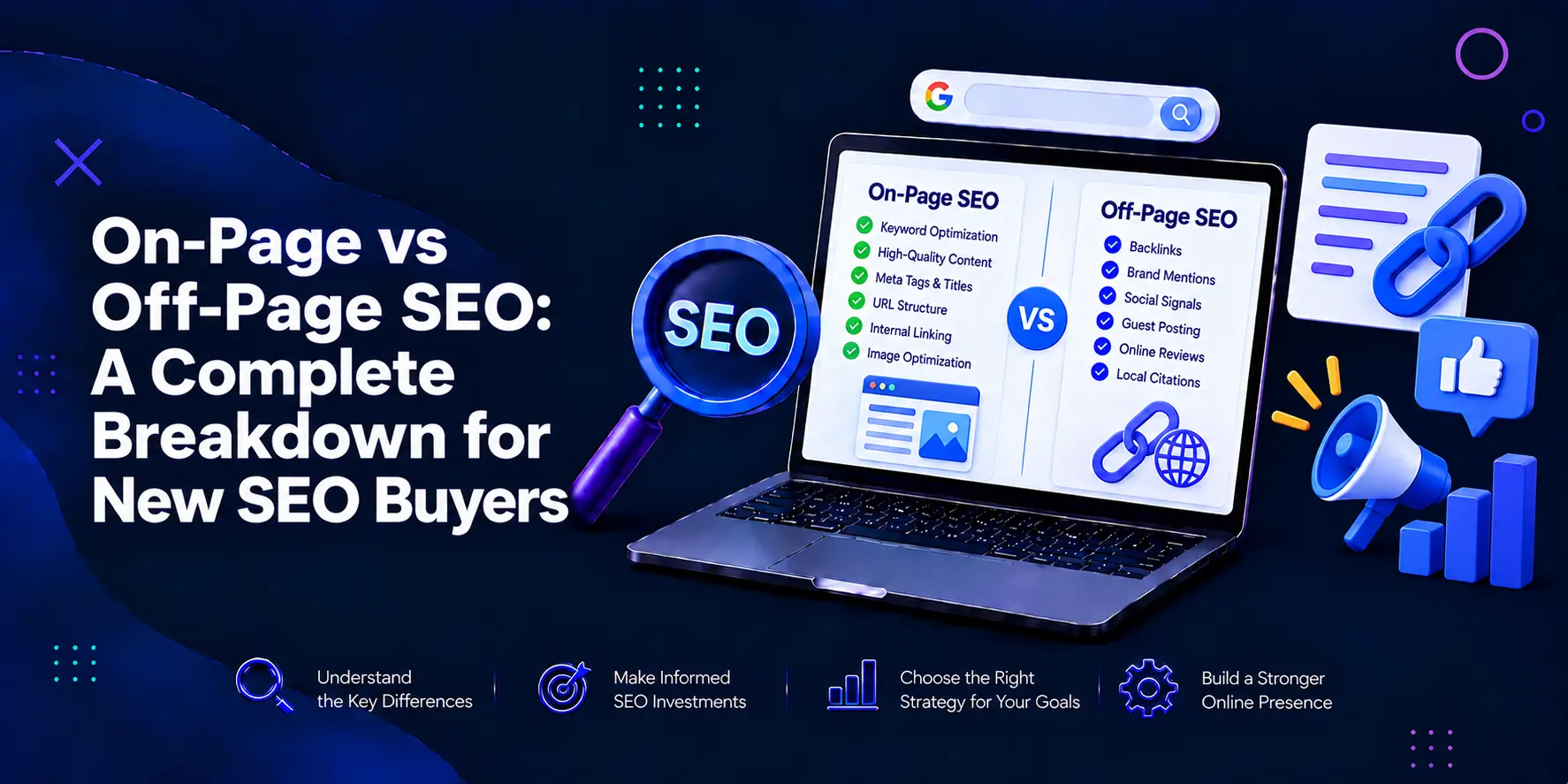
On-page SEO covers changes you make on your website to help search engines understand a page and help visitors use it. It includes content, headings, page titles, internal links, URLs, images, and page structure.
Off-page SEO covers signals that come from outside your website. Backlinks form a major part of this work, but off-page activity can include brand mentions, editorial references, digital PR, relevant directory listings, and reputation signals.
A simple way to remember the difference is this: on-page SEO builds the asset; off-page SEO builds confidence in the asset.
Search guidance supports clear titles, useful content, descriptive URLs, and relevant links. It also stresses people-first content over pages created only to chase rankings.
| Area | On-Page SEO | Off-Page SEO |
|---|---|---|
| Main focus | Your website and content | Signals from other websites and sources |
| Main goal | Relevance, clarity, usability | Authority, trust, discovery |
| Core tactics | Content, titles, headings, internal links, URLs | Backlinks, mentions, digital PR, citations |
| Control level | High | Lower |
| Main risk | Thin, unclear, or poorly structured pages | Spammy, paid or manipulative links |
| Best use | Build a strong search-ready page | Strengthen the page with external proof |
On-page SEO starts with one question: does this page give a clear, useful answer to the searcher?
Every page should serve one main purpose. A buyer searching for a comparison wants differences, pros, risks, and decision guidance. A buyer searching for a service wants scope, process, proof, pricing context, and a clear next step.
Match the page format to that need. Do not force an informational keyword into a hard sales page.
Strong content should explain, compare, answer objections, show examples, or organise complex ideas into clear steps.
Current search guidance recommends helpful, reliable, people-first material with original value instead of content that restates what other sources already say.
For new SEO buyers, a content plan should not start with word count. It should start with the problem each page must solve.
Your title and H1 should describe the page without repeating the same phrase. Search systems can use title elements, headings, visible page text, and link text when they form search result titles.
Use H2s for major sections and H3s for supporting points. Make each heading tell the reader what comes next.
A clear heading structure creates another benefit: readers can scan the page and reach the part that matches their question without working through blocks of unrelated copy.
A short, descriptive URL helps users understand a page before they open it. Search guidance recommends readable words in URLs rather than long strings of unclear identifiers.
Internal links move context through your site and help readers find the next useful page. A link building guide can point to link building services. A local strategy page can point to SEO in Singapore. A crawl section can connect to technical SEO. A search innovation page can link to AI SEO in Singapore.
Use anchor text that tells the reader what sits behind the link. Clear anchor text gives visitors a reason to click and gives search systems context about the destination page.
Images should support the topic. Add useful alt text where an image needs a text description.
Tables, comparison boxes, short answers, and structured data can improve clarity. Structured data can help search systems understand page information and may support richer search features when a page meets the rules.
These elements matter for new buyers because a well-structured page does more than target a keyword. It makes information easier to consume, compare, and act on.
A useful on-page SEO checklist keeps work focused. New buyers can use it to review a page before paying for promotion.
The aim is not to place a keyword in every possible location. The aim is to create a page whose subject, purpose, and value remain clear from the title through the final action.
Off-page SEO explained in one sentence means building credible signals outside your website that support its authority, reputation, and discovery.
Off-page SEO works through signals that you cannot control in the same way you control a title, heading, or paragraph.
Strong off-page work earns recognition from relevant sources. Guides may attract editorial links, research may gain citations, and expert commentary may earn references.
That makes off-page SEO less about “getting links” and more about creating reasons for credible sources to mention your pages.
A useful page gives outreach a strong starting point. Without that asset, link acquisition can become a numbers exercise that produces little value for users or the business.
Backlinks can help search engines discover pages and understand relationships across the web. Search guidance treats links as an important route for finding new pages.
Link quality matters. A relevant editorial link carries more useful context than a batch of unrelated links.
Keep these link building basics in mind:
Search spam policies warn against buying links for ranking value, excessive link exchanges, automated link creation, and schemes designed to manipulate ranking signals.
A buyer should ask how links will be earned, where they may appear, and why those websites would want to reference the target page.
If the answer centres on link quantity, fixed batches or placements with no connection to the topic, examine the plan with care.
On-page work may improve the title, H1, service explanation, FAQs, internal links, trust content, and call to action.
Off-page work may earn mentions from relevant publications, industry resources, partner content, or expert round-ups.
The page gains clearer relevance from its content while external references support its credibility.
On-page work may sharpen search intent, add a comparison table, answer common questions, improve headings, and link to deeper resources.
Off-page work may promote the guide to writers, editors, communities, and resource owners who may reference it.
This combination gives the guide useful information and stronger paths for discovery.
On-page work may strengthen location context, service details, FAQs, internal links, and contact information.
Off-page work may focus on consistent citations, local references, useful partnerships, and mentions from sources connected to the market.
These on-page and off-page SEO examples show the relationship between relevance and authority. One side shapes the page. The other builds support around it.
Technical SEO overlaps with on-page SEO, but it covers a wider layer of site health. It deals with how search systems crawl, render, index, and interpret your website.
Technical work can include crawl access, index controls, canonical tags, redirects, sitemaps, site architecture, performance, and structured data.
Canonical signals matter when several URLs hold the same or similar content because search systems may select one representative URL.
A new buyer should treat technical SEO services as the foundation when a site has crawl, index, migration, duplication, or performance problems.
Strong content cannot reach its full value if search systems struggle to access the right page.
This point also helps buyers separate technical work from content editing. Changing headings will not solve an indexing block. Building backlinks will not repair a broken redirect chain. Each problem needs the right SEO discipline.
The answer depends on the condition of the site.
If a page does not match search intent, has weak content, uses unclear headings, or lacks internal links, off-page work cannot repair those problems. Start on the page.
If the page offers strong value but competing pages have wider recognition and stronger references, off-page work may become the larger growth lever.
For most new SEO buyers, use this order:
So, on-page SEO vs. off-page SEO: which matters more? On-page work creates the reason to rank. Off-page work can strengthen the case. Strong SEO needs both.
The balance may change from page to page. A new service page may need content work. A mature guide with strong engagement may need authority. A large site with index problems may need technical fixes before either approach can deliver value.
Search experiences can generate answers, summaries, and follow-up paths from web content.
That shift does not erase SEO fundamentals. Current guidance for generative search features stresses unique, useful, non-commodity content and a clear point of view.
This makes an answer-friendly structure useful. Give each section one clear question or idea. Put the direct answer near the start. Support it with detail, examples, tables, and links.
For buyers exploring AI SEO in Singapore, do not replace core SEO with a new label. Build clear content, sound technical access, strong internal paths, and credible external support.
A page that gives concise answers and useful depth can serve traditional search users and answer-led search experiences without splitting the strategy into separate systems.
A good proposal should explain the work, not hide it behind broad labels.
Ask what pages will change, which issues take priority, how keyword intent will shape content, and how progress will be measured.
For off-page work, ask where links may come from, what quality checks will apply, and whether the method follows search spam policies.
Ask how technical findings connect with content and authority work. A clean technical base supports strong pages, while strong pages give outreach teams something worth promoting.
You should also expect clear ownership. The plan should show who handles content, technical fixes, outreach, reporting, and approval.
Avoid plans that promise rankings without explaining the work behind them.
For on-page work, track impressions, search clicks, target-query visibility, conversions, index status, and performance by page. Watch whether improved pages attract relevant visits and produce useful actions.
For off-page work, review referring pages, relevance, link quality, earned mentions, referral visits, and supported target pages.
Connect those signals to business outcomes.
A link has little value if it supports the wrong page. A ranking has little value if it attracts the wrong audience. Traffic has little value if visitors never move towards an enquiry, sale, or another useful action.
This measurement approach keeps SEO tied to commercial value instead of reports filled with numbers that lack context.
On-page and off-page SEO solve different parts of the same search challenge. On-page work shapes relevance, clarity, structure, and user value. Off-page work builds recognition through links, mentions, and trusted external signals. New buyers should not treat them as rival services or choose one for every situation.
Start by fixing technical barriers and weak pages, then earn authority around content that deserves attention. Use clear goals, safe link practices, and page-level measurement to guide each step. When both sides support the same search intent, SEO becomes easier to assess, improve, and connect to business growth.
On-page SEO improves content, structure, titles, links, and user experience on your website. Off-page SEO builds authority through backlinks, mentions, citations, and trusted references from relevant external sources and channels.
Yes, some pages will still rank because of their relevancy, helpfulness, good site architecture, and lack of competition. The value of backlinks increases when the competitor’s authority is greater and supported by more external signals.
Off-page SEO has no fixed timeline. Results depend on competition, link quality, page strength, crawl activity, and existing authority. Sustainable campaigns focus on steady growth rather than sudden link volume.
Start with technical access and on-page SEO. Build useful pages, clear structure, internal links, and strong intent alignment. Then add off-page work to strengthen authority around proven, valuable pages first.