
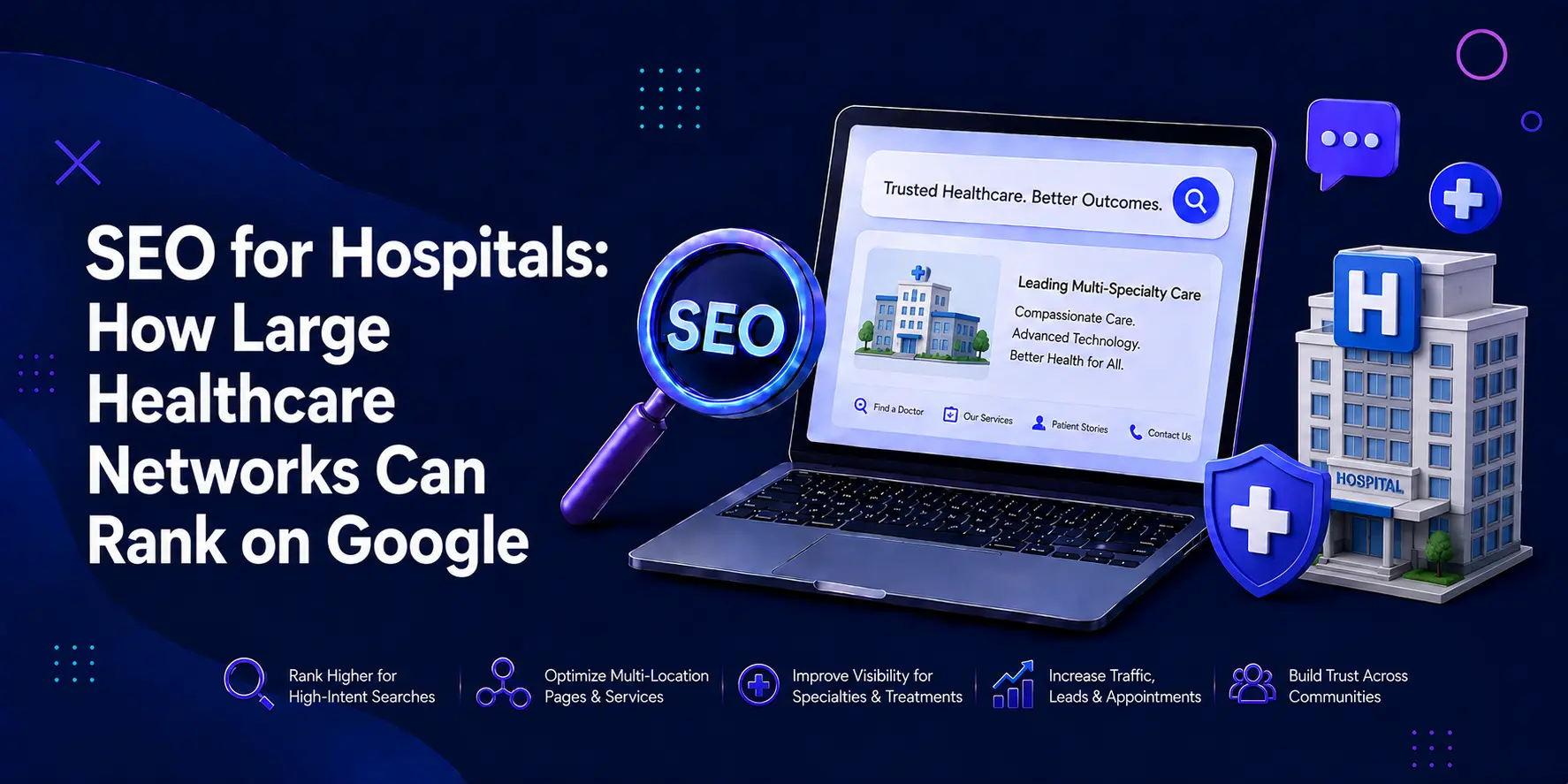
Hospitals carry greater search responsibility than clinics, because patients arrive with urgent questions, complex concerns, and high trust needs. A large healthcare network must guide people from symptoms to departments, from doctors to locations, and from research to appointments.
That is where SEO for hospital growth becomes a core digital asset. It helps patients find the right care without confusion. It also helps Google understand each service, specialist, branch, and medical resource.
In this guide, we explore how large hospitals can build search visibility with structure, trust, and patient-first content.
Get a free digital marketing consultation from BThrust's Singapore team and find out what's holding your growth back.
A hospital website is not a small service site. It is a living system with departments, doctors, diagnostics, emergency services, health guides, insurance information, and location pages. Because of this, every page must connect with the next useful step.
For example, a patient searching for chest pain may need emergency care, cardiology, diagnostics, or a heart specialist. Another patient searching for maternity care may need doctor profiles, delivery packages, NICU details, and appointment options.
This is why SEO for hospitals must work like a planned patient journey, not a set of random pages. Each page should answer a need, remove doubt, and guide the reader forward.
At the same time, hospital teams must respect medical accuracy. Search visibility matters, but patient trust matters more. Strong hospital SEO services balance both goals with care.
Before writing new pages, hospitals should organise the website. Without a clear structure, users get lost, and search engines struggle to understand page importance.
A strong hospital website usually needs these main sections:
This structure creates a clean path. A department page can link to related conditions. A condition page can link to treatments. A treatment page can link to doctors. A doctor profile can link back to departments and locations.
Department pages often decide whether a patient trusts a hospital. So, they should do more than list services. They should explain what the department treats, how care works, which doctors lead it, and where patients can access it.
For example, a cardiology page should include heart conditions, diagnostic tests, procedures, emergency signs, cardiac specialists, and branch availability. In the same way, an oncology page should explain cancer types, treatment options, tumour boards, support services, and technology.
This approach supports SEO for hospitals because each department becomes a complete search hub. It also helps patients understand care without feeling overwhelmed.
A strong department page should include:
Therefore, department pages should not sound like sales copy. They should sound useful, calm, and clear.
Large hospitals need more than basic keyword use. They need an SEO strategy for multi-department hospitals that protects clarity across every specialty.
First, group services by medical logic. Next, connect related pages with internal links. Then, create unique content for each department instead of copying the same format across every page.
For instance, orthopaedics may need pages for knee replacement, spine care, sports injury, arthritis, and trauma. Neurology may need pages for stroke, epilepsy, migraine, Parkinson’s disease, and nerve disorders.
This system gives each specialty space to rank. It also prevents one page from competing with another page on the same website.
In short, SEO for Healthcare works best when the site reflects real patient pathways.
Doctor profiles build confidence. Many patients search by doctor name, qualification, specialty, or treatment area before booking an appointment.
A good doctor profile should include education, experience, areas of interest, procedures performed, languages spoken, consultation location, appointment details, and professional memberships where relevant.
However, the profile should not feel like a plain CV. It should help patients understand whether the doctor fits their needs.
For example, instead of saying “Dr X has 15 years of experience,” the page can explain the conditions they manage, the procedures they perform, and the hospital departments they support.
Doctor profiles should also link to:
Large healthcare networks often manage several hospitals in one city or across many regions. Each location needs its own strong page.
A weak location page only gives an address and phone number. A strong location page explains what care is available at that branch.
Include departments, emergency support, diagnostics, visiting hours, parking, insurance help, pharmacy access, accessibility details, and key doctors at that location.
This matters because patients often search with location intent. They may search for “cardiology hospital near me” or “emergency hospital in [city].” If the location page answers these searches, it can attract relevant patients.
Here, local SEO services in Singapore and similar local search models can guide healthcare networks. The same principle applies anywhere: every branch must show what it offers, where it is, and how patients can reach it.
Content cannot perform well if the website has technical problems. This issue becomes serious for large hospital sites because they often contain thousands of URLs.
A technical SEO service should check crawl errors, broken links, duplicate pages, redirects, mobile usability, page speed, structured data, XML sitemaps, and indexation.
For example, a hospital may have several old pages for the same department. If these pages compete, rankings can weaken. In another case, important doctor pages may remain hidden because no department page links to them.
Technical work also affects user trust. If an emergency page loads slowly, patients may leave. If a booking form breaks on mobile, enquiries drop.
So, technical SEO is not only a search task. It is part of patient access.
Hospital content should guide people with care. It should not scare them, confuse them, or push treatment before explaining the basics.
Good content topics include symptoms, conditions, procedures, tests, recovery, preparation, risks, follow-up care, and when to seek urgent help.
For example, a knee replacement guide can explain who may need surgery, what tests come before it, what recovery may involve, and which doctors handle the procedure.
This kind of content supports SEO for hospital campaigns because it meets patient intent. It also builds authority across departments.
However, medical content should have expert review. Add reviewer names, update dates, and clear disclaimers where needed. This improves trust and keeps information aligned with clinical standards.
Many teams ask how to improve hospital website ranking on Google, and the answer starts with connection. Google should see how departments, doctors, locations, and patient guides fit together.
Here is a simple path:
These SEO tips for hospital websites help large networks focus on quality instead of volume.
In addition, hospitals should review search data. If patients search for “stroke symptoms” and the hospital has a stroke unit, the site should offer a clear, reviewed, and action-focused page.
Healthcare decisions involve fear, money, time, and family pressure. So, patients need proof before they contact a hospital.
Trust signals can include accreditations, doctor credentials, treatment experience, patient support services, technology, safety standards, insurance partners, and clear contact details.
Still, hospitals should avoid exaggerated claims. Phrases such as “best hospital” or “guaranteed cure” can damage credibility. Instead, show facts that patients can understand.
For example, mention available services, specialist teams, multidisciplinary care, diagnostic support, and recovery guidance.
This is where choosing a Healthcare SEO Agency becomes important. A capable partner should understand search growth, content compliance, and medical trust.
Rankings are useful, but they do not show the full picture. Hospitals should measure search performance by patient action.
Track organic traffic, appointment clicks, phone calls, branch-page visits, doctor-profile views, form submissions, and department-level growth.
Also, compare service lines. If cardiology receives strong traffic but few enquiries, the call-to-action may need work. If oncology receives low traffic despite strong services, content depth or internal linking may need improvement.
A good SEO service report should connect search performance with real hospital goals. It should show which pages bring patients closer to care.
Hospital websites change often. Doctors join. Departments expand. Locations move. New treatments launch. Old pages stay live unless someone manages them.
Therefore, large hospitals need SEO governance. Assign owners for medical review, content updates, technical checks, and analytics review.
Create a content calendar, but also create a review calendar. Health pages need freshness, accuracy, and clear responsibility.
This process keeps SEO for hospital work consistent across the whole network. It also prevents the website from becoming crowded, outdated, or confusing.
Overall, Large hospitals need search systems that match their scale. They must connect departments, doctors, locations, treatments, and patient resources into one clear journey.
When hospitals organise the site, improve technical health, write useful content, and build trust, Google can understand the network with less friction. More importantly, patients can find care with less stress.
Effective SEO is not just a marketing activity for hospitals. It is a digital access path that helps people move from concern to confidence, one useful page at a time.
Hospitals manage many departments, doctors, services, and locations. Their SEO needs strong architecture, accurate medical content, technical control, and clear patient journeys across large websites.
Hospitals should review key medical pages every six to twelve months. Update doctor profiles, services, timings, locations, and treatment details whenever facts change.
Yes. Doctor profiles capture name-based searches, build patient trust, and support department pages. They work best when linked with services, locations, and appointment options.
Technical SEO helps large hospital websites stay crawlable, fast, and organised. It fixes broken links, duplicate pages, slow templates, and hidden pages that block visibility.