
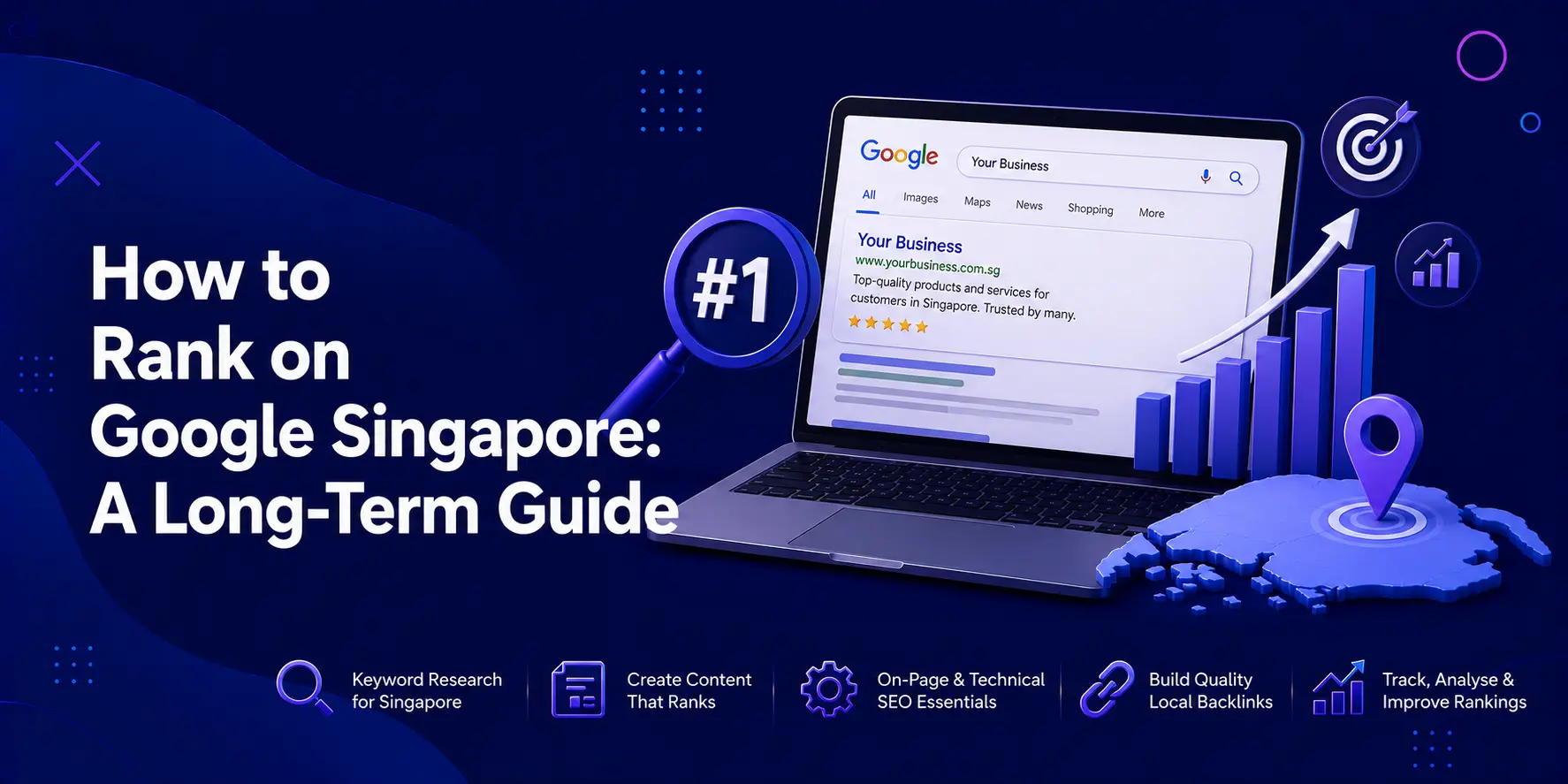
If you want to know how to rank on Google in Singapore, the answer is simple. Build a website that helps your audience, answers their questions, and improves over time. There is no shortcut to long-lasting Google rankings.
Businesses that achieve consistent visibility focus on quality content, a strong user experience, and continuous improvement. By following a long-term SEO strategy, you can build trust with both search engines and potential customers, leading to steady organic traffic and sustainable business growth.
In this guide, you will understand how to rank in Google across Singapore by understanding prime factors including keyword research together with on-page optimisation and technical enhancements, content development strategies, link acquisition methods, local search optimisation, performance evaluation, and achievable search engine position targets.
Whether you run a small business or a growing company, this guide will help you create a sustainable SEO plan that delivers long-term growth.
Get a free digital marketing consultation from BThrust's Singapore team and find out what's holding your growth back.
Long-term SEO creates lasting visibility, steady traffic, and better returns by improving your website over time instead of chasing short-term gains.
Many businesses expect quick rankings after publishing a few pages. In reality, Google rewards websites that continue to provide value over months and years.
A strong Google ranking system in Singapore should base its core on building trust between users and websites. Search engines use three main factors to decide which pages will receive their proper ranking positions by assessing content quality, website performance, authority, and user experience.
Instead of looking for quick fixes, focus on creating a website that grows stronger every month. The method establishes the fundamental structure that allows businesses to develop effective long-term SEO plans that produce enduring SEO results.
Google determines website rankings through its evaluation system, which studies content relevance together with quality standards, authority levels, user experience, and technical performance metrics.
Google’s goal is to provide the most helpful answer for every search. To achieve this, it considers several factors.
Your content needs to provide exact answers that satisfy the questions that users bring to you. Each webpage needs to concentrate on a single main subject while delivering all essential details about that subject.
Google trusts websites that earn quality backlinks from reputable sources. Strong authority develops over time through useful content and trusted mentions.
Visitors must be able to find information without facing any challenges. The combination of organised design elements and straightforward menus and text that readers can understand leads to better user interaction.
Your website needs to deliver fast loading times while maintaining mobile compatibility and search engine access to all vital website pages.
Together, these factors create a reliable Google ranking strategy in Singapore that supports long-term success.
Keyword research helps you understand what your audience is searching for and allows you to create content that matches their needs.
The first step in learning how to rank on Google in Singapore is understanding search intent.
Instead of targeting only broad keywords, include specific search phrases that reflect real customer questions. Because these longer phrases often attract visitors who are ready to take action.
Each keyword should match one of these goals:
Creating content around user intent helps improve rankings and engagement.
As part of any SEO Singapore guide, keyword research should remain an ongoing activity instead of a one-time task.
Helpful, original, and complete content improves visibility because it answers users’ questions better than competing pages.
Content remains one of the strongest ranking factors.
Each page should solve a specific problem. Instead of writing short articles, create complete resources that answer common questions from beginning to end.
Good content should include:
Update important pages every few months to keep information accurate.
A sustainable SEO strategy for Singapore businesses depends on publishing valuable content on a regular basis.
Businesses can also strengthen their overall Content Marketing service by creating guides, case studies, FAQs, and educational resources that continue attracting visitors over time.
Search engines become able to understand your content through on-page optimisation, which also creates better reading experiences for website visitors.
Every page should include:
Create titles that describe content while including your main keyword at suitable positions.
Create summary descriptions which motivate users to select your search result when they view search engine results.
Use H1, H2, and H3 headings to create order for your content.
Connect related pages across your website to help users discover more information.
Businesses tend to unite their SEO in Singapore services with Technical SEO and Content Marketing resources, which they display on their service pages to boost website structure and subject matter connection.
Compress images and use descriptive file names and alt text. Good on-page optimisation supports every Google ranking strategy in Singapore.
Technical SEO enables search engines to access your website through an error-free crawling process, which lets them understand and index its content.
Google search results show weak performance for websites that create excellent content because technical problems prevent Google from accessing their pages.
The system requires these essential core technical enhancements to achieve its operational goals.
Visitors experience better website performance when websites load their content quickly.
Most users search from mobile devices. Your website should display correctly on every screen size.
HTTPS protects visitors and builds trust.
Users become less satisfied when pages break, which also causes search engines to waste their crawling resources.
A website needs navigation with a clear structure to let both human visitors and search engine bots reach their desired important pages.
Businesses focus on these areas through their dedicated Technical SEO services to enhance their website health during extended time periods. Technical improvements are essential for sustainable SEO.
Quality backlinks help Google view your website as a trusted source within your industry. Link building should focus on relevance rather than quantity. Good backlinks often come from:
Avoid buying large numbers of poor-quality links.
A professional link-building service should focus on earning genuine mentions from reputable websites.
Strong authority develops gradually, making link building an important part of every long-term SEO strategy.
Local SEO helps your business appear when customers search for products or services in Singapore. Many searches include local intent. To improve local visibility:
Ensure your business name, address, and contact details remain consistent across online listings.
Positive reviews help build trust with both users and search engines.
If your business serves different areas, develop useful pages for each location instead of repeating the same content.
Local SEO strengthens your overall Google ranking strategy in Singapore, especially for SMEs serving nearby customers.
Tracking performance helps you understand what works and where improvements are needed. Monitor important metrics such as:
SEO is an ongoing process. Reviewing performance every month allows you to improve existing pages before creating new ones.
Many businesses combine regular reporting with their PSG Digital Marketing initiatives to support continuous website growth and better decision-making.
Performance tracking plays a key role in every long-term SEO strategy.
Most businesses begin seeing progress within three months, stronger growth around six months, and meaningful rankings after twelve months of consistent work.
Focus on:
You may notice improvements in website health and search visibility.
Your website may begin:
This stage reflects the benefits of a consistent, sustainable SEO strategy for businesses.
After one year of steady effort, many SMEs experience:
Businesses that continue investing in sustainable SEO often see results improve beyond the first year.
Avoid shortcuts that promise quick rankings because they often create long-term problems.
Some common mistakes include:
Short pages that provide little value rarely perform well.
Broken pages, slow loading speeds, and poor mobile usability affect rankings.
Write naturally for readers instead of repeating keywords.
Focus on earning trusted links through valuable content.
SEO requires ongoing effort. Rankings improve through consistency rather than one-time changes.
Following these principles supports a reliable Google ranking strategy in Singapore.
SMEs achieve better results by making SEO part of their long-term business growth instead of treating it as a one-time project.
A successful step-by-step guide to rank on Google in Singapore involves steady progress rather than dramatic changes.
Focus on:
These actions create a sustainable SEO strategy for Singapore businesses that continues generating traffic and leads over time.
Many SMEs also strengthen their online presence by combining Local SEO, Technical service, Link Building, Content and PSG Digital Marketing efforts into one consistent digital growth plan.
Overall, the best way to rank on Google is through consistent effort, useful content, technical excellence, and continuous improvement.
People need to discover the correct strategies that help them improve their Google search results in Singapore. A successful SEO Singapore guide combines keyword research, quality content, technical optimisation, authority building, local SEO, and regular performance reviews into one connected strategy.
The businesses which maintain their market positions over time dedicate their efforts to ongoing enhancement instead of pursuing immediate market advantages. The long-term SEO strategy enables SMEs to build lasting SEO achievements that bring them more website visitors and higher search engine results, and ongoing business expansion over time.