
Search marketing includes several terms that sound similar, yet each serves a different purpose in digital growth. SEO builds unpaid visibility in search results. SEM focuses on search marketing and often refers to paid search campaigns in commercial use. PPC describes an advertising model where businesses pay for each click. Understanding these differences helps buyers avoid unclear packages, wasted budget, and poor campaign choices.
This guide explains SEO vs SEM vs PPC, compares their strengths, and shows when each approach makes sense for new digital marketing buyers and small businesses in Singapore.
Get a free digital marketing consultation from BThrust's Singapore team and find out what's holding your growth back.
Before comparing results, costs, or timelines, it helps to understand what each term means.
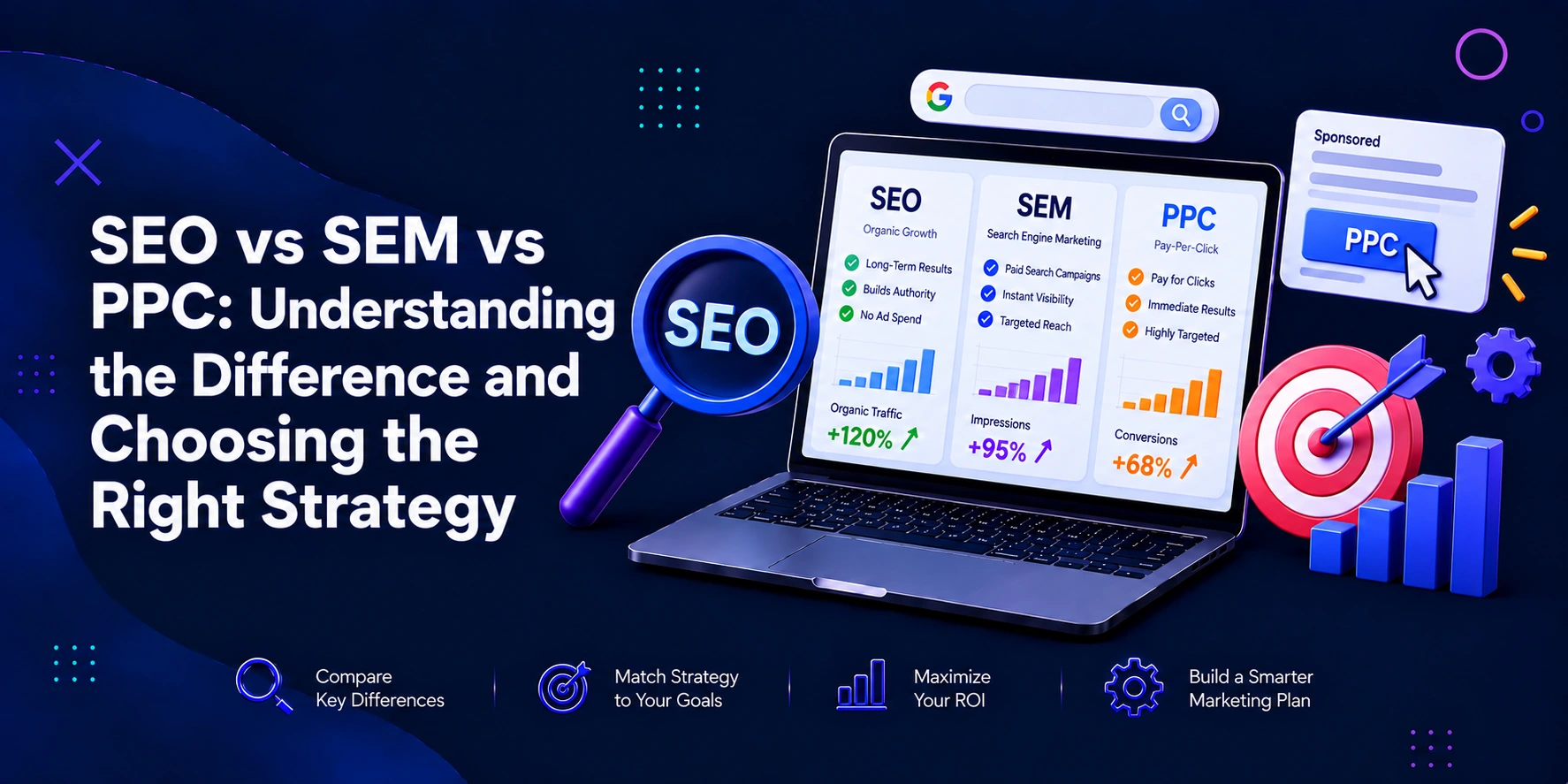
The main distinction is clear. SEO focuses on organic search visibility. SEM focuses on marketing through search engines, often through paid advertising. PPC describes how an advertiser pays for traffic.
Once these roles become clear, the difference between SEO and SEM becomes much easier to understand.
SEO, or search engine optimisation, helps a website attract visitors through unpaid search results. A business does not pay a search engine for each organic click. Instead, it invests in content, technical improvements, website structure, and authority.
Professional SEO in Singapore combines several areas of work to strengthen a website’s search presence and connect it with relevant customer demand.
SEO can include:
The purpose goes beyond gaining high rankings.
Effective SEO connects relevant searches with pages that answer questions, solve problems, and support buying decisions.
For example, an accounting company may build service pages for users searching for tax support while publishing guides for people comparing accounting providers. Both content types serve customers at different points in the buying journey.
SEO works well for businesses that want to develop a dependable source of search traffic.
It can suit companies that:
SEO does not produce instant rankings.
Search engines need time to discover pages, understand their content, and decide where they belong in search results. Competitive sectors can require sustained work before meaningful gains appear.
The main advantage lies in long-term value. A strong page can continue attracting relevant visitors after the initial optimisation work.
SEM has two common meanings.
The broad meaning covers search marketing as a whole, including SEO and paid search. Semrush uses this definition in several guides.
In agency use, SEM often means paid search advertising. HubSpot notes this common use, while Mailchimp defines SEM as paid advertising on search result pages.
For buyers, one question removes the risk: What does your SEM package include?
If an agency sells SEM services, check for Google Ads, Microsoft Ads, keyword targeting, bidding, conversion tracking, landing pages, and campaign management. Never assume SEO sits inside the package.
A paid SEM campaign can cover:
Paid search helps businesses place adverts in front of users who search for selected products, services, or solutions.
Advertisers can control budgets, bids, locations, schedules, and campaign goals. This control makes SEM useful when a company needs search visibility before its organic rankings become competitive.
PPC is not a marketing channel by itself. It is a payment model used within digital advertising.
With pay-per-click advertising, a business pays when a user clicks an advert. The cost of each click can depend on competition, bids, relevance, audience conditions, and platform rules.
Search advertising often uses PPC, but PPC also appears across other digital channels.
For example:
The key distinction is straightforward:
SEM describes marketing through search engines. PPC describes a method of paying for advertising.
As a result, a PPC campaign does not need to fall under SEM.
A social media advert may charge for each click, but it does not become search engine marketing because the advert appears on a social platform rather than a search engine.
| Area | SEO | SEM | PPC |
|---|---|---|---|
| Primary goal | Build organic search visibility | Gain visibility through search marketing | Generate traffic through paid clicks |
| Traffic type | Organic | Often paid search traffic | Paid traffic |
| Main cost | Strategy, content and optimisation | Advertising spend plus management | Cost per click plus management |
| Speed | Develops over time | Can generate traffic after launch | Can generate traffic after launch |
| Long-term value | Can continue after optimisation | Depends on campaign activity | Depends on continued advertising spend |
| Control | Less control over rankings | Strong targeting and budget control | Strong bid and budget control |
| Best suited for | Sustainable search growth | Paid search acquisition | Fast traffic and campaign testing |
This comparison highlights the core difference between SEO and SEM.
SEO works towards earning unpaid search rankings. SEM, in common agency use, focuses on paid visibility within search engines.
The difference between SEM and PPC comes down to category and payment structure. SEM describes the marketing activity, while PPC describes the pricing model used across many advertising platforms.
One of the most common questions from new marketing buyers is when to use PPC vs SEO.
The right answer depends on business goals, budget, competition, website quality, and the time available to generate results.
SEO makes sense when search demand remains consistent, and your business wants to build a stronger long-term presence.
Consider SEO when:
SEO can support both commercial and informational searches.
A service page can reach users who have strong purchase intent. A guide, comparison page, or FAQ can connect with people who are researching their options.
This range gives SEO value beyond one keyword, product, or campaign.
PPC can work well when a business needs traffic without waiting for organic rankings to develop.
Consider PPC when:
PPC also gives businesses a useful way to test offers, keywords and landing pages. If a keyword produces strong conversions through paid search, that information can guide future SEO work.
Traffic alone, however, does not prove campaign success. A PPC campaign needs accurate tracking, relevant adverts, and landing pages designed to turn visitors into enquiries or customers.
Many first-time buyers ask, which is better: SEO or PPC?
Neither strategy wins in every situation. SEO suits businesses that want to build lasting search visibility. PPC suits businesses that need speed, targeting control, and direct market testing.
A company with limited organic rankings can use PPC to capture search demand while its SEO strategy develops.
A company with strong organic visibility can use PPC to support product launches, competitive keywords, or high-value services.
The better choice depends on the job each channel needs to perform.
For many businesses, SEO and PPC work better as complementary channels than competing strategies.
Budget control becomes more important for smaller companies. SEO vs SEM vs PPC for small business in Singapore should start with customer demand, competition, profit margins, and customer value.
A small business cannot afford to target every keyword or run campaigns without clear commercial goals.
If customers search for phrases such as “office renovation Singapore” or “corporate tax consultant Singapore”, paid search can help your business reach people who are close to choosing a provider.
If the answer is yes, SEO can justify long-term investment.
A strong service page, comparison guide, or educational resource can continue supporting future search demand without requiring payment for every organic click.
If your business cannot track calls, forms, bookings, purchases, or qualified leads, fix your measurement system before increasing advertising spend.
Without proper tracking, you cannot see which campaigns create real business value.
For a Singapore tuition centre, renovation company, professional services firm or clinic, a combined strategy may offer the strongest approach.
PPC can target high-intent searches, while SEO can build service pages, local pages, and helpful content that support customers throughout the buying journey.
SEO and PPC can produce stronger insights when teams share campaign data instead of treating each channel as a separate system.
Paid campaigns can reveal which keywords attract clicks, enquiries and sales. SEO teams can use this information to decide which topics deserve service pages, comparison pages or supporting content.
This approach reduces guesswork and helps teams focus resources on topics with proven customer interest.
Paid search budgets tend to focus on commercial keywords because these terms connect with direct sales opportunities. SEO can reach customers earlier through educational searches, comparisons, definitions, and problem-based questions.
This wider coverage allows a brand to appear before a potential customer reaches the final purchase stage.
Do not judge SEO through rankings alone or PPC through click volume alone.
Track metrics such as:
These measures provide a stronger picture of whether search marketing supports business growth.
Choosing between SEO, PPC, and SEM becomes easier when you connect each option with a clear business goal.
Choose SEO when your business has consistent search demand, valuable expertise, and enough time to build strong organic visibility.
Choose PPC when you need leads sooner, understand customer value, and have a conversion-focused landing page ready for paid traffic.
Choose SEM services when you need expert support with keyword targeting, bidding, ad creation, conversion tracking, and landing page optimisation.
Use both when search influences customer decisions and your budget can support immediate lead generation alongside sustainable organic growth.
Before signing a contract, check the service scope, deliverables, reporting methods, account ownership and advertising costs. Clear expectations protect your budget and make campaign results easier to measure.
SEO, SEM, and PPC overlap, but each addresses a different marketing need. SEO builds organic search visibility. SEM covers search marketing and often means paid search in agency discussions. PPC explains how advertisers pay for many digital campaigns.
For new buyers, the right choice depends on goals, budget, timing, and measurement. Use SEO to build lasting search value. Use PPC to capture demand, test offers, and gain faster visibility. Use both when search contributes strongly to customer acquisition. A sound strategy does not force one channel to do everything; it gives each channel a clear commercial role.
SEM often refers to paid search marketing, while PPC describes a payment model. Many SEM campaigns use PPC, but PPC can also appear on social, display, and other advertising platforms.
SEO builds visibility in unpaid search results through content, technical work, and authority. SEM often refers to paid search campaigns that place adverts in search results for selected keyword terms.
A small business should use PPC when it needs faster traffic, has a clear offer, and can track conversions. SEO suits businesses that can invest in long-term organic visibility growth.
Yes. PPC tests keywords and landing pages, while SEO builds organic visibility around proven demand. Shared data helps both channels identify stronger opportunities and improve marketing decisions with greater confidence.