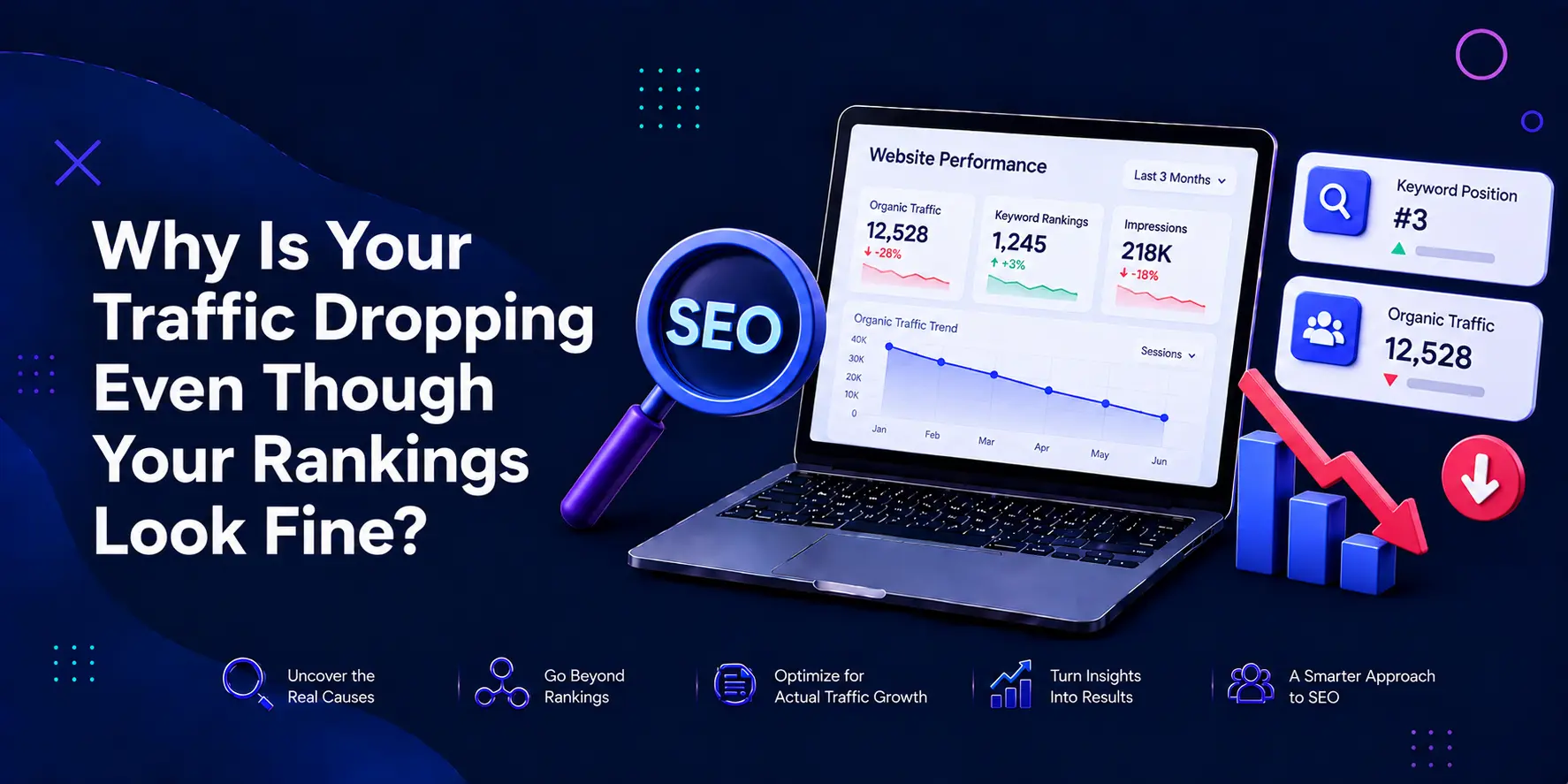
Your rankings look healthy. Your key pages still hold strong positions. Impressions may show little change. Yet organic traffic keeps falling. For marketing managers and business owners, this gap can raise serious questions about SEO performance.
In 2026, traffic dropping while rankings remain unchanged does not always signal an SEO failure. Search results themselves have changed. AI Overviews, direct answers, featured results, and other SERP features can satisfy users before they visit a website. As a result, ranking position alone no longer explains organic performance. You must examine clicks, CTR, search demand, SERP changes, and AI visibility together.
Get a free digital marketing consultation from BThrust's Singapore team and find out what's holding your growth back.
Traditional SEO followed a clear path: stronger rankings increased visibility, attracted clicks, and supported conversions. That connection has changed as Google’s search results have evolved.
A page can still rank in the top three positions while receiving fewer organic clicks. The issue is not always the ranking itself. It is the growing number of search features competing for user attention.
Before reaching a standard organic result, searchers may encounter AI Overviews, featured snippets, People Also Ask sections, videos, images, local packs, shopping results, and knowledge panels. These features can answer questions within the search results and reduce the need to visit another website.
This shift creates a significant challenge for SEO teams: strong search visibility no longer guarantees strong website traffic.
Research from Pew Research Center highlights this change. Users clicked a traditional search result during 8% of visits when an AI summary appeared, compared with 15% when no AI summary appeared. Links within AI summaries attracted clicks during only 1% of visits.
These findings show why traffic dropping while rankings remain unchanged has become an important performance issue for modern SEO teams.
Google AI Overviews can answer a search query before a user reaches standard organic listings. They may explain a subject, summarise a process, compare choices, or answer several related questions within one search experience.
This creates the AI Overview click loss problem.
A 2025 Ahrefs study analysed 300,000 keywords and found that an AI Overview correlated with a 34.5% lower average CTR for the top-ranking page.
The situation has become more significant. Ahrefs repeated its study with December 2025 data and reported in February 2026 that AI Overviews correlated with a 58% lower average CTR for the number-one organic result. Positions two and three also showed estimated CTR reductions of 50.8% and 46.4%.
Your page can therefore retain position one while losing a large part of its previous click opportunity.
Think about what a searcher might see before your organic listing:
Your ranking has not disappeared. Your share of search attention has changed.
This distinction matters. Traditional rank tracking tells you where Google places your page. It cannot tell you how much information Google gives users before they reach that page.
A zero-click search occurs when a user searches but does not visit an external website. The search results provide enough information to end the journey or guide the user towards another action.
The zero-click search impact changes how businesses should measure SEO success.
Pew found that users ended their browsing session after 26% of Google result pages that contained an AI summary. That figure fell to 16% when the search page had no AI summary.
Informational searches face particular pressure because AI systems can answer many basic questions within the search results.
Queries based on definitions, simple processes, explanations, and common questions may no longer generate the click volume they once produced.
This does not mean your content has lost its ranking value. It means Google can use information from across the web to meet part of the searcher’s need before a website visit occurs.
AI Overviews do not explain every traffic decline.
Rankings measure your position for a query. They do not measure how many people search for that query.
Suppose your page ranks first for a keyword that once generated 10,000 searches each month. If demand falls to 6,000 searches, your ranking can remain unchanged while your traffic drops.
Search demand can change because of:
Compare impressions with clicks and rankings.
If impressions decline while rankings remain stable, lower search demand may sit behind the traffic loss. If impressions remain stable while clicks fall, CTR deserves more attention.
This simple distinction can prevent your team from changing content that does not need fixing.
A ranking number needs context.
Your page might still rank third, but position three may no longer occupy the same visual space.
Google can place an AI Overview and several other features above traditional organic results. Your page remains third according to your ranking report, yet users may need to move through a large amount of content before seeing it.
This is another reason traffic dropping while rankings remain unchanged requires SERP analysis.
Review your most valuable keywords and examine the current search results. Look for:
Compare these findings with older SERP records when your SEO platform provides them.
A stable ranking does not guarantee stable search visibility.
AI features are not the only elements competing for attention. Other organic listings compete for the same click.
Your page can maintain its position while CTR falls because another result presents a stronger offer.
A competitor may use a clearer title, stronger benefit, recent date, useful number, recognisable brand name, or better match for search intent.
Search Console can help you spot this problem.
Look for pages and queries where:
That pattern can reveal a click problem rather than a ranking problem.
A basic summary has less value when an AI Overview already gives users the same information.
Your page needs to promise something deeper.
Consider adding:
The objective is not to make your title louder. It is to give searchers a clear reason to leave the results page and visit your website.
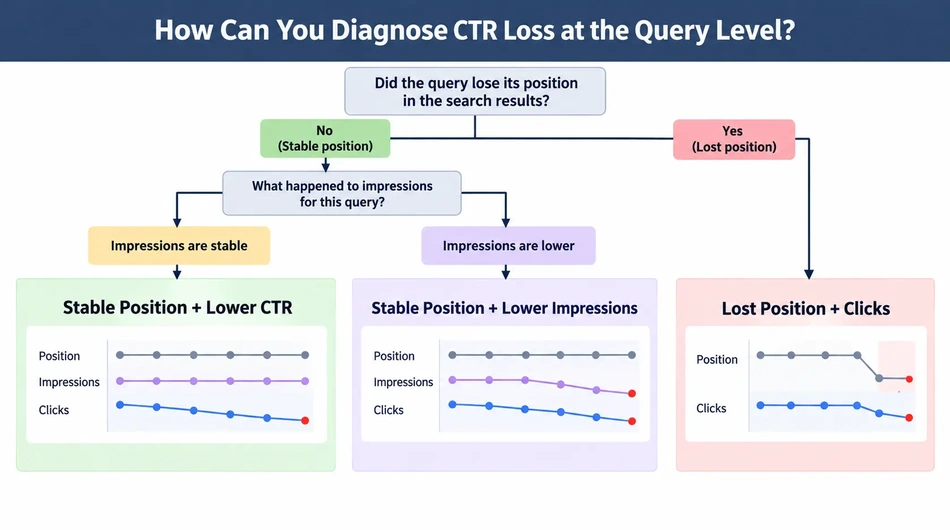
When marketing teams investigate why their organic traffic is dropping in 2026, query-level data should be central to the analysis.
Start with Google Search Console and compare the current period against a relevant previous period. Examine clicks, impressions, CTR, and average position to identify meaningful changes.
Next, group affected queries by performance pattern to determine where CTR losses are occurring and what may be driving them.
Start with keywords where positions and impressions remain close to previous levels, but CTR has fallen.
These queries may expose AI Overview interference, SERP changes, stronger competing snippets, or changing user behaviour.
These queries may indicate falling search demand.
Changing a title or rewriting a page will not restore traffic if fewer people search for the subject.
Treat these as more traditional SEO issues.
Review search intent, content quality, technical health, internal links, link-building, competing pages, and recent search changes.
Separating these patterns gives your team a much clearer diagnosis than looking at total organic traffic alone.
Yes. Traditional ranking reports now show only one layer of search visibility.
Marketing teams should also track whether their brand and content appear as cited sources inside AI-generated answers.
This matters because AI Overviews continue to occupy a major part of informational search. Ahrefs reported in June 2026 that AI Overviews appeared on 57.9% of question queries in its analysed data. Its wider CTR research used anonymised Search Console data from more than 400,000 websites.
That shift gives marketing teams new questions to answer.
Does Google cite your content? Does it mention your brand? Which competitors receive citations? Which queries produce AI Overviews? Which pages lose CTR when those features appear?
An answer engine optimisation strategy can help your business create clear, useful, well-supported information that search and answer systems can understand and reference.
No. The phrase rankings stable but traffic falling can describe a change in the search environment rather than a decline in your website’s search quality.
You need to identify what has changed before choosing a solution.
The zero-click search impact means raw traffic figures now need more business context. Marketing teams should connect organic performance with:
A smaller amount of high-intent traffic can create more value than a large amount of low-intent informational traffic.
Traffic remains important. It just cannot serve as the only measure of SEO health.
Start by identifying pages with stable rankings and falling CTR. Then check which queries trigger AI Overviews and other SERP features.
Protect content with commercial value. Users still need websites when they want pricing, detailed comparisons, tools, services, demonstrations, case studies, products, or help with a decision.
Strengthen your brand presence as well. Searchers who recognise and trust your brand have a stronger reason to choose your result among AI answers and competing listings.
Businesses that lack internal resources can also consider specialist AI SEO services for AI visibility measurement, content planning, entity development, and search performance analysis.
Most importantly, move beyond rankings as your main SEO KPI.
AI can summarise common information with ease. Your content must offer value beyond that summary.
Do not build another page that repeats information available across dozens of websites. Create something worth visiting.
Use original data. Share experience. Demonstrate a process. Compare real options. Show examples. Provide templates. Answer the questions that appear after the basic answer.
This approach can reduce the effect of AI Overview click loss because it gives users a reason to seek more depth.
Your SEO goal has changed.
Ranking remains valuable, but the stronger goal is to rank, earn attention, build trust, and create enough value to make the click worthwhile.
Search traffic can decline without a ranking collapse because AI answers, changing SERPs, lower search demand, and new user habits now shape click behaviour. When you notice traffic dropping while rankings are unchanged, investigate CTR before rewriting content or building more links.
Compare rankings with impressions, clicks, SERP features, query intent, AI visibility, conversions, and revenue. Rankings still play a major role in SEO, but they no longer provide a complete picture of organic performance. Businesses that measure the whole search journey can diagnose traffic losses with greater accuracy and invest in work that creates measurable business value.
AI Overviews, featured snippets, videos, and other SERP features can capture user attention before organic listings. Your ranking may stay stable while fewer searchers choose to visit your website.
Compare Search Console clicks, impressions, CTR, and rankings. Identify queries with stable positions but falling CTR, then check whether AI Overviews now appear within those search results for users.
Yes. Rankings still support search visibility, but businesses should also measure CTR, conversions, AI citations, branded demand, SERP features, leads, and revenue to understand their complete organic search performance.
Original research, expert insight, case studies, tools, templates, comparisons, and practical examples give users reasons to visit. Such content provides depth that short AI-generated search answers may not contain.