

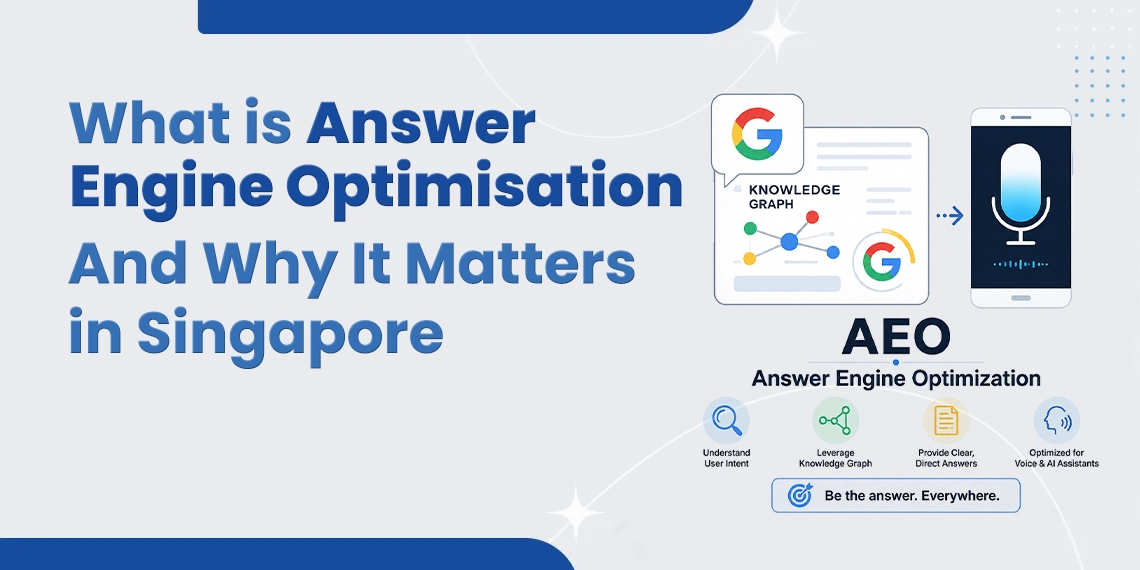
Answer engine optimisation is the process of structuring content so it can be selected as the most accurate and useful answer to a user’s question, which is increasingly important in Singapore due to high digital usage and fast search behaviour.
Think about how you search today. You no longer type short phrases and scan ten blue links. You ask full questions and expect a clear reply. You want one good answer, not ten options.
This shift has changed how content works online. It is no longer enough to rank on a page. Your content must answer the question directly. This is where answer-driven search optimisation comes in.
In Singapore, where digital adoption is high and users expect fast, clear information, this shift is even more important. Businesses that adapt early can stay visible while others fade into the background.
Get a free digital marketing consultation from BThrust's Singapore team and find out what's holding your growth back.
Answer engine optimisation is the practice of creating and structuring content so it can be easily extracted and presented as a direct answer to user questions.
Instead of focusing only on ranking, it focuses on:
In simple terms, it is the process of making your content easy to understand, easy to extract, and easy to trust.
This means your content must work well for both people and systems that deliver answers.
Answer engines work by analysing content, identifying the most relevant response to a user’s question, and delivering it in a clear and concise format.
To understand this shift, you need to know how direct answer search behaves. They no longer act like traditional search systems that simply display a list of links.
Instead, they aim to deliver one clear and useful response to a user’s question. Their goal is to reduce effort for the user by providing direct information without the need to browse multiple pages.
Answer engines read and interpret content in a deeper way. They analyse the meaning behind the words, not just the keywords.
This allows them to match a user’s question with content that best fits the intent. They look for clarity, structure, and relevance when deciding which information to use.
The system finds the best answer after it completes the content analysis process. The system chooses information that contains both accurate details and simple, understandable language.
The system selects content that answers questions directly with higher probability. Users who submit lengthy or complicated content receive decreased chances for their messages to be selected.
After selecting the best response, the direct answer search presents it in a short and clear format.
This could be a brief paragraph, a simple definition, or a step-by-step explanation. The focus is always on making the answer easy to read and quick to understand.
Only a small number of sources are chosen to provide these answers. This means not every website gets visibility, even if the content is good.
Because of this, competition is tighter than before. Content must be precise, well-structured, and directly useful to stand out.
Read More: How AI is Changing SEO in 2026
Answer-driven search optimisation matters in Singapore because users expect quick, clear, and direct answers, and businesses need to stand out in a highly competitive digital space.
Singapore has one of the most connected populations in the world, and this shapes how people search and consume information.
Users need immediate answers along with simple explanations and content that functions properly on their portable devices.
The audience will switch to different content when they encounter material that progresses at a slow pace while containing complicated information that becomes challenging to understand.
From finance to healthcare to education, most sectors in Singapore are crowded online. This makes it harder to stand out.
So, ranking alone is no longer enough; you also need to create useful, clear, and easy-to-understand content so users can find what they need without effort. This is where answer-driven search optimisation can give you an edge.
People now search in full sentences instead of short phrases. They ask questions like:
This shift means your content must reflect how people speak in real life, which makes it easier to match their intent and deliver the right answer.
The key difference is that traditional SEO focuses on rankings and keywords, while answer engine optimisation or AI SEO focuses on delivering clear, direct answers to user questions.
| Aspect | Traditional SEO | Answer Engine Optimisation (AEO) | Generative Engine Optimisation (GEO) |
|---|---|---|---|
| Focus | Focuses on placing keywords within content to improve rankings | Focuses on answering user questions clearly and directly | Focus on making content worthy of being cited or referenced by AI models |
| Content goal | Aims to attract clicks and drive traffic to a page | Aims to provide the best possible answer with a clear outcome | Aims to appear as a trusted source inside AI-generated responses |
| Approach | Relies on keyword usage and general topic coverage | Solves specific questions and matches user intent | Builds depth, authority, and original insights that AI models draw from |
| Content structure | Often uses long paragraphs and detailed explanations | Uses short paragraphs, clear headings, and structured formats | Uses well-organised, factual content with named sources and verifiable data |
| Readability | Can include complex language and longer sentences | Keeps language simple and easy to understand | Clear and precise — AI models prefer unambiguous, well-attributed claims |
| Format | Less emphasis on format, more on content volume | Uses lists, steps, and concise sections for clarity | Structured data, statistics, original research, and expert quotes |
| Extraction | Not always optimised for the quick extraction of information | Designed so systems can easily extract answers | Optimised for AI to identify, lift, and attribute specific facts or insights |
| Trust factors | Important but not always central to ranking | Critical, as only reliable and clear content gets selected | Essential — brand credibility, expert authorship, and data accuracy drive citation |
| Key signals | Keywords, backlinks, and page authority | Accuracy, clarity, and consistency | Source credibility, content freshness, citation worthiness, and named authorship |
AEO SEO fits into this shift by prioritising content clarity, structure, and intent so that information can be selected as the most reliable answer source. Content is no longer judged only by where it appears, but by whether it can be selected as the best answer.
Ranking on a search page still matters, but it is no longer the final goal. Users often receive answers without clicking through multiple links.
This means your content must do more than attract attention. It must provide clear and direct value within seconds.
Being visible is useful, but being selected as the answer carries more weight in today’s search environment.
Content now competes to be picked as the single most relevant response. This requires clarity, structure, and accuracy.
Information must be easy to extract and simple to understand. When content meets these standards, it has a higher chance of being used as a trusted reference. This is what sets strong content apart from the rest.
The transition has made AI SEO optimisation an essential component for all future content strategies.
Now organisations must understand how their content reaches audiences instead of focusing only on its position in search engine results.
Staff members should focus their efforts on delivering particular answers to actual questions through proper organisation of their responses. The people who adopt this method will stay in the spotlight, but others might vanish from sight.
Also Read: What is AI-Powered SEO? A Beginner’s Guide to Getting Started
Many businesses now complement their existing marketing efforts with an AI SEO service to improve visibility in AI-generated answers and conversational search results.
Clear content always wins, so remove anything that does not add value.
Build Topic Depth
Cover topics fully, not just on the surface. This builds trust and authority.
Update Content Regularly
Information changes fast, so keep your content fresh and accurate.
Think Beyond Rankings
Visibility now includes:
Also Read: Top AI SEO Tools Every Marketer Should Use in 2026
Overall, Answer engine optimisation is not a trend. It is a shift in how information is delivered and consumed.
In Singapore, where users expect speed and clarity, this matters even more. To stay relevant, your content must answer real questions, be easy to read, and be structured clearly.
If you focus on helping the user first, you are already on the right path. The goal is simple: be the best answer, not just another option.