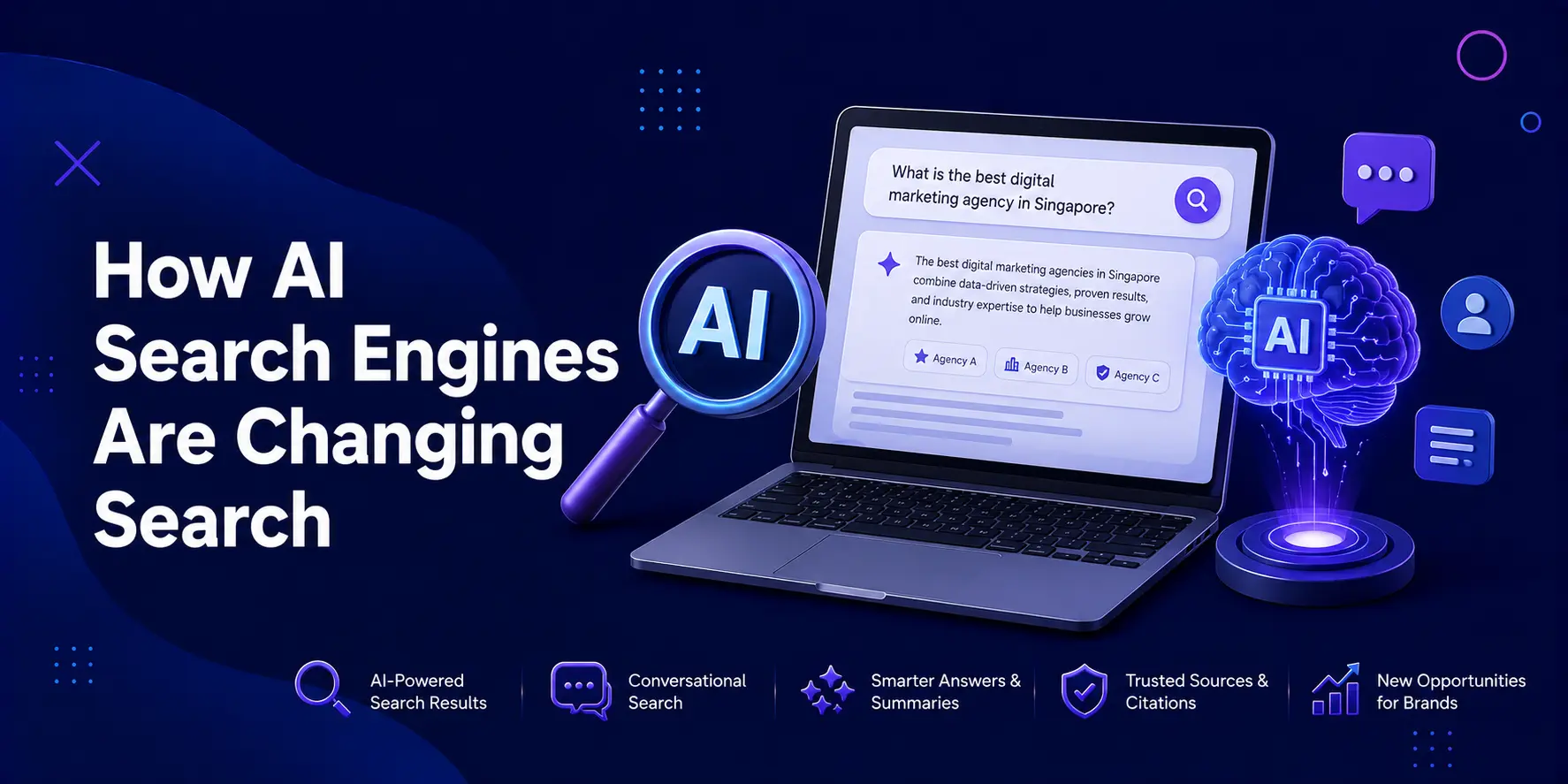

AI SEO is changing the way SEO is handled in 2026 by shifting the focus from keyword rankings to direct answers, user intent, and content that search systems can select and summarise.
This shift has pushed AI-oriented SEO into the centre of digital strategy. Businesses can no longer rely on old methods like keyword stuffing or simple link building. Instead, success depends on how well the content answers real questions and fits user intent.
This blog explains how search has changed using AI, how optimisation has evolved, and what you can do to stay visible.
Get a free digital marketing consultation from BThrust's Singapore team and find out what's holding your growth back.
Search engines no longer match exact keywords. They analyse intent, context and meaning, then select and display direct answers instead of just listing links.
Search results now often show a direct response at the top of the page. This response is built by selecting and combining information from different sources.
That changes the goal of AI and SEO, so you are not only trying to rank but also trying to be included in that answer.
To increase your chances:
If the system cannot extract a clear answer, it will skip your content.
People now search in full sentences. They ask questions the way they would ask a person.
Example:
This directly affects AI for SEO.
What works now:
If your content delays the answer, it is less likely to be used.
Search results now depend on context, not just keywords.
Systems adjust results based on:
This means one keyword does not have one fixed result.
For AI-based SEO, this leads to a clear shift:
Content that covers a topic fully is more likely to match different contexts.
In short, search engines now select content that is clear, direct, and easy to extract. If your content does not provide that, it will not be chosen, even if it is accurate.
SEO is no longer just about keywords and links. It now depends on content quality, site structure, and user interaction with your pages. In fact, AI is changing SEO by shifting the focus from simple optimisation tactics to a more holistic, user-first approach.
Search systems no longer rank pages based on one keyword. They assess how well a site covers a full topic.
AI-enabled SEO now requires:
This structure helps search systems recognise depth and authority.
Publishing more content does not improve rankings. Pages must provide clear and useful information.
Strong content should:
Generative AI SEO is effective only when content is edited and refined to add clarity and usefulness.
Search systems measure how users respond to a page.
They track:
If users leave quickly, the page loses visibility.
For SEO with generative AI, this means:
Pages that are easy to scan and understand perform better.
Search systems do not pick content at random. They select pages that are clear, direct, and easy to extract. Understanding this is key for SEO and AI.
Content must be easy to scan. This includes:
Search systems prefer content that is easy to extract and summarise.
Each section should answer a specific question. Avoid long introductions before getting to the point.
For example:
This improves your chances in GEO SEO, where systems generate responses from multiple sources.
Search systems favour sites that show consistent expertise. Key signals:
This is where AI-powered SEO becomes important. It focuses on building authority over time, not quick wins.
Content that repeats common points is often ignored.
To stand out:
Search systems prioritise content that adds new value, not content that repeats what already exists.
These shifts show one clear pattern as traffic now depends on visibility across answers, platforms, location, and intent, not just rankings.
Many users get answers without clicking any link, which reduces traffic but increases visibility. This is a key change in AI SEO because success is not only about clicks, but it’s also about:
Search now happens across:
Your strategy must include more than one channel.
Traffic no longer comes only from search result clicks. It now comes from answers, mentions, and multiple platforms.
Businesses must:
Specific queries bring better traffic. These users often have a clear intent.
Targeting long-tail queries helps:
Getting cited is now the main goal in SEO AI. Content must be clear, structured, and useful enough to be selected as a source.
Start with the answer, keep sentences short and simple. Each section should address one question.
This makes it easier for systems to extract and use your content.
Break content into sections:
This helps both users and systems.
Length alone does not improve performance, so content must provide value.
Include:
This supports AI-based SEO.
Create multiple pieces around one topic and link them together.
This signals expertise and improves visibility.
Outdated content loses value, so regular updates show relevance.
This is key in fast-changing areas like gen AI SEO and improves selection chances.
Link related pages within your site. This helps:
It also supports AI SEO tools that analyse site structure.
Overall, Search engines have developed past their basic function of showing website rankings. The search process now requires users to receive accurate answers that must appear within their specific context while maintaining user confidence.
AI SEO in Singapore exists as a permanent development that goes beyond being a short-term market trend. Digital visibility now depends on this new digital structure, which forms its essential base.
To succeed in 2026:
SEO AI will serve as an operational system that users can access through simple interfaces to perform their required tasks.
SEO through AI systems uses content optimisation to enable answer systems that understand context during their response generation process. The system concentrates on three main elements, which include user intent, content structure and clear information delivery.
Traditional SEO focused on keywords and links. SEO AI focuses on meaning, user behaviour, and content quality.
GEO SEO stands for generative engine optimisation. It focuses on getting content selected in generated answers rather than just rankings.
Focus on:
This improves your AI-powered SEO performance.
AI-oriented SEO tools can help with analysis and optimisation. However, strong content and strategy remain the most important factors.
Yes. Local search is growing. Using terms like AI SEO Singapore helps target specific audiences and improve relevance.