

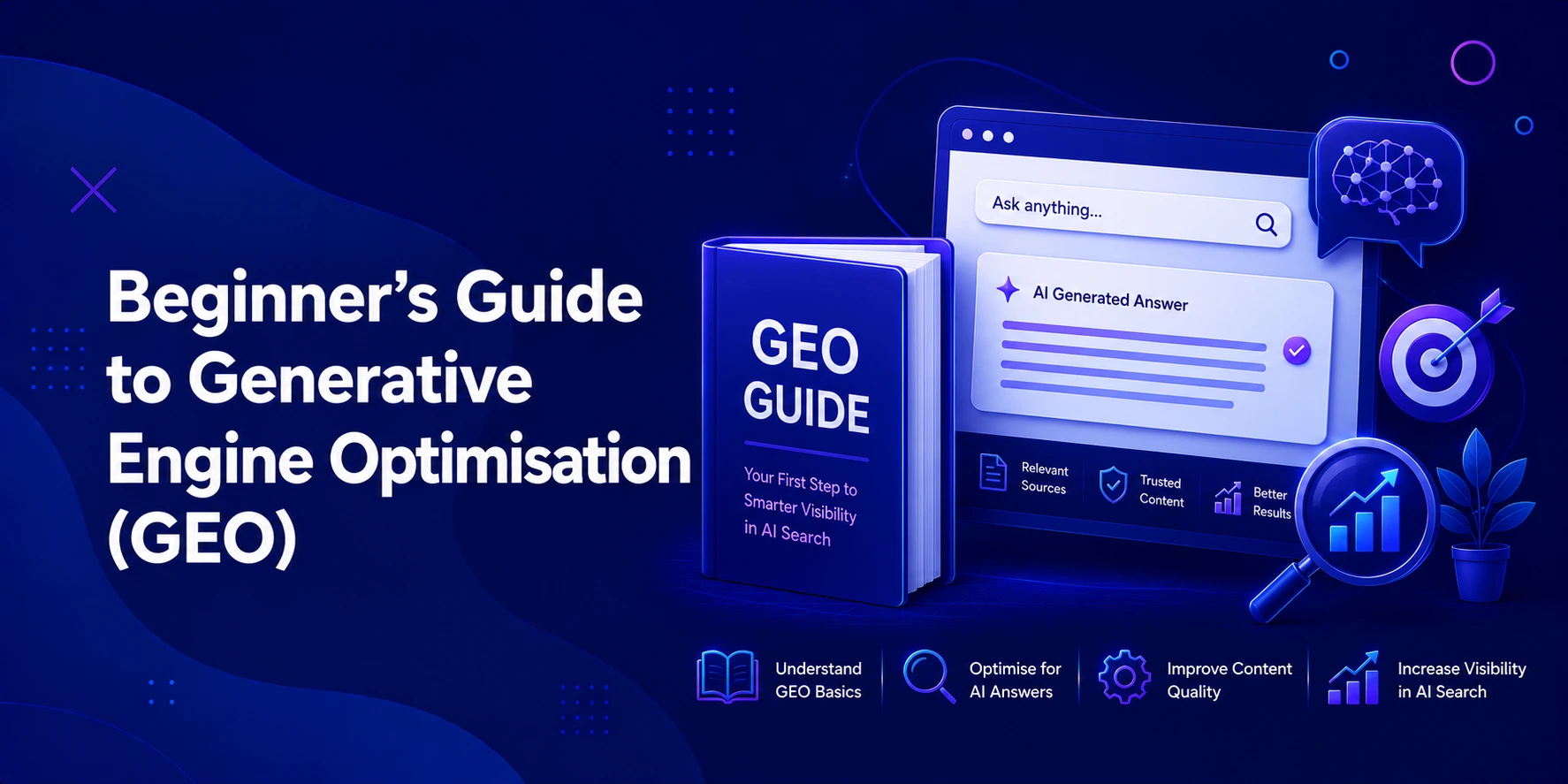
Generative Engine Optimisation (GEO) is the process of creating and structuring content so AI-powered search engines can understand, extract, and cite it in their answers. GEO helps increase your visibility in AI-generated responses by focusing on clear questions, direct answers, and well-organised content.
Search has changed. You have felt it. Instead of a list of blue links, you now see direct answers written by artificial intelligence. These answers appear on Google, Bing, and other search platforms. They pull information from across the web and give users one clear response.
This shift creates a new challenge for website owners. How do you get AI to pick your content as the source for its answers? So the answer is GEO. This guide explains what GEO is, why it matters, and how to start using it today.
Get a free digital marketing consultation from BThrust's Singapore team and find out what's holding your growth back.
Generative Engine Optimisation is the practice of shaping your content so AI search engines choose it as a source for their answers. Traditional SEO helps you rank in normal search results. But GEO helps you get cited in AI-generated responses.
Think of it this way. SEO is like trying to win a spot on the first page of a library catalogue. Meanwhile, GEO is like getting your book quoted directly by a librarian who answers every question.
AI search engines look for content that is clear, structured, and trustworthy. They prefer answers that are easy to extract and hard to misunderstand. Generative Engine Optimisation helps you meet these requirements.
GEO matters because more people now receive answers directly from AI-powered search experiences instead of clicking traditional search results. Websites that optimise for GEO have a better chance of being cited as trusted sources in these answers.
The search process through AI has moved past its experimental phase. People use this method to search for information, which occurs every day by millions of users. People receive direct answers when they ask questions. Your website visitors will not click through unless your content solves their problem by providing the information they need.
The situation creates two distinct outcomes that will affect your business operations. AI systems tend to direct users toward competitor content, which results in a loss of website traffic for your business. AI systems generate major exposure for your content when they select it as their main information source.
Traditional SEO still matters. But Generative Engine Optimisation is the next layer on top of it. You need both.
| Aspect | Traditional SEO | Generative Engine Optimisation (GEO) |
|---|---|---|
| Goal | Rank higher in search engine results pages (SERPs). | Get cited and referenced in AI-generated answers. |
| User Action | Users click a link to visit a website. | Users read an AI-generated answer and may or may not visit the source. |
| Content Format | Focuses on keywords, backlinks, meta tags, and page optimisation. | Focuses on clear questions, direct answers, structured data, and content organisation. |
| Success Metric | Search rankings, organic traffic, and click-through rates. | Citation frequency, AI visibility, and inclusion in AI-generated responses. |
The traditional SEO systems provide website rewards when they achieve higher search engine positions and build strong backlink networks.
The primary goal of Generative Engine Optimisation (GEO) requires content creators to develop AI-friendly material that enables AI systems to extract information while tracking their sources.
The best content strategy emerges from uniting these two methods to achieve maximum visibility in both search engine results and AI-based search systems.
The core principles of Answer Engine Optimisation include answering real user questions, providing direct responses, keeping answers concise, using clear headings, and supporting claims with specific facts and data.
AI search starts with a question. Your content should answer the exact questions your audience types into search boxes. Go to forums, social media, and support tickets. Find the real questions people ask. Use those exact phrases as headings in your content.
Do not guess what people want to know. Find the data and follow it.
When you answer a question, give the direct answer in the first sentence. Do not build up to it. Do not add extra words.
For example:
Weak answer: “There are several factors to consider when looking at why the sky appears blue during daylight hours, including the way light travels through the atmosphere.”
Strong answer: “The sky is blue because blue light scatters more than other colours when sunlight hits the atmosphere.”
The strong answer gives a direct answer immediately. AI can extract this with zero confusion.
AI systems extract a single answer from your content while ignoring all other information that appears on your page. Each answer must make sense on its own.
Users should create answers that contain between 40 and 60 words. The response length allows users to produce useful information which AI systems can process without problems.
Users should avoid using the phrases “as mentioned above” and “see the previous section” in their answers because these expressions do not work when answers need to stand independently.
Headings help AI understand your content hierarchy. The H2 and H3 tags function to divide questions from their related content areas.
Each question should have its own heading. The answer should sit directly under that heading. This clear pattern signals to AI that a question-answer pair exists on the page.
AI systems need answers that present particular numerical information. “About 70 percent” is better than “most of them.” “In March 2025” is better than “recently.” Specific claims give AI something concrete to cite. Vague claims get ignored.
You can start with GEO by reviewing existing content, identifying common user questions, writing concise answers, improving page structure, and updating information regularly.
Look at your current pages. Find places where you answer common questions. Add clear question headings above those answers.
Shorten your answers to 40 to 60 words. If a page has no questions and answers, add a short FAQ section at the bottom. Five to eight good questions are enough.
Search your topic on social platforms and see what people ask. These sources reveal the real language of your audience.
The best GEO SEO strategy is to write helpful content for real people. When you do that, you usually satisfy AI requirements anyway. Do not write robotic answers just to please AI. Write clear, honest, useful answers. AI will notice the quality.
Every page on your site should answer at least one clear question. The question should appear as a heading. The answer should follow immediately.
Product pages answer “What features does this product include?” Service pages answer “How does this service work?” About pages answer “Who runs this company?” When every page answers a clear question, every page becomes citation-ready for AI.
AI search engines prefer fresh information. Outdated answers get ignored. Old statistics get replaced with newer ones. Set a schedule to review your key pages every three months. Update dates, numbers, and examples. Keep your answers current.
Some people ask if GEO SEO replaces traditional SEO. It does not. They work as partners.
Traditional SEO brings people to your site through search results. Generative Engine Optimisation makes your site visible within AI answers. The best strategy uses both.
Think of it this way. GEO SEO helps you get quoted. Traditional SEO helps you get clicked. You want both.
If you are currently looking for SEO services in Singapore or anywhere else, ask your provider about adding GEO to your strategy. Many AI SEO agencies now offer GEO as a service alongside traditional optimisation.
You can do GEO yourself using the steps in this guide. But many businesses choose to work with experts.
When you look for a Generative Engine Optimisation agency, ask these questions:
A good ai seo agency in Singapore will have clear answers to these questions. They will not promise instant results. They will talk about structure, clarity, and user intent.
Many providers of AI SEO in Singapore now include GEO in their packages. The same is true in other markets. Look for agencies that already understand AI search behaviour.
If you are searching for Artificial Intelligence Search Engine Optimisation help, ask specifically about their GEO process. Not every agency has made the shift.
Common GEO mistakes include writing long answers, hiding content, using promotional language, and failing to keep information updated.
Long answers get cut off or ignored. Keep your answers between 40 and 60 words. Say what needs to be said and stop.
Some designers put answers inside expandable boxes or tabs. AI cannot always see this content. Put your answers in plain view on the page.
AI does not trust marketing fluff. “We are the best” gets ignored. “Our software includes three security layers” gets cited. Be factual, not boastful.
An answer written in 2023 might be wrong in 2025. AI will find a newer source. Keep your content fresh.
AI search will keep growing. More platforms will add AI answers. More users will trust them.
AI search optimisation will become a standard part of content strategy. It will sit alongside SEO, not replace it. The websites that start now will have a head start.
The good news is that GEO rewards good content. If you already write clear, helpful answers for your customers, you are halfway there. Add the structure and headings. Keep your answers short and direct. Update your facts regularly.
That is Search generative optimisation in a nutshell. No tricks. No shortcuts. Just clear content that helps people and machines understand each other.
Search has moved from links to answers. Generative Engine Optimisation helps you become the source behind those answers. So,
You do not need to be a technical expert. You do not need expensive software. Also, you need to write clearly and structure your content well.
Begin today. Pick one page on your site. Add a question heading. Write a 50-word answer below it. That is your first step into the world of GEO.