
Maximizing Your Reach: The Ultimate Guide to Optimal Instagram Post Timing

When to post on Instagram could very much determine how much engagement you are going to get. It is not just about the likes but ensuring that this content does get to the right people at the right time. This ensures that the people most likely to see your posts are actually the audience themselves since they mostly scroll their feeds. In this way, due to the interaction involved, there would be a likelihood of visibility based on the Instagram algorithm of popular posts. Being a top SEO agency in Singapore, we are aware that the key to optimising your online visibility is careful scheduling.

How Instagram’s Algorithm Is Impacting Post Reach in Singapore

The Instagram algorithm can seem mysterious, but it follows several clear principles. The Instagram algorithm ranks the post by a user higher based on how much interest it believes the user will take in its content and how recent the post is, both taken from previous interactions. This simply means that if your post is recent and has some sort of human interaction, then it is certainly going to show up in your followers’ feeds.

To this extent, the knowledge of when your audience is online has a very high importance. If one knows the times and posts with relevance to those peak times in the schedule of their audience, then right after the time of posting, you are likely to have a better shot at engagement, being key to visibility. As a digital marketing agency in Singapore, we have personally witnessed how a brand’s exposure may be increased by coordinating with these ideal times.

Decoding the Best Days and Times to Post for Maximum Visibility in Singapore

The best times to post on Instagram can be really wide and varied, but some patterns do emerge from aggregate engagement data. For instance, Singapore followers are usually most active during midday hours and late evenings on weekdays.

For example, posting between 12 pm and 1 pm on any weekday would be effective in catching users through their lunch break, while early evenings around 9 pm are equally opportune since most people relax while catching up on social media.

On the weekends, it’s slightly different. Saturday and Sunday mornings, in fact, have poor activity but pick up from 2 PM to 3 PM. These are points that would need testing, as they could change depending on the specific behaviour of your audience.

Digital marketing agency in Singapore usually follow this given timeline for posting on Instagram depending on different industries:

Industry Weekday Posting Times Weekend Posting Times
Travel and Tourism 10 am-12 pm, 7 pm-9 pm 9 am-11 am, 4 pm-6 pm
Fashion and Apparel 12 pm-2 pm, 7 pm-9 pm 9 am-11 am, 5 pm-7 pm
Fitness and Wellness 6 am-8 am, 5 pm-7 pm 8 am-10 am, 4 pm-6 pm
Food and Beverage 12 pm-2 pm 5 pm-7 pm

Tailoring Your Instagram Strategy to the Unique Behaviours of the Singapore Audience

These local trends and elements of the culture you understand will be able to underpin your Instagram strategy. It means that you will have access to a huge base that generally seems to be easily connected. These trends and cultural elements of the locals will play a huge role in underlying your Instagram strategy.

The unique digital audience from Singapore could be easily connected, engaging in content mostly contextualized towards local elements. For example, deeper involvement of your audience could be found with local festivals, public holidays, or even current events.

Also, consider the commuting behaviour. Most of them are on their phones during public transport. Posting in the morning and evening commutes might also have higher chances of engagement. Similarly, Crafting posts tied into local lunchtime specials or after work hours could catch users at exactly the moment they would be most likely to be online.

Strategies to Enhance Engagement Through Well-Timed Posts

Try to develop a posting schedule that coincides with when your audience is most active on Instagram. For instance, if data indicates that most of your followers are likely to engage at noon, scheduling posts around that time should most likely increase the visibility of your content. Also, running polls or asking questions within your posts is a good way to encourage interaction at these times.

The other effective measure is making use of Instagram content formats. This is where your posts, stories, reels, and live videos come in handy—just to ensure that content keeps flowing in fresh and engaging.

Diversify the content type to match the various user behaviours exhibited throughout the day. For instance, stories can be great for quick updates, while longer posts can be the best performing in the evening when users have more time to engage.

Here is a post-timing chart used by the SEO agency in Singapore for better user engagement:

Day Time Best Times to Post
Monday 9 am-10 am Capitalize on the start of the workweek.
Tuesday 9 am-10 am Engage the productive mindset.
Wednesday 5 am, 11 am, 3 pm A trifecta of posting opportunities.
Thursday 12 pm, 5 pm Lunchtime and pre-end-of-day moments.
Friday 9 am-10 am, 5 pm-6 pm Provide distractions as the weekend nears.
Saturday 8 am-12 pm Tap into Saturday morning scrolling.
Sunday 10 am-2 pm Capture relaxed morning routines or busy personal times.

Leveraging Analytics to Fine-Tune Your Posting Schedule

Instagram has powerful ways, for example, Instagram Insights, that help to get more closely acquainted with your followers. This will not only show who those following you are but also give you an insight into when your followers are most active on the platform. You can turn that into practice by reviewing such analytics regularly to come up with better posting times for good engagement.

Or get more specific—track the post-performance and look for patterns among various time frames and days. Ultimately, it’s a data-driven strategy that will empower you to proactively adjust the content calendar based on what will likely resonate most with the audience.

Adapting Your Content Strategy Based on Performance Metrics

Pay very close attention to the number of engagements—likes, comments, and shares—then let these metrics tell you which content decisions to make. For instance, if most comments usually roll in on posts at 8 pm, then you want to post more interactive or discussion-worthy content at this time.

Also, play around with different types of content to see which one works best for you and your users. This may be changing up the forms of existing posts or adding new ones that are in line with the interests of your readers as determined by analytics.

Tips for Maintaining an Active and Engaging Instagram Presence

To have an interesting Instagram presence, consistency is essential. Come up with a content calendar that will have you post after every ‘x’ day. That still allows you some flexibility if, say, there are some current events or trending topics you want to react to. This balance will make your feed dynamic and relevant, thus maintaining user interest and engagement.

At the same time, it is extremely important to establish direct interaction with followers: answer their comments, be an active interlocutor in discussions, and sometimes be the pioneer of dialogue with the help of direct messages. Direct contacts will help your brand not only increase the level of interaction but also create a community.

Finally, follow up with changes in features and best practices affected by Instagram. Finally, you would want to keep a look at all the changes and updates to features and best practices done by Instagram. It is, therefore, good to employ features as they come into the platform algorithm changes and the introduction of new ones into your strategies. Staying abreast of these changes will help your strategy stay effective and keep your engagement rates from plummeting.


Core Update of March 2024: Why It is Important for SEO Agencies in Singapore?

The digital front never remains constant, and the Google Core Update of March 2024 brings with it very pivotal changes in the journey. Algorithm modifications have been made in this release to enhance search result quality and lessen spam.

Based on the increased quality of results in searches, this update has carried forward the significance of valuable content and ethical practices of SEO. Thus, it becomes very essential for SEO agencies in Singapore and everywhere around the globe to understand how the new update functions, so they can guide their strategies accordingly.

The March 2024 Update: A Leap Towards Better Search Quality

2024’s first core update is not only an ordinary adjustment. This represents a much more nuanced evolution in the search giant’s long-running effort to prefer content that really serves the user’s intent.

Google, with this update, hopes to filter out the content that appears to be designed mostly for drawing clicks and lacks a mission to inform or help the users. This puts an even greater emphasis on quality and relevance as an imperative for creators in their content strategy.

New Spam Policies: Setting New Standards

With the March 2024 update, Google introduces new spam policies targeting three key areas:

  1. Expired Domain Abuse: This is when one buys an expired domain and hosts it from its past reputation of hosting low-quality content. Actually, this is one of the trickiest methods to reduce the search result credibility.
  2. Scaled content abuse: Here, it is the mass creation of contents that add minimum value, usually completed through automation with low efforts of human input. This is a policy to discourage flooding search results with such content.
  3. Site Reputation Abuse: This takes place when high reputation sites host third-party content of low quality, which tends to mislead the user and at the same time, exploit the standing of the site in search rankings.

Google also stands for the commitment that the search results are maintained with integrity and the best practices that creators and SEOs ought to follow to remain within the norms.

Impact on SEO Strategies

For an SEO Agency, these changes signal a shift towards more authentic and user-focused content creation. In other words, it brings back the concept of quality against quantity but still insists that they reposition their strategies in content-based arguments. Agencies are now in a position whereby they have to do an audit of practices, and that should conform to the updated Google guidelines that focus on giving content that serves user needs.

One of the big changes within 2024’s first core update is a change to the link signal within the Google ranking algorithm. Up to now, links have been one of the main determining factors in a good SEO strategy. A little change is coming with this update. Let’s unpack that.

Deemphasizing links: Google now treats links merely as one signal among many in their new approach to grading page quality. This change should be taken to mean a new, more comprehensive approach to grading page quality and will help to get out from the rudimentary misinterpretation of links being the only scorecard for a page’s value.

Content and links: This update presents a new dimension for content that is created and maintained for link manipulation. It is likely to penalize low-quality content that is mostly derived from making, and which has been manufactured to deceive linking and ranking signals. This is supposed to discourage acts such as PBN (Private Blog Network) link-building.

Outbound Links: Google has directly referred to its emphasis on manipulative outbound links for the first time. These may include any links, which are intended to manipulate rankings from or to a site.

Repurposed expired domains: The update also brings with it a new signal for targeting the abuse of repurposed expired domains. This will help ensure that repurposed domains don’t unfairly benefit from their history in having signals carrying over from their prior content.

These changes to the link signal reflect the evolving approach of Google to understand and value web content. That being said, the lasting improvement of SEO agencies would be to find and adapt strategies in a way that would prioritize their relevant content and not from traditional, unnecessary, and risky link-building tactics. It’s a wake-up call for everyone to think broader in terms of SEO—that is, if sustainable success in search rankings is going to be actualized, on issues of user experience and content quality.

The Significance of Content Quality in the March 2024 Update

2024’s first core update, placing more weight on the quality of content, has seen a big move to rewarding really helpful and original pieces. What the moves send is a very loud and clear message to both SEO agencies and content creators that the bar of the value that the content adds is being raised. Here is what this means for your SEO strategy.

Prioritizing High-Quality Content

Google anticipates a 40% decrease in low-quality, unoriginal material in search results when this upgrade is combined with its earlier initiatives. The update targets the elimination of an appreciable proportion of low-quality, unoriginal content from the search results. This is in line with Google’s motive to put more focus on the users’ experience and help searchers have access to the most relevant and useful information. For that reason, SEO agencies:

  • Focusing on creating content that addresses the needs and questions of the audience.
  • Moving away from keyword stuffing and instead, integrating keywords naturally within valuable content.
  • Ensuring that all content provides a unique perspective or valuable information not readily available elsewhere.

Enhancing User Experience

Now, understand that Google’s refined ranking systems are better able to assess if web pages might not be as helpful or impact the overall user experience positively. It indicates SEO agencies should adhere to the guidance that:

  • Improve website navigation and accessibility.
  • Optimize page loading speeds.
  • Ensure mobile responsiveness.

The Role of SEO Agencies in Adapting to the Google Core Update

The Google Core Update, March 2024, is part of something new, which still creates new ordeal for SEO agencies in what strategy is concerned. Now, they have to align with the new and improved Google criteria for quality and relevance of content. For example, consider the following SEO professional guides:

Audit and Adjust SEO Strategies

  • Conduct thorough audits of existing content to identify areas for improvement.
  • Adjust content strategies to focus more on quality and relevance to the user’s search intent.
  • Re-evaluate the use of keywords to ensure they contribute to the natural flow of the content.

Embrace Ethical SEO Practices

  • Move away from manipulative link-building tactics and instead, focus on earning links through high-quality content.
  • Avoid practices targeted for taking advantage of weaknesses within algorithms and instead focus on building a good foundation of content and user experience.

Understanding the Extended Rollout Period and Its Implications

This will come with a new phased rollout process, expected to be global, and to take several weeks. Such a process allows the gradual implementation of changes across the global search infrastructure to ensure a smooth transition for users and webmasters.

To properly navigate the change, SEO companies and their customers must comprehend this rollout time and its repercussions.

Navigating Ranking Fluctuations

If the websites are displaying search ranking fluctuations during the roll-out, then it is quite natural for Google to update the website because it is the normal shifting process that the algorithms shift over to the new criteria. SEO agencies should:

  • Monitor client websites closely for changes in search rankings and traffic patterns.
  • Keep in contact with your clients on how they will get to see the changes and be assured that such variations are a normal thing within the period of change updating.

Adapting to the Update

A phased rollout of Google Core Update, then, would allow SEO agencies to change their strategies in real-time, as the update progresses, agencies may:

  • Increase attention to user experience on one website after another, making it an ever-more important
  • Analyse early impacts of the update on various sectors and adjust strategies accordingly.
  • Identify trends and insights from the initial phases of the rollout to better align with the updated algorithm.

Continuous Improvement

Use the extended rollout period too. In summary, underscores the importance of constant review and update of SEO strategies in a never-ending attempt at perfection. Agencies should make maximum use of this time to

  • Refine content quality and relevance based on initial observations of the update’s impact.
  • Explore new opportunities for enhancing user experience and site performance.

Preparing for Compliance: Tips for SEO Agencies in Singapore

The compliance deadlines of these newly adapted policies are just around the corner, and this is all the more reason that any SEO Company in Singapore needs to make sure their strategies fall in line with the new set of guidelines. Here’s what they should brace themselves for:

Understand the New Spam Policies

  • Get familiar with what new spam policies detail: abuse of expired domains, scaled content abuse, and site reputation abuse.
  • Review your current practices and content to ensure they do not fall into these categories.

Focus on Content Value

  • Evaluate your content creation processes to prioritize the delivery of real value to your audience.
  • Show clients why they should care, in the first place, about investing in original research or in-depth guides and content that helps answer their specific users’ needs and questions.

Enhance Site Reputation

  • Work with clients to improve the oversight and quality of third-party content published on their sites.
  • This should guarantee that the value of the content for your site’s audience, either sponsored or partner, was in no way targeted only at search rank manipulation.

Monitor and Adapt to Changes

  • Keep a close eye on the impact of 2024’s first core update on your clients’ site rankings and traffic.
  • Be ready to adapt strategies based on the outcomes of the update and ongoing guidance from Google.

Educate Your Team and Clients

  • Keep your team well-informed about the new updates and assure them of the need to comply with Google’s guidelines.
  • Educate clients about the significance of the update and how it affects their content and SEO strategies.

In doing so, the SEO agencies in Singapore would have put themselves not only in a good place to comply with the March 2024 Google Core Update but also with their clients, very important to succeed in this continuously evolving digital environment.

With an emphasis on high-quality and valuable content, and ethical SEO practices, its resonance with guidelines from Google would be better, and it will improve the brand’s online presence stronger and further reach.

Conclusion

Google said that 2024’s first core update is the epitome of unbridled promise to improve search quality content and requirements by prioritizing high-quality, useful content. This will be a great update to most of the SEO agencies both in and outside of Singapore. It will force them to go back into their strategies and redefine them so that they meet the increased focus that Google gives to the content value and users’ satisfaction. In that way, the agencies are better placed to offer service to the client based on ensuring they realize sustainability in a setting that is highly dynamic in the digital sector.

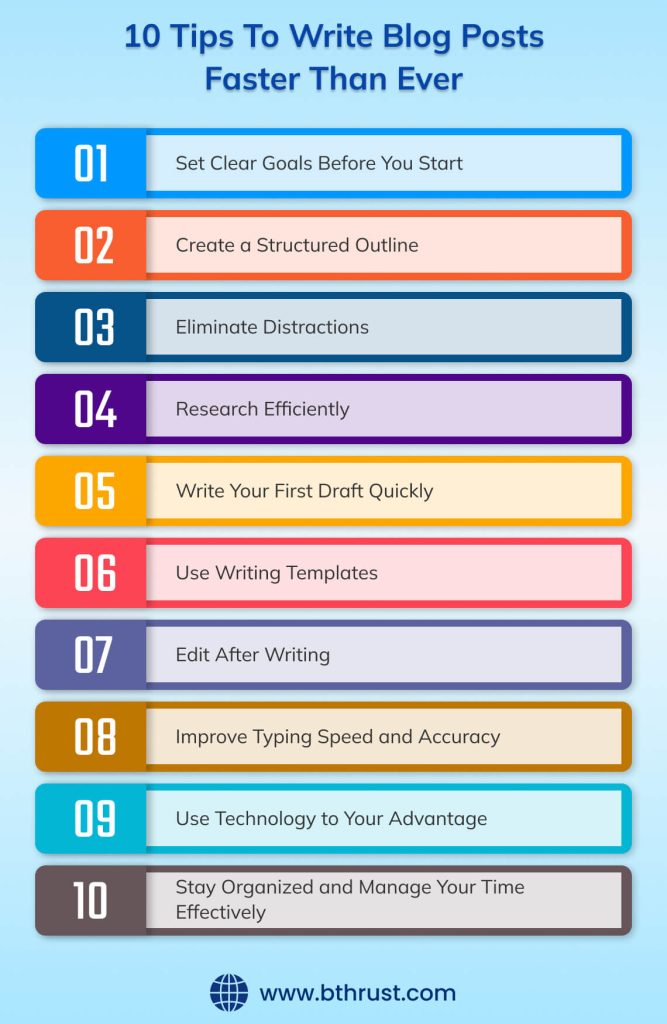
10 Tips To Write Blog Posts Faster Than Ever

The digital era has started in a landscape in which content is king, making the ability to provide outstanding blog posts at a fast pace a valuable ability for bloggers and content creators alike. With the ever-growing demand for fresh, attractive content material, the project often lies not just in generating ideas but in execution—turning the ideas into properly crafted articles successfully.

The essence of blogging successfully in this fast-paced environment hinges on optimizing the writing technique without compromising the best of the content. This guide is designed to offer actionable recommendations and techniques that will help you write blog posts faster than ever before.

By streamlining research, drafting, and editing methods, and leveraging era to your advantage, you could substantially lessen the time it takes to go from concept to book. Whether you are a seasoned blogger looking to enhance your productivity or a newcomer eager to make your mark in the blogging world, mastering the artwork of quick and powerful writing is essential for staying applicable and engaging to your audience in the competitive digital content space, a priority shared by Digital Marketing Agency in Singapore.

Blog writing tips

1. Set Clear Goals Before You Start

Before you even type the first phase of your blog post, it’s essential to have clear expertise of what you aim to achieve. Setting clear goals for each piece of content not only provides direction but also significantly accelerates the writing procedure. Begin by defining the purpose of your post.

Ask yourself, “What do I want my readers to dispose of from this?” Whether it is to inform, persuade, entertain, or a combination of these, having a clean reason in mind from the outset will guide your writing. Equally important is outlining your audience.

Understanding who you’re writing for allows you to tailor your language, tone, and content material to satisfy their needs and interests, making the writing system more trustworthy and targeted. How to write blog posts faster involves not just quick typing but also a deep understanding of your objectives and audience, streamlining the process from conception to completion.

2. Create a Structured Outline

Transitioning smoothly into the writing segment, the creation of a based definition can not be overstated in its significance. A definition serves as a roadmap for your weblog post, outlining what you plan to cover and in what order.

This step can dramatically lessen writing time by preventing you from veering off-subject matter and supporting you prepare your mind cohesively. Start by using jotting down the primary points you need to cover, then enlarge each point with subtopics or thoughts that aid it.

3. Eliminate Distractions

In the ultra-modern virtual age, distractions are handiest a click away. Therefore, developing distraction-loose surroundings is critical for fast writing. Begin by way of identifying your primary resources of distraction—be it social media, emails, or noisy environments—and take proactive steps to cast off or decrease them.

Tools that include internet site blockers can help hold you focused on writing while noise-cancelling headphones can be a boon in noisy environments. Moreover, putting aside unique times for writing whilst you’re least likely to be disturbed can substantially enhance your productivity.

4. Research Efficiently

Efficient research is foundational to writing blog posts quickly. Spending hours aimlessly surfing the net for records may be a main time sink. Instead, approach studies with a method. Start with a listing of specific questions or key factors you want information on and use these to manual your seek.

Bookmarking reliable assets and organizing your findings as you move can prevent a splendid quantity of time later. Furthermore, leveraging equipment and structures that aggregate facts from various sources can streamline your research technique.

5. Write Your First Draft Quickly

Once your studies are entire, it’s time to start writing. The key to writing your first draft quickly is to allow cross of the urge to edit as you write. Focus on getting your ideas down on paper, but hard they will be.

This section is not approximately perfection; it is about progress. Writing without self-modifying permits your thoughts to float greater freely, considerably dashing up the writing technique. Embrace the truth that your first draft is simply that—a draft.

It would not need to be best or maybe desirable. The crucial component is to capture your thoughts and thoughts. You’ll have the possibility to refine and polish your paintings at some stage in the enhancing segment.

6. Use Writing Templates

One of the simplest approaches to hurry up your weblog writing is by making use of writing templates. Templates serve as a pre-described shape on your posts, permitting you to quickly plug in statistics while not having to begin from scratch each time.

This method is especially useful for keeping consistency across your content, mainly in case you’re handling a blog with multiple routine issues or codecs. To make the maximum out of templates, start by identifying the varieties of posts you write maximum often, consisting of how-to courses, listicles, or opinion portions.

7. Edit After Writing

A commonplace pitfall in the writing technique is the temptation to edit whilst you write. This habit can considerably sluggish down your progress, as it shifts your recognition from creation to correction.

To write blog posts faster, it’s essential to separate those two methods. Once your first draft is complete, take a smash earlier than returning to your work with fresh eyes for the modifying segment.

Editing after writing permits you to peer at the larger photograph and make greater effective revisions. Use this time to refine your language, shape, and drift, making sure your post is coherent and attractive.

8. Improve Typing Speed and Accuracy

Your typing speed and accuracy directly affect how fast you can remodel your thoughts into written content. Improving those capabilities can notably lessen the time it takes to jot down a blog post. Regular practice with those sources can lead to important enhancements for your writing efficiency.

Moreover, turning into talented keyboard shortcuts can save you a considerable amount of time ultimately. Learning shortcuts for paste, undo, and other commonplace movements can streamline your writing system, permitting you to cognizance more of a content material introduction than on navigating software programs.

9. Use Technology to Your Advantage

In the modern virtual age, a plethora of tools and software programs are available to help bloggers in every aspect of the writing process. From concept generation and research to writing and enhancing, leveraging era can provide a tremendous rise in your productivity.

Writing software programs with functions like distraction-free modes, automatic saving, and cloud-based backups can decorate your writing experience. Additionally, voice-to-text software programs can be a game-changer for individuals who choose to speak their minds in place of typing.

10. Stay Organized and Manage Your Time Effectively

Finally, powerful organization and time control are key to writing weblog posts more quickly. Develop a content calendar to plot your posts, allowing you to think ahead approximately topics, research, and writing.

This foresight can prevent final-minute rushes and ensure a regular glide of content material. Allocating unique blocks of time for writing, getting to know, and modifying also can decorate your productiveness.

By dedicating centered intervals to each task, you could limit distractions and preserve a high degree of efficiency. Remember, consistency is important; regular writing now not handiest improves your ability but also hastens your typical system.

In the end, by way of imposing these techniques—from using writing templates and editing after writing to improving typing competencies, leveraging era, and handling a while efficaciously—you can significantly reduce the time it takes to write a blog.

Each step is designed to optimize a specific element of the writing technique, ensuring that you can produce exceptional content faster and more effectively. Remember, the purpose is not just to put in writing faster but to streamline your workflow in a manner that maintains, or even enhances, the high quality of your blog posts.

With exercise and dedication, these recommendations turn into a necessary part of your blogging habit, permitting you to keep up with the demands of the virtual content panorama.

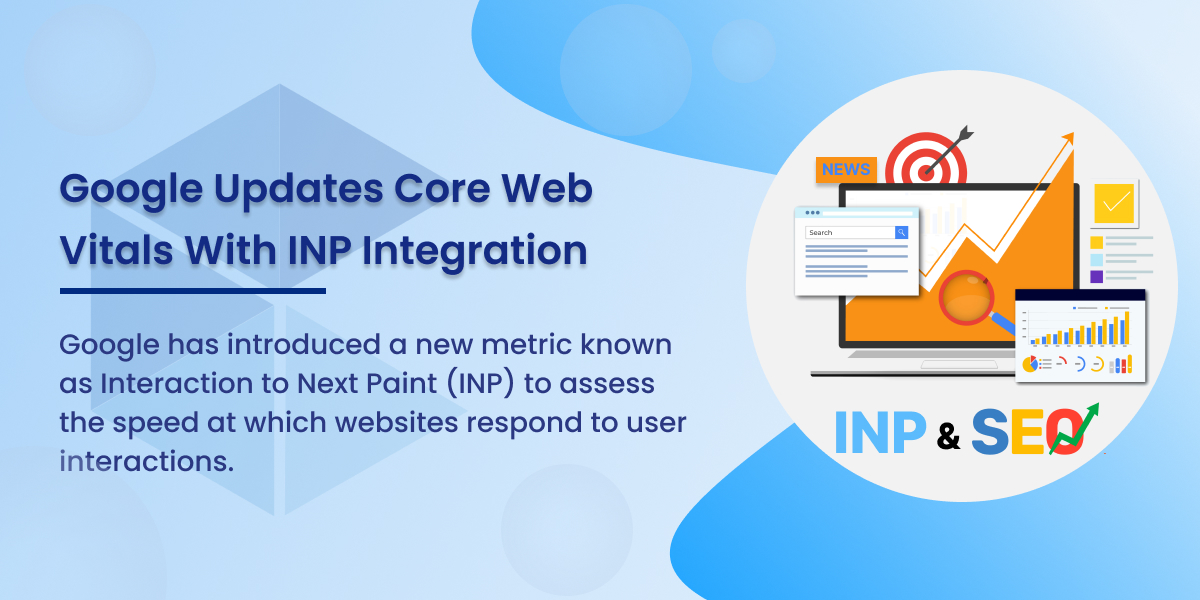
Enhancing User Experience: Google Updates Core Web Vitals With INP Integration On March 12th

The digital landscape is constantly evolving, with people enjoying the vanguard of this variation. Google’s Core Web Vitals have become a pivotal benchmark for assessing internet site performance, immediately influencing search engine rankings and personal pride.

Recognizing the crucial function of net usability and accessibility, Google introduced an enormous update: the mixing of Interaction to Next Paint (INP) into Core Web Vitals, scheduled for March 12th.

This addition marks a massive shift toward enhancing the responsiveness of web interactions, underscoring the importance of an unbroken person. As websites strive to satisfy the increasing expectancies of customers, the inclusion of INP gives a greater comprehensive framework for comparing and improving website performance.

This replacement not handiest highlights Google’s commitment to fostering an intuitive and efficient online environment but also challenges internet developers and placement owners to optimize their structures for this new metric.

The integration of INP into Core Web Vitals is poised to redefine the standards of net usability, making it an essential consideration for each person seeking to excel inside the virtual space.

Introduction to Google’s Core Web Vitals

At the heart of seamless online experience lies the performance of an internet site, an element that Google has prioritized through its Core Web Vitals initiative. These metrics function as a quantifiable measure of a site’s fitness, without delay influencing its rating on search engine effects pages.

Historically, Core Web Vitals have targeted three important aspects: loading overall performance, interactivity, and visible balance. Each of these components performs a crucial function in figuring out how customers understand and interact with a website, making them crucial for site owners to screen and enhance.

With the virtual arena becoming increasingly aggressive, the need for websites to supply a top-notch person has never been greater important. Users these days expect rapid, responsive, and stable interactions on every occasion they go to a website.

Recognizing this, Google’s introduction of INP as a new metric within Core Web Vitals underscores the tech giant’s dedication to improving web usability by providing a more comprehensive framework for evaluating consumer experience.

What are Core Web Vitals?

Core Web Vitals are a hard and fast of unique factors that Google considers crucial in a webpage’s overall consumer revel. These metrics are part of Google’s broader Web Vitals initiative, designed to offer unified steerage for first-class signals that are crucial to handing over a splendid internet enjoyment.

Before the combination of INP, Core Web Vitals comprised three foremost metrics: Largest Contentful Paint (LCP), which measures loading overall performance; First Input Delay (FID), which assesses interactivity; and Cumulative Layout Shift (CLS), which evaluates visible balance.

Each metric gives a unique insight into special facets of the person’s experience, allowing builders to pinpoint regions for improvement. For instance, LCP enables making certain that the principal content of a page masses quickly, FID measures the time it takes for a page to become interactive, and CLS quantifies how regularly customers enjoy unexpected layout shifts.

Together, these metrics shape a foundation for optimizing websites to satisfy consumer expectancies for pace, responsiveness, and stability.

Impact of INP Integration on Core Web Vitals

Core Web Vitals

The integration of Interaction to Next Paint (INP) into Google’s Core Web Vitals is a game-changer for net builders and site owners alike. This update not only expands the scope of web performance metrics but also emphasizes the significance of interactive responsiveness in supplying a superior user revel.

With INP, the point of interest shifts toward ensuring that web interactions are as seamless and green as feasible, highlighting the essential role of responsiveness within the usual health of an internet site.

Moreover, the addition of INP underscores the evolving nature of internet usability requirements. As websites become greater complex and user expectancies upward push, the metrics used to evaluate them should additionally adapt.

INP addresses this by providing a more granular perception of how consumer interactions affect perceived performance. Consequently, web developers now have a greater complete toolkit at their disposal to diagnose and enhance their sites, ensuring they meet the high requirements of the contemporary internet environment.

Preparing for the INP Integration

For internet builders, the creation of INP gives a unique set of challenges and possibilities. To optimize for INP, it is crucial to recognize the elements that have an impact on this metric and put in force techniques to decrease interaction delays.

This includes optimizing JavaScript execution, reducing render-blocking off sources, and leveraging modern net technologies to decorate responsiveness. Fortunately, Google affords a wealth of tools and assets to help in this endeavor.

Tools like Lighthouse, PageSpeed Insights, and Chrome DevTools provide actionable insights and recommendations for enhancing INP ratings. By utilizing those gear, developers can pick out bottlenecks and put into effect optimizations that immediately affect the responsiveness of their websites.

Additionally, embracing satisfactory practices for net improvement is more crucial than ever. This consists of code splitting, lazy loading, and prioritizing critical resources, all of which can notably improve interaction readiness.

By focusing on these regions, builders can make sure their websites aren’t handiest rapid and visually stable but also highly responsive to personal inputs, thereby enhancing the general user’s enjoyment.

How INP Integration Enhances User Experience

The ultimate aim of integrating INP into Core Web Vitals is to raise the consumer revel on the internet. By prioritizing interplay responsiveness, Google recognizes the crucial position that well-timed feedback performs in consumer delight.

An internet site that responds rapidly to user inputs feels extra intuitive and tasty, leading to elevated user pleasure and retention. Furthermore, the focus on INP highlights the interconnectedness of overall performance metrics and consumer experience.

A website that excels in loading velocity and visible stability but falls quickly in responsiveness can nonetheless frustrate customers. Therefore, INP serves as a reminder that a holistic technique for internet performance is vital to truly satisfy consumer expectancies.

By striving to excel in all components of Core Web Vitals, along with INP, developers can create websites that are now not the most effective and rank properly in search engines like Google but additionally satisfy customers with their performance and responsiveness.

In the end, the mixing of INP into Core Web Vitals represents an extensive breakthrough in Google’s efforts to decorate internet usability. By focusing on the responsiveness of web interactions, this update offers builders with greater nuanced information about what constitutes a first-rate user revel in.

As the digital panorama continues to evolve, staying abreast of those changes and optimizing for metrics like INP will be essential for everyone trying to succeed within the aggressive world of online content.

With the proper equipment and techniques, enhancing INP scores is within reach, imparting a clear pathway to growing more engaging, responsive, and person-friendly websites.

Understanding The Digital Transformation Of Marketing

The digital transformation of marketing has emerged as an essential evolution in the way businesses interact with their target audience and market their products or services. This transformation transcends the mere adoption of the latest technologies, it represents an essential shift in advertising strategies to align with the hastily converting digital landscape.

As consumer behaviors and possibilities increasingly circulate online, the significance of digital advertising and marketing has never been greater said. Businesses throughout industries are compelled to reimagine their advertising and marketing approaches, ensuring they’re no longer simplest applicable but also aggressive in this digital era.

The shift toward digital structures offers exceptional opportunities for focused engagement, analytics-pushed techniques, and customized purchaser experiences. However, it also gives unique challenges, such as the want for non-stop mastering and modeling of new digital gear and trends.

Understanding and navigating the digital transformation of marketing is important for businesses aiming to thrive in cutting-edge digital-centric global, making it a pivotal aspect of cutting-edge marketing techniques.

Evolution of Marketing in the Digital Age

The adventure from conventional to digital marketing has been innovative and evolutionary. Initially, marketing efforts were largely limited to print advertisements, TV advertisements, and billboards. However, the appearance of the internet and digital technologies ushered in a new generation.

This transition was not abrupt however a slow shift that noticed the combination of digital tools and systems into advertising strategies. Key technological improvements, along with the proliferation of the net, the rise of social media, and the appearance of fact’s analytics, have been riding forces behind this transformation.

These technologies have now not only improved the reach of advertising campaigns but also better the ability to customize and degree their effectiveness.

Moreover, the digital age has introduced a -manner of communication channels between organizations and clients, fostering extra interactive and engaging courting. This paradigm shift has necessitated a reevaluation of marketing strategies to leverage those new systems for brand advertising, purchaser engagement, and market research.

Core Components of Digital Marketing Transformation

Digital transformation marketing

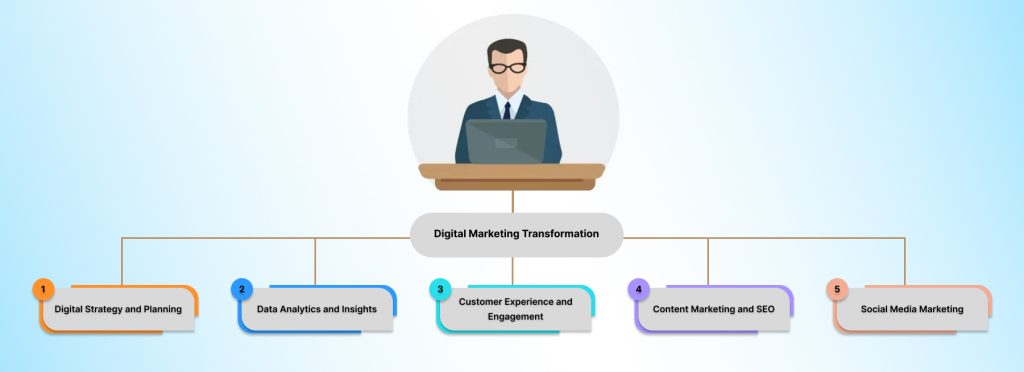
The digital transformation of advertising encompasses numerous middle additives, each playing a vital role in shaping the effective digital advertising and marketing strategy of digital marketing agency in Singapore.

Digital Strategy and Planning: At the heart of digital transformation is the improvement of a complete digital approach. This involves setting clear goals, understanding the audience, and deciding on the proper blend of digital channels to engage them. Planning additionally includes budget allocation and timeline putting to ensure the green execution of digital campaigns.

Data Analytics and Insights: Data is the lifeblood of digital advertising and marketing. Through fact’s analytics, agencies can gain insights into patron behavior, choices, and trends. This record is invaluable for making knowledgeable decisions, tailoring advertising messages, and optimizing campaigns for higher overall performance.

Customer Experience and Engagement: Digital transformation locations have a sturdy emphasis on improving the client’s revel. This involves creating personalized and seamless interactions across all digital touchpoints. Engaging content, responsive layout, and interactive capabilities are key to charming the target market and fostering loyalty.

Content Marketing and SEO: High-quality, relevant content is critical for attracting and retaining clients. Coupled with search engine optimization (search engine optimization), content advertising and marketing help grow visibility in search engine results, using natural traffic to websites. This strategy is crucial for building brand authority and trust.

Social Media Marketing: Social media systems offer unparalleled possibilities for emblem publicity and customer engagement. Effective social media advertising and marketing involves creating compelling content material, enticing the target audience, and leveraging social media advertising and marketing to attain a wider target market.

The Role of Technology in Marketing Transformation

Technology is the riding force behind the digital transformation of advertising. Automation and synthetic intelligence (AI) are revolutionizing advertising with the aid of streamlining operations, personalizing purchaser interactions, and presenting predictive insights. For example, chatbots can cope with customer inquiries in actual time, while AI-pushed analytics can predict patron behavior and options.

The impact of big statistics and analytics can not be overstated. By harnessing considerable quantities of statistics, businesses can discover patterns and insights that tell strategic decisions.

This records-driven approach allows entrepreneurs to tailor their campaigns to the specific needs and interests of their audience, enhancing the effectiveness of their advertising efforts. Social media systems have converted the landscape of digital advertising and marketing by supplying agencies with powerful tools to attain and interact with their target audience.

Challenges and Solutions in Digital Marketing Transformation

Marketing challenges solutions

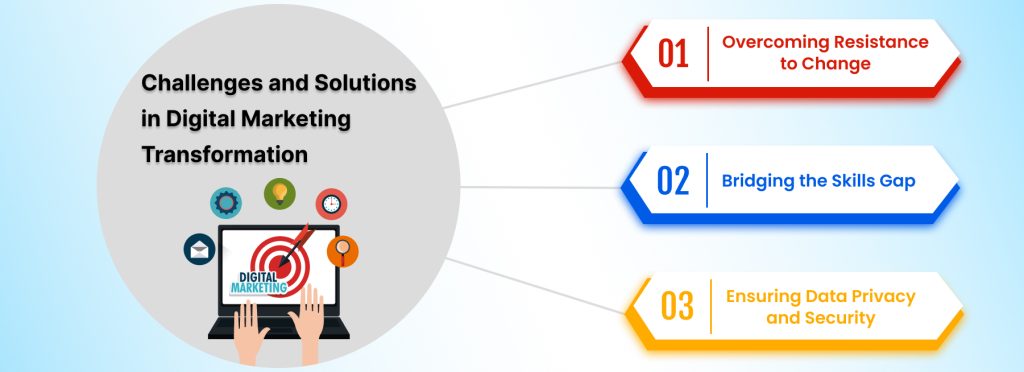
As businesses navigate the digital advertising and marketing transformation, they come upon a myriad of demanding situations. However, for each obstacle, there exists a strategic solution to triumph over it.

Overcoming Resistance to Change: One of the number one hurdles is the resistance to trade, frequently rooted in a lack of information or fear of the unknown. To address this, corporations need to foster a tradition of innovation and continuous getting to know. Educating groups about the advantages of digital transformation and involving them in that manner can power purchase-in and enthusiasm.

Bridging the Skills Gap: The digital panorama is ever-evolving, requiring a selected set of abilities. The hole between the needed digital know-how and the skills presently available inside organizations can restrict development. Investing in training and development, in addition to hiring specialists while important, guarantees that groups are geared up to address digital advertising efficiently.

Ensuring Data Privacy and Security: With the increasing reliance on facts, concerns about privacy and safety are paramount. Businesses ought to adhere to statistics safety rules and put into effect robust safety features to guard customer facts. Transparency approximately information use and ensuring compliance with laws build consideration with clients.

Measuring the Success of Digital Transformation in Marketing

To gauge the effectiveness of digital advertising efforts, businesses must pay attention to key performance signs (KPIs) that align with their strategic desires.

Key Performance Indicators (KPIs) for Digital Marketing: Identifying the right KPIs is vital for measuring success. These may additionally consist of internet site traffic, conversion prices, engagement metrics on social media, and email open fees, among others.

Tools and Techniques for Measuring ROI: A plethora of gear exists to help organizations degree the return on investment (ROI) in their digital advertising activities. Analytics platforms, CRM systems, and advertising and marketing automation gear offer insights into patron conduct and marketing campaign performance.

Continuous Improvement and Optimization Strategies: The digital advertising and marketing landscape is dynamic, necessitating ongoing optimization of campaigns. A/B checking out, client feedback loops, and analytics are important for expertise in what works and what doesn’t.

In conclusion, the digital transformation of advertising presents both challenges and possibilities. By addressing those demanding situations head-on and leveraging the proper techniques, equipment, and technology, groups can enhance their digital advertising efforts, degree their fulfillment efficaciously, and live organized for destiny traits.

Embracing non-stop mastering and adaptation is essential for thriving in the ever-evolving digital landscape. As we appear to the future, the potential for digital marketing is boundless, presenting thrilling opportunities for groups to connect to their target audience in progressive and significant methods.

How SEO Services Can Help Your Business Grow?

The digital age has brought in a new era of marketing, in which Search Engine Optimization (SEO) emerges as a pivotal strategy for agencies aiming to thrive within the competitive online panorama. This transformative method extends past mere visibility, delving into the intricacies of internet presence, personal engagement, and brand credibility.

SEO stands as a beacon for companies, guiding them via the complexities of digital algorithms and consumer behaviors. It offers a multifaceted toolkit designed to beautify internet site rankings, drive focused traffic, and foster a long-term boom.

As the digital marketplace continues to conform, the significance of adopting a strategic and knowledgeable approach to SEO can’t be overstated. It isn’t always pretty much adapting to the prevailing however additionally approximately looking ahead to future traits and integrating seamlessly with broader advertising efforts.

For organizations seeking to navigate the digital terrain correctly, information and enforcing powerful search engine optimization techniques is critical. This exploration into the world of SEO services targets to light up the route for organizations striving for boom, visibility, and a sustainable competitive aspect within the digital global.

SEO services benefits

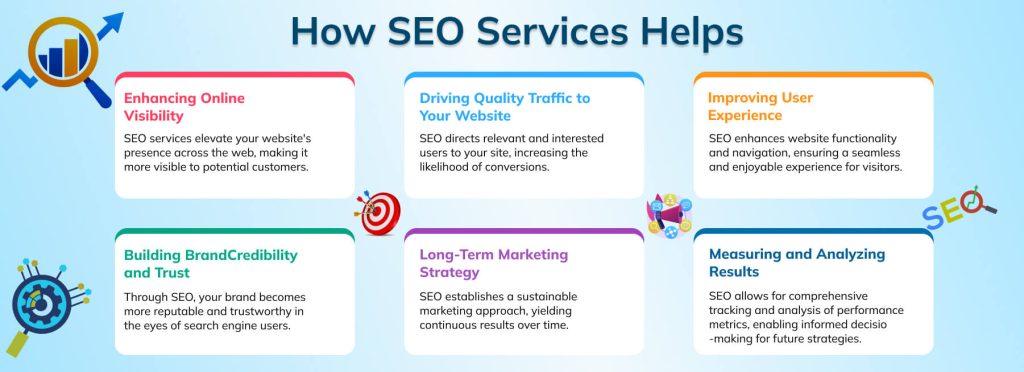
Enhancing Online Visibility

At the coronary heart of any hit digital marketing method lies the search for greater online visibility. Search engine optimization stands as a beacon for groups aiming to stabilize a distinguished spot in seek engine results.

The strategic incorporation of applicable keywords and content optimization is paramount. By meticulously studying seek developments and consumer conduct, SEO experts can tailor your website’s content to match the queries of your target audience.

Consequently, this now not only elevates your internet site’s ranking on search engines like Google but additionally guarantees that your enterprise will become greater visible to capability clients.

Driving Quality Traffic to Your Website

Furthermore, the essence of search engine optimization transcends past merely attracting site visitors; it is about drawing within the proper type of site visitors. Through centered SEO services, agencies can attain a target audience that is actively trying to find the goods or services they provide.

This precision in targeting capability customers substantially enhances the chance of converting traffic into customers. By focusing on long-tail key phrases and developing content material that addresses the specific desires and questions of your target market, SEO allows you to attract a more engaged and fascinated traveler base.

Improving User Experience

User revel in (UX) has increasingly emerged as a cornerstone of powerful SEO. Search engines like Google are giant fees on the usability and accessibility of websites. This method that factors which include internet site format, loading pace, and cell responsiveness are not simply elements of the right design but are critical for search engine optimization success.

An optimized internet site gives seamless navigation and short access to information, which no longer simply satisfies search engines like Google and Yahoo but more importantly, meets the expectancies of users.

By ensuring that your website is responsive and loads fast throughout all gadgets, search engine optimization offerings help in providing a superb consumer experience that can substantially boost your website online score and maintain visitors coming returned.

Building Brand Credibility and Trust

In the virtual market, the credibility and trustworthiness of your logo are closely connected to your search engine ratings. High visibility on search engines like Google regularly interprets to a belief of reliability and authority by using potential customers.

SEO techniques that focus on constructing a robust online presence, which includes generating superb inbound links and growing authoritative content, can substantially beautify your logo’s credibility. This manner includes no longer only optimizing your website but also ensuring that your logo is always represented throughout diverse online structures.

Long-Term Marketing Strategy

SEO isn’t a short restoration but a protracted-term advertising approach that requires patience, endurance, and continuous optimization. Unlike conventional advertising techniques, which regularly offer transient visibility, search engine optimization provides a sustainable technique for constructing a sturdy online presence.

The splendor of SEO lies in its value-effectiveness and its capability to supply compounding returns through the years. As your internet site’s ranking improves, so does your visibility, traffic, and, in the long run, your commercial enterprise’s increase.

This ongoing manner of optimization and model-to-look engine algorithms guarantees that your commercial enterprise stays aggressive and continues to thrive inside the ever-evolving virtual panorama.

Long-Term Marketing Strategy

SEO distinguishes itself as a cornerstone of long-term marketing strategies, standing in stark comparison to the ephemeral nature of conventional advertising and marketing techniques. Its inherent fee-effectiveness is matched by way of a unique ability to construct upon itself over time, creating a basis for sustained online visibility and growth.

The strategic investment in SEO transcends the instantaneous gains, focusing instead on a slow buildup of your logo’s digital footprint. This approach no longer best enhances your website’s seek engine ratings but also solidifies your market function in the long run.

Measuring and Analyzing Results

The capacity to measure and examine the outcomes of SEO efforts is important for refining strategies and ensuring the ultimate allocation of sources. Utilizing advanced analytics equipment, groups can measure a wide array of metrics, from organic site visitors and conversion rates to keyword rankings and one-way link fine.

These records provide useful insights into the effectiveness of your search engine optimization strategies and the conduct of your internet site’s traffic. By continuously monitoring those metrics, agencies can perceive areas of improvement and modify their strategies for that reason.

This iterative manner now not best complements the performance of SEO efforts but additionally drives incremental upgrades in internet site performance and enterprise boom.

Integrating Search Engine Optimization with Other Marketing Efforts

The integration of SEO with different virtual advertising efforts amplifies its impact, creating a synergistic impact that could appreciably enhance average advertising and marketing overall performance.

Whether it’s content marketing, social media, or pay-in-line with-click (PPC) advertising and marketing, SEO serves as the glue that binds these various techniques collectively. For example, content material optimized for SEO can force greater traffic to your website, whilst social media can grow your content’s reach and engagement.

Getting Started with Professional Search Engine Optimization Services

Selecting the right SEO provider company is an essential choice that can decide the success of your SEO efforts. It’s critical to select a partner that now not simplest possesses the considered necessary information and experience but also aligns with your enterprise’s desires and values.

Look for providers that offer transparent communique, custom-designed strategies, and a measurement report of achievement. Setting realistic expectations and clear milestones is crucial for measuring the effectiveness of your SEO campaigns.

In the end, the journey from understanding the importance of SEO marketing as a protracted-time period advertising method to the combination of SEO with other advertising efforts and the selection of expert search engine optimization services highlights the multifaceted role of SEO in using business increase.

The landscape of virtual advertising is ever-evolving, and SEO stays at the leading edge of this evolution, supplying organizations a sturdy framework for reaching sustained online visibility, engagement, and increase. By embracing the principles mentioned in this exploration, companies can unlock the full capability of SEO, paving the way for a destiny marked by using digital achievement and prosperity.

Unveiling The Top 10 SEO Trends In Singapore 2024

The virtual landscape is constantly evolving, and nowhere is this greater obvious than inside the realm of SEO services in Singapore. As 2024 unfolds, Singapore stands at the leading edge of this evolution, embracing new traits and technology that can shape the future of online search and enterprise visibility. This weblog submits targets to unveil the top 10 SEO trends in Singapore, presenting a complete guide for businesses and marketers keen on navigating this dynamic environment.

From the developing significance of mobile-first indexing to the state-of-the-art use of synthetic intelligence in optimizing search strategies, those tendencies spotlight the critical shifts in how search engines like Google operate and the way customers engage with them. Understanding these traits is essential for anybody trying to steady a competitive part inside the virtual market. The insights furnished right here are tailor-made to no longer best inform but also equip organizations with the necessary equipment to thrive inside the ever-converting virtual landscape of Singapore.

1. Mobile-First Indexing

Initially, mobile-first indexing may additionally sound complicated, however, in essence, it’s a trustworthy idea. Google now predominantly makes use of the mobile version of the content material for indexing and rating. Considering the surge in mobile usage in Singapore, this shift is significant. To make it applicable, websites have to ensure their mobile variations are fully optimized. This consists of a responsive layout, fast loading times, and streamlined navigation. Such optimizations not simplest cater to the cellular-first indexing but also enhance the person experience, an important component in preserving visitor engagement.

2. Voice Search Optimization

Voice search is unexpectedly gaining traction in Singapore, driven by way of the benefits it offers and the huge use of virtual assistants. Optimizing for voice search includes a shift in approach – specializing in natural language and conversational key phrases. For example, even as a text-based total search is probably “search engine marketing trends Singapore,” a voice search will be, “What are the modern-day SEO trends in Singapore for 2024?” Tailoring content material to answer such queries can hugely enhance visibility in voice searches, a trend that’s gaining momentum.

3. Artificial Intelligence in SEO

Artificial Intelligence (AI) is revolutionizing numerous industries, and search engine marketing isn’t an exception. In the context of Singapore’s digital landscape, AI gear is being hired to research seek styles, and personal conduct, enabling more targeted and powerful SEO strategies. One practical software is using AI to pick out content gaps or to generate content material ideas that can be more likely to resonate with the target audience. Such clever analysis ends in growing content material that now not handiest draws but additionally keeps customers’ interest.

4. Local search engine optimization for Singaporean Businesses

For small and medium-sized corporations in Singapore, nearby search engine marketing is a sport-changer.  It’s about optimizing your online presence to attract more commercial enterprises from relevant local searches. This includes claiming your Google My Business listing, ensuring NAP (Name, Address, Phone Number) consistency across the web, and amassing fantastic reviews. Also, localizing content material can make an extensive distinction. For instance, mentioning nearby landmarks or events can increase relevance in nearby seek consequences, making your business greater visible to the network you serve.

5. Video Content Optimization

Video content optimization

The adage “A photo is well worth one thousand words” holds even more truth on the subject of video content material. In Singapore, where virtual consumption is excessive, video content material has become an important element of powerful search engine optimization strategies. However, optimizing video content goes past simply creating attractive videos. It encompasses right tagging, the usage of descriptive titles and outlines, or even transcribing video content for better indexing. Remember, your video must now not only captivate but also be easily discoverable.

6. E-E-A-T Principle (Experience, Expertise, Authoritativeness, Trustworthiness)

E-E-A-T regulation is a key part of search engine optimization and can be very crucial, especially in Singapore. E-E-A-T stands for Experience, Expertise, Authority, and Trustworthiness. In this way, for a website to do well in search results, it should show that it knows a lot about its subject, is a reliable source, and can be trusted. Google emphasizes these factors even when comparing content material of high quality.

To leverage this, Singaporean websites should show off the information, authoritativeness, and trustworthiness of their content material. This includes developing particular, properly-researched articles through knowledgeable authors, mentioning authoritative sources, ensuring the internet site has a sturdy approximately web page, and getting in touch with records. Essentially, it’s approximately constructing a reputation that resonates with both customers and search engines like Google and Yahoo.

7. User Experience (UX) and SEO

User Experience (UX) is really important in search engine marketing. It plays a big role in how well a website does. A seamless UX design is instrumental in keeping site visitors engaged and lowering jump fees – elements that engines like Google favor. For Singaporean websites, this means adopting a layout that is both aesthetically captivating and practical. Quick loading times, cell responsiveness, intuitive navigation, and clean calls-to-action are key elements. Enhancing UX is a continuous method that includes knowledge of consumer behavior and possibilities, thereby making websites extra user-friendly and search engine compatible.

8. Content that Answers Specific Queries

With the evolution of seek algorithms, there’s a great shift closer to valuing content material that at once answers customers’ queries. In Singapore, where net users are seeking quick and accurate records, this fashion is particularly relevant. To adapt, content material creators need to attention to expertise and address the particular questions their target market might have. This should involve using gear to become aware of common queries or diving into boards and social media to gauge user pursuits. Crafting content that is informative and at once relevant to those queries can significantly enhance an internet site’s search engine visibility.

9. The Importance of Secure Websites (HTTPS)

Website safety is paramount, now not only for personal safety but also for search engine marketing. Search engines, including Google, prioritize websites that use HTTPS encryption. This trend is mainly crucial in Singapore’s virtual landscape, in which cybersecurity is a growing challenge. Switching to HTTPS is more than just a security degree; it’s a statement of acceptance as true with reliability, which could undoubtedly affect a domain’s seek engine ranking. For corporations, this means making sure that their website now not handiest offers top-notch content material but also a secure browsing experience.


10. Semantic Search and Intent Optimization

Semantic search and intent optimization mark a tremendous shift in how engines like Google interpret personal queries. Rather than focusing entirely on key phrases, engines like Google now attempt to recognize the context and intent in the back of a search. In Singapore, wherein numerous languages and cultural nuances play a role, optimizing for semantic search is important. This entails creating content that goes beyond key phrases and delves into the topics and issues that users are genuinely inquisitive about. By aligning content methods with semantic seek and consumer reason, companies can create greater relevant, attractive, and ultimately, powerful search engine marketing techniques.

As we navigate through these tendencies, it’s obvious that SEO in Singapore is unexpectedly evolving, with a clear cognizance of improving user revel in, security, and content relevance. Understanding and implementing these tendencies can substantially uplift a business’s online presence, ensuring it continues to be at the vanguard of the virtual panorama in 2024.

Best ChatGPT Keyword Research Prompts To Use In 2024

The dynamic landscape of virtual advertising continually evolves, and in this ever-converting environment, the significance of powerful keyword studies will become increasingly critical. Staying ahead inside the aggressive realm of SEO in Singapore requires now not only the simplest know-how of present-day trends but also looking forward to future shifts.

ChatGPT, with its sophisticated AI algorithms, transforms conventional keyword research methodologies. It gives deep insights into user conduct, seeking developments, and the aggressive landscape. This device is going past the scope of conventional keyword studies gear using imparting tailored recommendations, aggressive analysis, and even predictions of rising tendencies.

For virtual entrepreneurs, content material creators, and search engine optimization strategists, ChatGPT represents a pivotal shift in how keyword research is conducted. In this blog, we delve into the best ChatGPT prompts for keyword research activities to use in 2024. We explore its various functionalities, from fundamental keyword discovery to superior aggressive evaluation and integration with different SEO gear.

The Evolution of Keyword Research Tools

Keyword studies, a cornerstone of SEO, have evolved remarkably over time. Initially, virtual entrepreneurs trusted basic equipment that furnished restrained insights. However, the landscape modified with the advent of more state-of-the-art platforms offering deeper analytics and fashion predictions. Recently, AI tools like ChatGPT have ushered in a brand new generation. These tools blend linguistic knowledge with statistics evaluation, allowing a more nuanced technique for keyword discovery.

Why Choose ChatGPT for Keyword Research

Opting for ChatGPT in keyword research presents several blessings. Firstly, its AI-driven insights surpass the constraints of conventional gear, supplying a better analysis of search traits and personal behavior. Unlike conventional tools, ChatGPT can interpret and expect nuanced keyword trends, making it a treasured asset for SEO strategists. Additionally, its capacity to manner herbal language queries simplifies the keyword studies method, making it extra reachable and user-pleasant.

Getting Started with ChatGPT for Keyword Research

Embarking on keyword studies with ChatGPT is a truthful system. The fundamental requirement is an understanding of how to interact with the AI. ChatGPT’s interface, designed for ease of use, permits customers to enter queries in herbal language. This function is particularly useful, as it eliminates the want for complex syntax or search parameters. By without a doubt asking AI questions about keyword trends, search volumes, or associated terms, customers can gain valuable insights.

Effective ChatGPT Prompts for Keyword Discovery

To harness the whole capacity of ChatGPT in keyword studies, it is vital to apply powerful prompts. For example, a prompt together with “What are the trending key phrases in [industry/niche] for [year]?” can yield a complete list of applicable phrases. Additionally, asking ChatGPT to evaluate the recognition of specific key phrases over the years can provide insights into rising tendencies. The secret is to be clear and precise in your queries to make certain the outcomes are as targeted and useful as possible.

Advanced ChatGPT Prompts for Competitive Analysis

As we delve deeper into the competencies of ChatGPT for SEO, it will become evident that this tool isn’t just about locating keywords; it is about information in the competitive panorama. To do that successfully, you could use prompts like, “Show me the pinnacle key phrases my competition is ranking for in [specific industry or niche].”

ChatGPT, with its superior algorithms, can analyze huge amounts of information, offering insights into your competition’s keyword techniques. Furthermore, by asking, “How have these keywords done over the past 12 months?” marketers can gain a clear view of the traits and shifts in the market, enabling them to strategize greater efficaciously.

Utilizing ChatGPT for Long-Tail Keyword Identification

ChatGPT keyword research

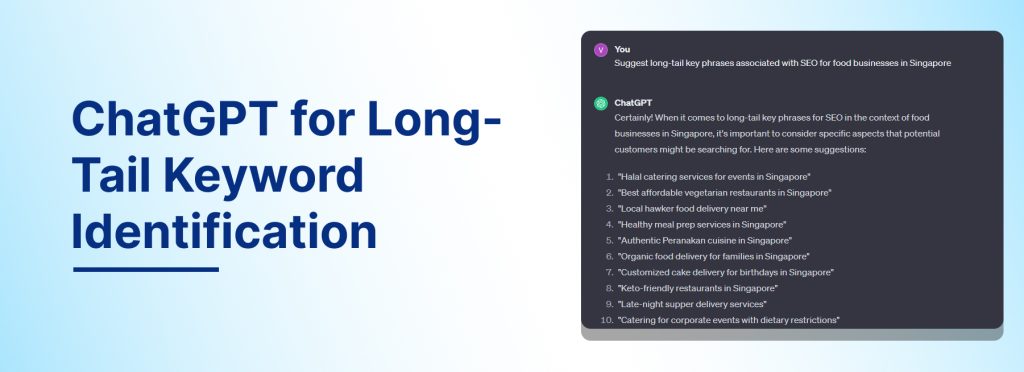
In the realm of SEO, lengthy-tail key phrases are a goldmine for targeting specific niches. ChatGPT shines on this issue by way of producing long-tail keyword guidelines that are often not noted via traditional tools. For example, a spark-off like, “Suggest long-tail key phrases associated with [primary keyword] for [target audience or niche]” can reveal a plethora of areas of interest-unique keywords. This ability to tailor searches to particular audiences or sectors makes ChatGPT an invaluable device for crafting targeted SEO techniques.

Integrating ChatGPT Insights with Other Search Engine Optimization Tools

While ChatGPT is a powerful device in its right, its true power lies in its ability to integrate with different search engine optimization systems. For a comprehensive search engine marketing approach, it’s useful to mix the insights from ChatGPT with analytics from different tools.

For instance, the usage of ChatGPT to generate keyword ideas, and then analyzing the keywords through the use of a tool that makes a specialty of seek extent and competition information, gives a well-rounded view of your search engine marketing panorama. This synergistic approach guarantees a strong and records-driven search engine marketing strategy.

ChatGPT Prompts for Local search engine optimization Keyword Research

Local SEO is crucial for businesses focused on precise geographic locations. ChatGPT can be particularly useful in this location by way of generating region-particular keyword suggestions. A prompt like, “What are the famous local seek terms in [city or region] for [industry or service]?” can yield pretty relevant key phrases for nearby search engine marketing campaigns. Additionally, ChatGPT can help understand the language and search conduct of neighborhood audiences, in addition to refining the effectiveness of local SEO efforts.

Find Your Target Market And Audience | Explore The Key Differences

Knowing your audience is essential in the ever-changing world of digital marketing. Two crucial concepts in this realm are the target market and target audience. While the target market and audience might sound similar, they serve distinct roles in shaping effective marketing strategies.

Delineating Target Market: A Comprehensive Overview of Its Scope and Significance

A target market is a broad group of potential customers identified as the main focus of a marketing strategy. This group shares common characteristics like age, location, or income. Recognising your target market is vital for several reasons:

  • Guides Product Development: Knowing who you’re creating products for ensures they meet the needs and preferences of this group.
  • Shapes Marketing Messages: Tailored messages resonate more with a specific group, increasing engagement and response rates.
  • Improves Resource Allocation: By focusing on a specific target market strategy, you allocate resources more effectively, enhancing ROI.

The Concept of Target Audience: A Closer Look at Its Specificity and Application

A target audience, on the other hand, is a more specific subset of your target market. This group is identified for particular marketing campaigns or messages. For instance, within a target market of young adults, a target audience could be college students interested in affordable tech gadgets.

Recognising your target audience helps in:

  • Creating Focused Content: Content tailored to a specific audience drives better engagement.
  • Selecting Appropriate Channels: Knowing your audience guides you to the right platforms for your marketing efforts.
  • Enhancing Customer Experience: Personalised experiences build stronger connections with your audience.

Distinguishing Between Target Market and Target Audience

Comparing these two concepts highlights their differences:

  • Scope: The target market has a broader scope, while the target audience is more focused.
  • Application: The target market guides the overall business strategy, whereas the target audience is crucial for specific campaigns.
  • Customisation: Messages for a target audience are more customised than those for a target market.

Read More – SEO Company in Singapore

Strategies for Identifying Your Target Market: Steps and Best Practices

Identifying your target market involves several steps:

  1. Analyse Your Offerings:
  • Identify the problems your products or services solve.
  • Determine who benefits most from these solutions.
  1. Conduct Market Research:
  • Use surveys, interviews, and data analysis to understand potential customers.
  • Analyse trends and patterns in customer behaviour and preferences.
  1. Observe Competitors:
  • Study your competitors’ target markets.
  • Seek out any vacant or untapped markets.
  1. Develop a Target Market Profile:
  • Document characteristics like age, location, income, and lifestyle.
  • Use this profile to guide marketing strategies.
  1. Evaluate and Adjust:
  • Regularly review your target market.
  • Adjust your strategies as your market evolves.

Best Practices in Target Market Identification

To effectively identify your target market, consider these best practices:

  • Use a Mix of Data Sources: Combine quantitative data (like surveys) with qualitative insights (like customer interviews).
  • Stay Customer-Focused: Always prioritise the needs and preferences of potential customers.
  • Be Flexible: Be ready to adapt to your target market as new trends and customer behaviours emerge.
  • Collaborate Across Departments: Involve different teams (like sales and customer service) for a well-rounded understanding of your market.

Techniques for Pinpointing Your Target Audience

Market audience analysis

A vital first step in developing a successful target market strategy is determining who your target market is. It entails being aware of the demands, tastes, and habits of your ideal clients. Here’s how you can accurately pinpoint your target audience:

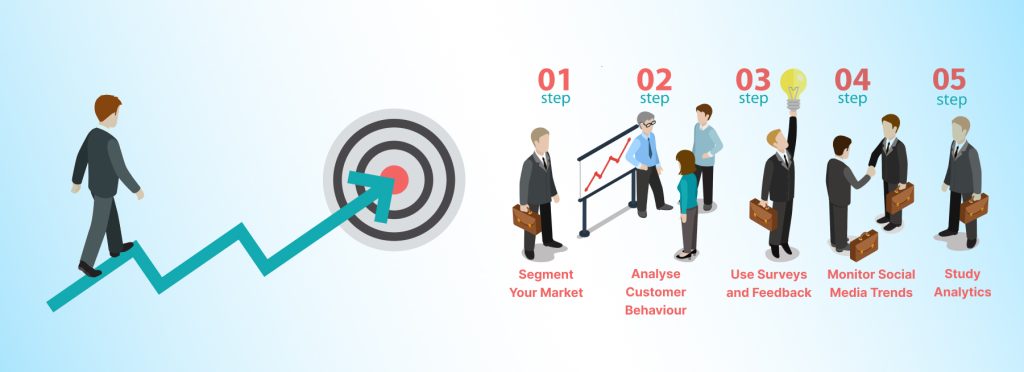
  1. Segment Your Market: Start by breaking down your market into smaller groups. Look at factors like age, location, income, and interests. This helps in creating a more focused approach.
  2. Analyse Customer Behaviour: Pay attention to how customers interact with your brand. What are their buying habits? Which products do they prefer? This insight is invaluable.
  3. Use Surveys and Feedback: Direct feedback from customers can reveal a lot about your audience. Surveys and feedback forms are great tools for this.
  4. Monitor Social Media Trends: Social media platforms are goldmines for audience research. Look at the discussions, preferences, and trends relevant to your brand.
  5. Study Analytics: Website and social media analytics can provide detailed information about your audience, like their demographics, online behaviour, and engagement patterns.

Integrating Target Market and Audience Insights into Your Marketing Strategy

Including these insights into your marketing plan is the next step once you have an accurate grasp of your target market and audience. This guarantees that the demands and preferences of your target audience are met by your marketing initiatives.

  • Tailor Your Messages: Customise your marketing messages to resonate with your target audience. This personal touch can significantly increase engagement and conversion rates.
  • Choose the Right Channels: Different audiences have different preferred platforms. Choose the channels where your audience is most active.
  • Measure and Adapt: Continuously measure the effectiveness of your strategies and be ready to adapt. This agility is key in responding to changing audience needs.

Challenges and Considerations in Target Market and Audience Identification

Identifying your target market and audience is not without its challenges. One major challenge is the dynamic nature of consumer behaviour. Preferences and trends can change rapidly, making it essential to stay updated. Another consideration is the balance between specificity and appeal. You want to be specific enough to be relevant but not so narrow that you miss out on potential market segments.

Read More – Cloaking in SEO

Future Trends in Market and Audience Segmentation

The digital landscape is constantly evolving, and so are the techniques for market and audience segmentation.

  • Increased Use of AI and Machine Learning: These technologies are becoming more sophisticated in predicting consumer behaviour and preferences.
  • Greater Emphasis on Personalisation: Consumers expect more personalised experiences, and brands will need to adapt to this expectation.
  • Integration of Offline and Online Data: Combining these data sources can provide a more comprehensive view of the target audience.

Conclusion

For your marketing efforts to be successful, you must comprehend your target market and audience. It gives you the ability to develop more effective, audience-relevant marketing tactics. This understanding is a continuous process rather than a one-time endeavour. Your strategy should change along with the marketplace. You can make sure that your marketing activities remain relevant and successful by remaining knowledgeable and flexible.

What Is Cloaking in SEO: Everything That You Need to Know

Search Engine Optimization, or SEO, is the lifeblood of digital visibility. In an ocean of websites, your platform needs to stand out, and SEO is the beacon that guides users to your content. Essentially, SEO is a suite of strategies designed to increase a website’s chances of being found by search engines—and by extension, potential visitors.

Imagine a brilliant show hidden behind a curtain; no matter its quality, it’s invisible to the audience. SEO pulls back this curtain. Being discovered by the appropriate individuals at the appropriate moment is just as important as simply being visible.

The Concept of Cloaking in SEO

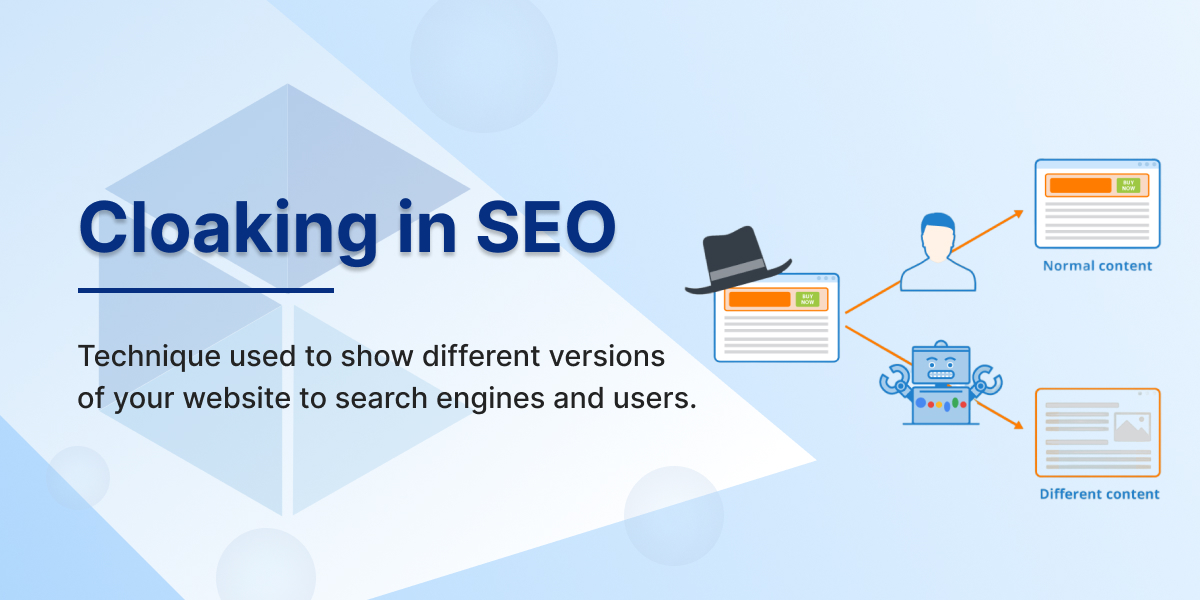
Enter cloaking: a contentious SEO technique. In technical terms, cloaking is when a website displays one set of content to search engine crawlers for indexing and a different set to the actual visitors. It’s a clever trick, but one that can have dire consequences.

The goal of search engines is to show viewers the most relevant content. When they crawl a site, they expect to see the same version that a user would. Cloaking in SEO disrupts this trust, creating a discrepancy between what’s indexed and what’s displayed.

The Motivations Behind Using Cloaking

Why do website owners cloak? The reasons vary. Some websites may be rich in visuals but sparse in text, which traditionally doesn’t sit well with Google’s algorithms. Others might rely on Flash, a technology that’s not particularly search-engine friendly. Cloaking can be a shortcut to rank such content higher without making it genuinely compliant with Google’s standards.

But, as with all shortcuts, the risks are substantial. Specifically, Google has said that they view cloaking as an infringement of their policies. The pursuit of quick wins could lead to long-term losses, including penalties or even a complete ban from search results.

Dissecting Cloaking Practices

Cloaking is a black hat SEO practice that comes in several forms, each designed to game the system in different ways:

  • Hidden Text: This involves placing text on a page that’s invisible to the visitor but readable by search engines. For instance, text could be hidden by matching its colour to the background or through more complex methods involving JavaScript or CSS.
  • User-Agent Cloaking: Here, a site determines whether the visitor is a human or a search engine crawler using a piece of code. If it’s a crawler, they’re shown a different, optimised version of the site.
  • IP Cloaking: This method redirects a user to a high-ranking page, unbeknownst to them, to leverage its SEO standing.
  • HTTP Accept-Language Header Checks: By examining the language headers of the user, the server decides whether to show the real site or a cloaked version.

While each method is distinct, they share a common goal: to present search engine crawlers with optimised content that doesn’t match what actual visitors see. It’s a risky business that can tarnish a website’s reputation and plummet its rankings once exposed.

Search engines have grown wise to these tactics, enhancing their algorithms to sniff out and penalise such practices. Therefore, it’s in the best interest of website owners to adhere to white hat SEO strategies that may take longer but build sustainable, long-term success.

The Risks Associated with Cloaking in SEO

Cloaking SEO risks

The Perils of Punishment

Cloaking in SEO is a practice that may seem tempting for quick search engine ranking gains, but is fraught with significant risks. It goes against Google’s Webmaster Guidelines, and such defiance comes at a cost. If you engage in cloaking, whether knowingly or not, Google may penalise your site. This means your website could crash in search rankings overnight, erasing the hard-earned trust of your visitors and the visibility of your content.

The Threat of a Ban

More alarming is the prospect of a site being banned. Google doesn’t shy away from removing websites that breach its rules from its index altogether. Such a manual penalty is a severe action, often irreversible, making your website virtually invisible to users searching online.

The Inevitability of Detection

Search engines have evolved, becoming ever more adept at identifying cloaking. Their algorithms now swiftly spot the disparity between content presented to the search engine and what is displayed to the user. Therefore, employing cloaking is akin to playing a high-stakes game where the house always wins.

The Impact of Cloaking on User Trust and Brand Reputation

User experience is the heartbeat of a successful online presence. When cloaking leads to a mismatch between user expectations and the actual content, it doesn’t just sour the individual experience; it can tarnish the brand’s image.

Eroding Customer Trust

Once trust is broken, it’s a difficult task to rebuild it. Customers value transparency, and when a brand is caught in deceptive practices like cloaking, it signals a willingness to cut corners—a red flag for many.

Long-Term Brand Damage

Your brand’s reputation is a priceless asset. Deception through cloaking can severely damage the trust you’ve built with your customers. Trust is the foundation of any brand, and once it’s broken, it’s incredibly challenging to rebuild.

Identifying Cloaking on Your Website

It’s crucial to ensure your website doesn’t fall foul of cloaking, even accidentally. This is how to identify the indications:

  1. SERP vs Page Content: Check if the content on your site matches what appears in search engine results. Mismatches might be warning signs.
  2. Shady SEO Signs: Be vigilant for other black hat SEO service practices on your site, such as excessive keyword stuffing, low-quality spun content or unnatural backlinks.
  3. Utilise Online Tools: SEO cloaking checker tools like SiteChecker can be instrumental in identifying cloaking and ensuring that your site remains compliant.

The Importance of Compliance and Prevention

Regular Site Audits

Conduct frequent audits of your website to ensure no inadvertent cloaking occurs. This preventive measure is a cornerstone of a robust SEO strategy and protects the integrity of your site.

Be Proactive Against Hacking

A hacked website can become a victim of cloaking without the owner’s knowledge. Stay ahead by securing your website against unauthorized access.

Uphold Google’s Guidelines

Google’s webmaster guidelines are not just rules but a blueprint for online success. Aligning with these guidelines ensures that your SEO efforts yield sustainable results.

whatsapp